
Tron's Strategic Fee Cuts: A Catalyst for Long-Term Ecosystem Growth and TRX Value Appreciation
The Fee Cut: A Bold Move to Reignite Adoption
On August 29, 2025, the TronTRON-- (TRX) network executed a historic 60% reduction in transaction fees, slashing the energy unit price from 210 sun to 100 sun and reducing USDTUSDC-- transfer costs from $2.47 to $0.72 per transaction [1]. This decision, approved by the Super Representative community and endorsed by founder Justin Sun, aimed to counter rising costs that had eroded Tron’s appeal for microtransactions and cross-border payments [2]. By lowering barriers to entry, Tron sought to reinvigorate user participation, particularly in developing markets where low-cost stablecoin transfers are critical [3].
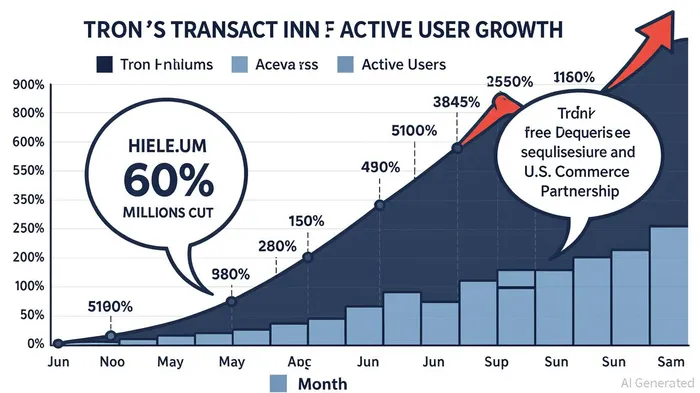
The immediate impact was striking. Daily active addresses surged to 2.53 million, outpacing BNBBNB-- Chain and SolanaSOL-- [4], while USDT transaction volumes on Tron hit 8.29 million in a single week [5]. These metrics underscore the network’s ability to leverage fee reductions as a lever for user growth, a principle validated by blockchain economics research showing a logarithmic relationship between fee cuts and transaction volume increases [6].
Network Economics: Balancing Short-Term Sacrifice for Long-Term Gains
Tron’s fee cut temporarily reduced its monthly revenue from $58 million to $810,330 in daily earnings [1]. However, this short-term pain is framed as a strategic investment in long-term gains. By prioritizing accessibility, Tron aims to expand its user base by 45%—projecting 38.9 million eligible accounts for USDT transfers—and attract 12 million new users [7]. This aligns with broader blockchain economics principles: lower fees drive higher transaction throughput, which in turn increases network utility and token demand [8].
The network’s quarterly fee review mechanism further reinforces this strategy. By adjusting fees based on TRX price, network activity, and growth metrics, Tron ensures adaptability to market conditions [1]. This dynamic approach mirrors Ethereum’s post-EIP-4844 trajectory, where gas price reductions led to an 82% surge in daily transactions on OptimismOP-- [9].
Comparative Edge: Tron vs. EthereumETH-- in the Post-Fee Cut Era
Tron’s fee model now positions it as a formidable competitor to Ethereum. While Ethereum maintains an average transaction fee of $1.17 and processes 2.02 million daily transactions [10], Tron’s fees for USDT transfers are 6.8 times cheaper, and its daily transaction volume exceeds Ethereum’s by a factor of 10 [4]. This efficiency is amplified by Tron’s Delegated Proof-of-Stake (DPoS) consensus, which enables 3-second block times and sub-$0.01 fees [11].
Ethereum’s institutional adoption and $102 billion TVL [10] remain strengths, but Tron’s focus on low-cost, high-volume use cases—such as micropayments and digital content monetization—creates a complementary ecosystem. The network’s TVL in DeFi protocols like JustLend ($6 billion) [1] and its partnership with a major fintech firm for cross-border payments [5] further diversify its value proposition.
Developer Activity and Ecosystem Resilience
Tron’s fee cut has also spurred developer activity, with 3,000–5,000 new contracts deployed daily—a 40% increase from pre-fee-cut levels [1]. The Tron Virtual Machine (TVM), compatible with Ethereum’s EVM, lowers barriers for developers to port applications, accelerating dApp growth in DeFi, NFTs, and GameFi [11]. This aligns with academic findings that blockchain fee reductions correlate with increased developer participation and ecosystem innovation [12].
Moreover, Tron’s integration with the U.S. Department of Commerce—publishing quarterly GDP data on its blockchain—highlights its institutional credibility and technical robustness [3]. Such partnerships reinforce trust in Tron as a scalable infrastructure for both financial and governmental applications.
Long-Term Value Drivers: From Token Burns to Regulatory Tailwinds
While fee reductions temporarily reduce TRX’s burn rate, the network’s long-term value is underpinned by strategic initiatives. The GENIUS Act’s legal clarity for stablecoins in the U.S. [5] and Tron’s $1 billion USDT minting event demonstrate regulatory alignment, a critical factor for institutional adoption. Additionally, Justin Sun’s emphasis on prioritizing user growth over short-term profitability [2] signals a commitment to sustainable ecosystem development.
Analysts project TRX could reach $0.65 by December 2025, driven by increased transaction volumes and strategic partnerships [4]. This optimism is supported by historical precedents: token burns (e.g., BNB’s $882.59 peak post-burn [1]) and fee-driven adoption (e.g., VeChain’s 4.59% token value increase [1]) illustrate how scarcity and utility can drive price appreciation.
Conclusion: A Fee Cut with Far-Reaching Implications
Tron’s 60% fee reduction is more than a tactical adjustment—it’s a strategic repositioning to dominate the low-cost blockchain market. By aligning network economics with user adoption dynamics, Tron has created a flywheel effect: lower fees → higher transaction volumes → increased utility → stronger TRX demand. While Ethereum’s institutional edge remains, Tron’s agility in fee adjustments and developer incentives positions it as a key player in the next phase of blockchain adoption. For investors, this represents a compelling case for TRX’s long-term value appreciation, anchored in both economic fundamentals and ecosystem resilience.
Source:
[1] Tron Slashes Network Fees by 60% in Landmark Move, [https://www.btcc.com/en-US/square/coincentral/888107]
[2] Justin Sun backs proposal to cut Tron fees by 60%, says users will benefit most, [https://www.mexc.com/news/justin-sun-backs-proposal-to-cut-tron-fees-by-60-says-users-will-benefit-most/78357]
[3] TRON Selected by U.S. Commerce Department for GDP Data Publication as Network Adoption Surges After 60% Fee Reduction, [https://cryptoslate.com/tron-selected-by-u-s-commerce-department-for-gdp-data-publication-as-network-adoption-surges-after-60-fee-reduction/]
[4] Tron Network Hits 2.5M Active Users Outpacing BNB Chain, [https://www.coinspeaker.com/tron-network-hits-2-5m-active-users-outpacing-bnb-chain-solana-after-60-fee-cut/]
[5] TRON Sees Over 8 Million USDT Transactions in One Week, [https://www.fastbull.com/news-detail/tron-sees-over-8-million-usdt-transactions-in-news_6100_0_2025_3_6872_3/6100_DOT-USDT]
[6] Predicting ACP-125's Impact on AvalancheAVAX-- Network Activity, [https://app.blockworksresearch.com/unlocked/fee-sensitivity-analysis-predicting-acp-125-s-impact-on-avalanche-network-activity]
[7] TRON's 60% Fee Cut: Strategic Move or Short-Term Risk?, [https://www.bitget.com/news/detail/12560604940357]
[8] Blockchain in Finance | 2024, [https://www.rapidinnovation.io/post/blockchain-in-finance-enhancing-security-and-efficiency]
[9] Tron slashes fees by 60% to boost on-chain activity risking ..., [https://cryptoslate.com/tron-slashes-fees-by-60-to-boost-on-chain-activity-risking-28-million-hit-to-revenue/]
[10] Binance Smart Chain vs. Ethereum Statistics 2025, [https://coinlaw.io/binance-smart-chain-vs-ethereum-statistics/]
[11] Tron (TRX) Explained: Technology, Investment & Buying ..., [https://baxity.com/what-is-tron-trx]
[12] The Impact of Blockchain Technology on Financial Services, [https://dl.acm.org/doi/10.1145/3726122.3726195]






Comentarios
Aún no hay comentarios