
TRON's Resilience in a Volatile Market: A Case for Long-Term Investment in Blockchain Infrastructure
The blockchain industry has long been a theater of volatility, where technological innovation and market sentiment often diverge. Yet, TRON's performance in 2025 offers a compelling case study in resilience. Despite a 16% decline in its native token TRXTRX-- during Q4 2025-the worst quarterly drop since 2017-the network's infrastructure metrics tell a different story. With record-breaking transaction volumes, strategic partnerships, and a maturing DeFi ecosystem, TRONTRX-- has demonstrated its capacity to thrive even as broader crypto markets falter. For investors seeking long-term value in blockchain infrastructure, TRON's trajectory warrants closer scrutiny.
Transaction Volume and Network Adoption: A Foundation of Growth
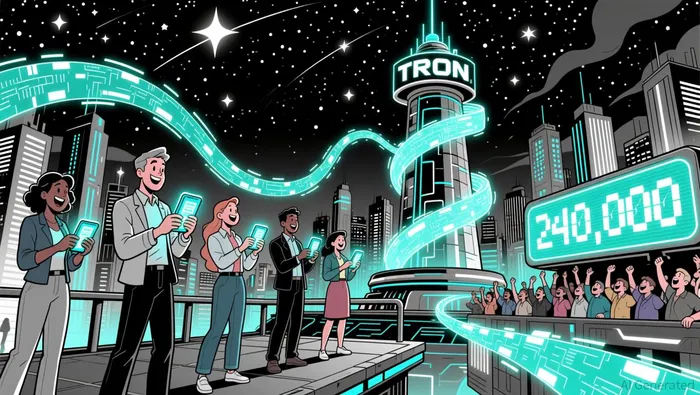
TRON's user base has expanded at an unprecedented rate. By December 2025, the network's total accounts surged to 355.4 million, a 26.3% year-over-year increase, with daily account creation averaging 240,000 new users according to data. This growth is not merely quantitative but qualitative: active addresses hit 28.7 million in June 2025, the highest since mid-2023 as research shows. Such metrics underscore TRON's ability to attract and retain users, even as macroeconomic headwinds weigh on crypto markets.
The network's role as a stablecoin settlement infrastructure has further solidified its relevance. Monthly USDTUSDT-- transfers on TRON reached $699.4 billion in October 2025, reflecting its dominance in cross-border transactions. This is amplified by the 41% increase in USDT supply to $81.2 billion, positioning TRON as a critical backbone for global stablecoin activity. For institutional investors, this utility represents a defensible moat in an industry often criticized for speculative overreach.
Infrastructure Innovations: Building for the Future
TRON's infrastructure upgrades in 2025 have been pivotal. The GreatVoyage-v4.8.0 (Kant) protocol enhanced network performance and EthereumETH-- compatibility, enabling developers to deploy cross-chain applications more seamlessly. Meanwhile, the launch of USDD 2.0-a fully decentralized stablecoin-addressed transparency concerns and expanded accessibility for retail and institutional users alike according to analysis. These upgrades are not just technical achievements but strategic moves to future-proof the network against competition from EVM-compatible chains.
The U.S. Department of Commerce's decision to use TRON for publishing GDP reports marks another milestone. This is the first time a federal agency has leveraged a blockchain network for official economic data, signaling growing institutional trust in TRON's infrastructure. Such partnerships could catalyze broader adoption, particularly in sectors requiring immutableIMX-- record-keeping.
DeFi and Ecosystem Expansion: Navigating Challenges
TRON's DeFi sector faced headwinds in 2025, with a 33% decline in total value locked (TVL). However, this dip masks underlying strength. SunSwap, the network's primary decentralized exchange, saw daily trading volumes rise from $49 million in July to $67 million by September 2025. JustLend, a key lending protocol, also reported growing deposits and borrowing activity, particularly with stablecoins like USDT and USDD. These trends suggest that while TVL may fluctuate, TRON's DeFi ecosystem remains a hub for stablecoin-centric finance.
The 60% reduction in energy fees approved by community governance in Q3 2025 further illustrates TRON's adaptability. This move drove daily active users above 2.5 million, surpassing BNBBNB-- Chain and SolanaSOL-- in key activity metrics. For investors, this highlights TRON's ability to balance user affordability with network scalability-a critical factor in sustaining long-term growth.
Balancing Price Volatility with Fundamentals
Critics may point to TRX's 16% Q4 2025 price drop as a red flag. However, this decline occurred amid broader market weakness and does not negate the network's operational success. TRON's infrastructure metrics-transaction volumes, active addresses, and stablecoin dominance-have continued to trend upward, even as TRX prices faced retracement according to research. This decoupling between token price and network fundamentals is not uncommon in early-stage blockchain projects but underscores the importance of distinguishing between short-term volatility and long-term value.
Moreover, the network's role in derivatives trading peaked at $1.1 billion in December 2025 suggests that TRON's utility extends beyond speculative trading. These developments position the network as a foundational layer for global financial infrastructure, a narrative that could drive renewed interest from institutional investors.
Conclusion: A Case for Strategic Investment
TRON's 2025 performance exemplifies the resilience of blockchain infrastructure projects that prioritize utility over hype. While TRX's price volatility may deter short-term traders, the network's transaction growth, strategic partnerships, and ecosystem innovations present a compelling case for long-term investors. As the industry matures, projects that can demonstrate real-world adoption-such as TRON's role in stablecoin settlements and government data publishing-are likely to outperform in the long run.
For those willing to look beyond quarterly price swings, TRON offers a glimpse into the future of decentralized infrastructure: a network that is not only surviving but actively shaping the next phase of blockchain adoption.






Comentarios
Aún no hay comentarios