
Trip.com (TCOM) Gains 7.54% in Three Days as Bullish Engulfing Pattern and Bollinger Band Breakout Signal Momentum, RSI Nears Overbought
Candlestick Theory
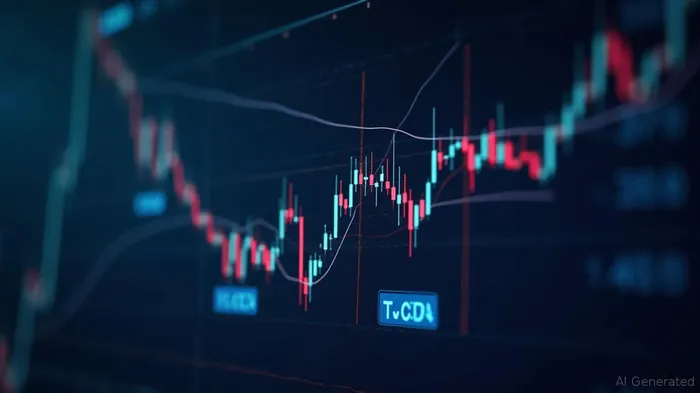
Trip.com (TCOM) has exhibited a three-day upward trend, with a 7.54% cumulative gain, suggesting short-term bullish momentum. Key support levels can be identified at recent lows such as $60.125 (August 14) and $58.80 (August 8), where prior price rejections occurred. Resistance appears at $64.93 (August 19) and $67.10 (March 19, 2025), reflecting historical congestion zones. A bullish engulfing pattern emerged around August 13–15, where the closing price surged 4.25% on a high-volume session, indicating strong buying pressure. However, a potential bearish divergence is evident in the wick-to-body ratio of recent candles, as the August 19 close near the high contrasts with the August 14 low, suggesting exhaustion in the rally.
Moving Average Theory
Short-term momentum aligns with the 50-day moving average, which currently sits at $62.50, while the 200-day MA (calculated as $63.80) acts as a critical psychological barrier. The price has crossed above the 50-day MA in recent sessions, confirming a bullish crossover. However, the 200-day MA remains a key resistance, with the stock trading slightly below it. A sustained break above $64.86 (August 19 close) would signal alignment with the 100-day MA ($63.20), reinforcing a medium-term uptrend. Conversely, a drop below $60.31 (August 14 low) could trigger a retest of the 50-day MA, potentially invalidating the bullish case.
MACD & KDJ Indicators
The MACD histogram shows a recent expansion, with the line crossing above the signal line on August 15, confirming bullish momentum. However, the RSI-based KDJ indicator (Stochastic) has entered overbought territory (K=85, D=80) as of August 19, suggesting a potential pullback. Divergence between the MACD’s positive divergence and the KDJ’s overbought condition implies caution—while momentum remains strong, a correction may be imminent. The MACD’s 9-day signal line at $1.20 supports the idea of a continuation, but traders should monitor for a bearish crossover if the RSI drops below 50.
Bollinger Bands
Volatility has expanded recently, with the August 19 close at $64.86 touching the upper BollingerBINI-- Band (calculated at $64.90). This contraction-followed-by-breakout pattern suggests a high-probability continuation of the uptrend. The 20-day volatility (standard deviation) is at 2.1%, above the 1.8% average for the past three months, indicating heightened uncertainty. If the price retests the lower band ($62.00) without breaking it, it could validate the $62.37 (August 15 low) as a new support level.
Volume-Price Relationship
Volume has surged during the recent rally, with the August 13 session seeing a 4.25% gain on 5.27 million shares traded, far exceeding the 1.5–2 million average. This confirms the validity of the price action. However, the August 19 volume (4.32 million) is slightly lower than the prior session, signaling potential weakening. A divergence between price highs and declining volume may hint at distribution by short-term traders, suggesting a need for caution in extending long positions.
Relative Strength Index (RSI)
The 14-day RSI has reached 68 as of August 19, nearing overbought territory. Historical data shows that the RSI peaked at 72 in March 2025 and dropped to 58 within a week, indicating a typical overbought correction. While the current level does not yet trigger a hard overbought signal (>70), it acts as a cautionary threshold. A close above 70 would require a 1.5% further rally, which may be met with profit-taking pressure, especially given the KDJ’s overbought condition.
Fibonacci Retracement
Key Fibonacci levels derived from the May–August 2025 swing high ($67.10) and low ($58.80) include 38.2% at $63.00 and 61.8% at $61.30. The current price ($64.86) is approaching the 38.2% retracement level, which could act as a magnet for short-term buyers. A breakdown below $63.00 would target the 50% level at $60.45, aligning with the August 14 low. Conversely, a breakout above $67.10 would invalidate the Fibonacci projection, suggesting a continuation of the broader uptrend.
Backtest Hypothesis
The backtest strategy of buying TCOMTCOM-- when RSI exceeds 70 and exiting below 70 (2022–present) underperformed the benchmark by 26.09% (41.39% vs. 15.30%), despite a maximum drawdown of 0.00%. This suggests the strategy’s rigid overbought threshold failed to capture extended bullish momentum, as seen in the recent March–April 2025 rally. The low Sharpe ratio (0.15) reflects poor risk-adjusted returns, likely due to frequent whipsaws in volatile phases like August 2025. Integrating Fibonacci retracement and Bollinger Band confluence (e.g., buying at 61.8% retracement during Bollinger Band contraction) could improve results by filtering false breakouts.





Comentarios
Aún no hay comentarios