
Trio-Tech's Q4 Resilience: A Blueprint for Sustainable Profitability and Balance Sheet Fortitude
In an era where corporate resilience is measured not just by quarterly profits but by the ability to navigate macroeconomic turbulence, Trio-TechTRT-- International's Q4 2024 results offer a compelling case study. The company, which operates in the machinery and equipment sector, reported $10.7 million in revenue for the fiscal year ended June 30, 2025, a 10% increase from the prior year [1]. This growth, driven by a 70% surge in its Industrial Electronics (IE) segment to $4.1 million, underscores Trio-Tech's capacity to pivot amid sector-specific headwinds, particularly in its Semiconductor Back-End Solutions (SBS) division, where revenue dipped to $6.6 million [1].
Operational Resilience in a Fragmented Landscape
The divergence between Trio-Tech's segments highlights its strategic adaptability. While the SBS segment faced “reduced demand and trade-related challenges” [4], the IE segment secured $1.2 million in follow-on orders for point-of-sale components, signaling robust demand for customized solutions. This contrast is not merely a function of market dynamics but a reflection of Trio-Tech's operational discipline. According to a report by Business Wire, the company's gross margin, though slightly down to 25% from 27%, remained a buffer against external shocks [1].
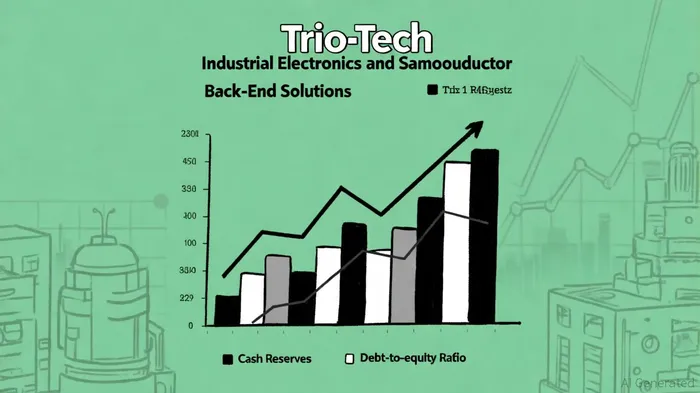
The balance sheet further reinforces this narrative. Trio-Tech ended the quarter with $19.5 million in cash and deposits, an 11% increase in working capital, and a conservative debt-to-equity ratio of 0.41 [1]. These metrics, coupled with a share repurchase program of up to $1.0 million, suggest a management team prioritizing long-term stability over short-term gains. As stated by the company's Q4 earnings release, this financial fortitude positions Trio-Tech to “support future growth” even as it navigates foreign exchange volatility, which eroded $671,000 in profits for the year [1].
The Sustainability Conundrum: Profitability vs. ESG Ambiguity
Critically, Trio-Tech's “sustainability” narrative remains opaque. While the company has not disclosed carbon emissions data or joined initiatives like the Race to Net Zero [2], its operational resilience could be interpreted as a form of business sustainability. Trio-Tech's focus on low-carbon machinery and equipment aligns with industry trends, yet the absence of explicit climate targets contrasts with global investor expectations. A 2025 Triodos Bank report notes that firms failing to address scope 3 emissions risk reputational and regulatory exposure [3], a gap Trio-Tech has yet to bridge.
However, Trio-Tech's financial performance suggests a different kind of sustainability: one rooted in adaptability. The company's ability to offset a Q3 net loss of $495,000 with a Q4 profit (excluding foreign exchange impacts) demonstrates a capacity to absorb shocks—a trait increasingly valued in volatile markets [4]. This operational agility, combined with a debt-free posture, may mitigate concerns over its ESG ambiguity for investors prioritizing financial over environmental metrics.
A Path Forward: Balancing Caution and Optimism
For Trio-Tech, the path to sustainable profitability hinges on two levers: scaling its IE segment and mitigating SBS vulnerabilities. The IE division's 70% growth rate, driven by demand for industrial automation and customized electronics, presents a clear tailwind. Meanwhile, the SBS segment's challenges—linked to broader semiconductor industry downturns—require strategic recalibration. Trio-Tech's recent focus on “customized solutions” [4] hints at a pivot toward niche markets less susceptible to cyclical swings.
Investors should also monitor the company's capital allocation decisions. With $19.5 million in cash and a share repurchase program underway, Trio-Tech has the flexibility to reinvest in high-margin ventures or further strengthen its balance sheet. The absence of significant debt (a debt-to-equity ratio of 0.41 [1]) provides a safety net, but the lack of ESG commitments remains a risk in an era where sustainability-linked financing is becoming standard.
Conclusion
Trio-Tech's Q4 results paint a picture of a company navigating complexity with a blend of operational grit and financial prudence. While its ESG profile lags behind peers, its balance sheet strength and segment-level agility offer a compelling argument for sustainable profitability. For investors, the key question is whether Trio-Tech can leverage its industrial electronics momentum to offset semiconductor sector headwinds—and whether it will eventually align with global sustainability benchmarks. Until then, the company's resilience remains its most tangible asset.





Comentarios
Aún no hay comentarios