
Trinidad and Tobago's Transition from Hydrocarbon Dependence: Strategic Diversification and Emerging Sectors as Catalysts for Sustainable Investment Returns
The Hydrocarbon Conundrum: A Legacy of Volatility
Trinidad and Tobago's economy has long been tethered to hydrocarbons, with the energy sector contributing 58.2% of government revenue and 85.7% of export earnings in 2022[1]. However, this dependence has proven precarious. In Q3 2024, energy output contracted, dragging down real GDP growth[2], while U.S. sanctions on Venezuela-linked projects like Dragon and Manakin-Cocuina further constrained expansion[3]. Despite a 7.7% year-over-year rise in hydrocarbon production in January 2025[4], S&P Global Ratings warns that declining reserves and global energy transitions threaten fiscal stability, with a projected 6% government deficit in 2025[5].
Strategic Diversification: Beyond the Hydrocarbon Horizon
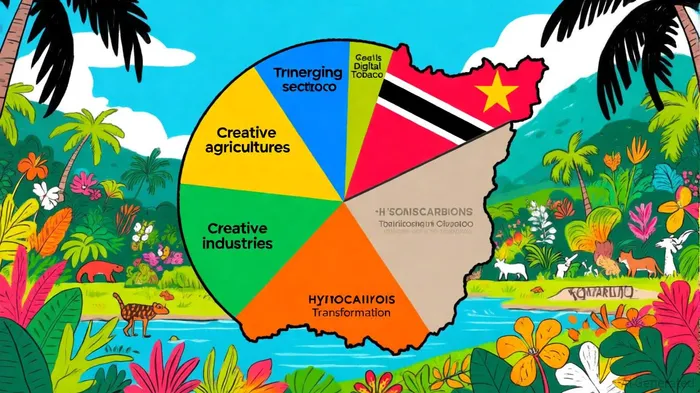
Recognizing these risks, Trinidad and Tobago has embarked on an ambitious diversification strategy, targeting agriculture, creative industries, and digital transformation. These sectors are not merely alternatives but engines of sustainable, high-value growth.
1. Agriculture: Feeding the Economy
The TT Chamber of Industry and Commerce has prioritized agriculture to reduce the $7.3 billion annual food import bill[6]. Government investment of $1.184 billion in 2025[7] supports climate-resilient systems and niche crops like cocoa and tropical fruits. While agricultural GDP is projected to decline to $7.7 million by 2026[8], this reflects a strategic shift toward higher-margin exports rather than subsistence farming. The Agricultural Finance Support Programme (Agro-Incentive Grant) has already disbursed $42 million since 2019, empowering 116 farmers and agro-entrepreneurs[9]. Private-sector innovation, such as AgriAssure's AI-driven compliance tools, is further unlocking trade opportunities[10].
2. Creative Industries: The "Orange Economy"
Trinidad and Tobago's creative sector—encompassing music, film, fashion, and digital media—is gaining traction as a global export. Recent investments generated $55 million from film production and $5.3 million in music exports[11], while fashion designers have penetrated 21 international markets[12]. The TT Chamber's Orange Economy Committee advocates for an Orange Economy Act, modeled on Turkey's film industry success, to formalize support for creative enterprises[13]. Initiatives like CreativeTT and the Caribbean Development Bank's Cultural and Creative Industries Innovation Fund (CIIF) are addressing financing gaps and market access[14].
3. Digital Transformation: Building a Tech-Driven Future
Digital infrastructure is expanding rapidly, with mobile connectivity at 135% of the population and internet penetration at 84.7%[15]. The Start-Up TT initiative, inspired by Chile's Start-Up Chile program, aims to attract foreign investment and foster innovation[16]. The D'Hub project, a collaboration between government and developers, has already produced 15 proof-of-concept solutions for public services, with TT$50,000 in awards[17]. AMCHAM T&T's proposed National Infrastructure Investment Fund (NIIF) could further catalyze private-sector participation in digital infrastructure[18].
Investment Opportunities and Risk Mitigation
For investors, Trinidad and Tobago's diversification strategy offers tangible returns in sectors poised for growth:
- Agriculture: Agro-processing and climate-resilient infrastructure present opportunities in a $270 million GDP target by 2026[19].
- Creative Industries: Film and music exports, bolstered by intellectual property protections, could scale to $100 million annually[20].
- Digital Transformation: GovTech and AI-driven platforms, supported by the TT Digital Project, are attracting regional and international partners[21].
However, challenges persist. Regulatory uncertainty and foreign exchange shortages remain hurdles[22], while creative industries face skills gaps in digital marketing and IP management[23]. To mitigate these risks, the government must accelerate reforms, including digitized customs systems and digital nomad visas[24], while investors should prioritize partnerships with local stakeholders.
Conclusion: A Balanced Path Forward
Trinidad and Tobago's transition from hydrocarbon dependence is neither a rejection of its energy legacy nor a gamble on unproven sectors. Instead, it is a calculated pivot toward resilience and inclusion. While hydrocarbons will remain a near-term growth driver—projected to contribute 1.3% to 2025 GDP[25]—the emergence of agriculture, creative industries, and digital transformation offers a blueprint for sustainable returns. For investors, the key lies in aligning with policies that de-risk exposure to energy volatility while capitalizing on Trinidad and Tobago's strategic location, English-speaking workforce, and cultural dynamism.







Comentarios
Aún no hay comentarios