
Trident Resources' Strategic Land Expansion in the La Ronge Gold Belt: A Catalyst for Shareholder Value Creation
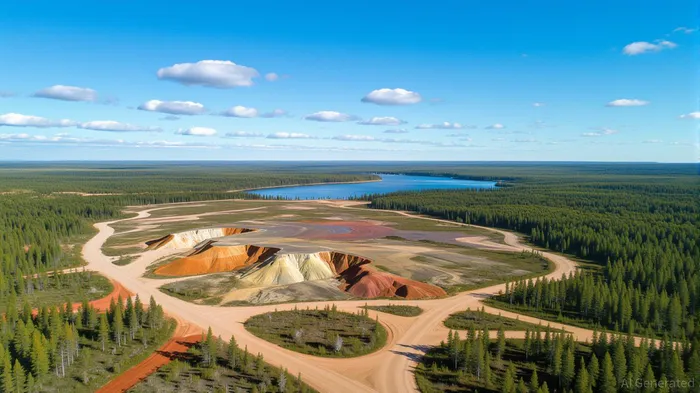
In the ever-evolving landscape of gold exploration, strategic land consolidation often serves as the linchpin for unlocking value. TridentTDTH-- Resources Corp. (TSXV: TD) has positioned itself as a standout player in this arena, leveraging its recent acquisitions in the La Ronge Gold Belt to amplify its resource base and exploration upside. For investors, the company's aggressive land expansion—spanning over 23,000 hectares of high-potential claims—represents a compelling case study in how geological promise, financial discipline, and operational focus can converge to drive shareholder value.
Strategic Rationale: Consolidating Control in a High-Grade District
The La Ronge Gold Belt, a historically underexplored region in Saskatchewan, has emerged as a critical frontier for gold and copper exploration. Trident's recent acquisitions, including 16,245 hectares adjacent to its flagship Contact Lake and Greywacke projects, underscore its intent to dominate this district. These claims, situated just 30 kilometers northeast of La Ronge, are not only road-accessible but also host historical gold showings exceeding 45.5 g/t Au—a metric that signals the presence of high-grade mineralization.
The acquisition of the Hailstone Property (6,902 hectares) further strengthens Trident's position. This property, adjacent to the Greywacke Gold Project, is prospective for both gold and copper, with historical samples reporting up to 15.9 g/t Au and 2.68% Cu. By consolidating these assets, Trident is creating a contiguous land package that aligns with the geological continuity of the Wacke Mineralization Trend—a 7 km corridor of known gold-bearing structures. Such strategic land control reduces the risk of third-party encumbrances and allows for systematic exploration of deep-seated and near-surface targets.
Financial Discipline: Cost-Effective Expansion with Royalty Flexibility
Trident's approach to land acquisition is equally noteworthy for its financial prudence. The recent deals, including a non-arm's-length agreement with Eagle Plains Resources Ltd., required minimal upfront cash outlays—$14,370 in cash and a 2% NSR royalty on the 16,245-hectare package, with a $1M buy-back option for 1% of the royalty. Similarly, the Hailstone Property option agreement demands only $40,000 in cash, 50,000 shares, and $200,000 in exploration expenditures over four years. These terms reflect a low-risk, high-reward structure, allowing Trident to preserve liquidity while securing critical assets.
The company's robust balance sheet—boasting over $11 million in working capital—further insulates it from dilution risks. This financial flexibility ensures Trident can fund its summer drilling program at Contact Lake and advance the Hailstone Property without relying on equity raises, a critical advantage in a volatile market. Additionally, the ability to buy back royalties (e.g., the 0.5% NSR on Hailstone for $250,000) provides long-term cost savings and enhances net returns on discoveries.
Geological and Market Context: A High-Potential, Underexplored District
The La Ronge Gold Belt's underexplored status is both a risk and an opportunity. While the region lacks the infrastructure and historical drilling of more mature gold districts, it also offers a blank canvas for modern exploration techniques. Trident's portfolio includes four known gold deposits at Contact Lake and a 7 km mineralized trend at Greywacke, suggesting the potential for district-scale discoveries. The Knife Lake Copper VMS Project, with its 56,565-hectare footprint, adds a copper component to the mix—a commodity with growing demand in the green energy transition.
From a market perspective, Trident's strategy aligns with broader industry trends. Gold prices have remained resilient amid macroeconomic uncertainty, and junior explorers with clear catalysts (e.g., drill results, land consolidation) often outperform the sector. Trident's focus on high-grade gold and copper in a politically stable jurisdiction (Canada) positions it to capitalize on both precious and base metal demand cycles.
Risk Mitigation and Long-Term Value
Critics may question the speculative nature of gold exploration, but Trident's approach mitigates key risks. The company's use of historical data to target high-grade zones, combined with its proximity to existing infrastructure (e.g., roads, power), reduces exploration costs. Furthermore, the option to buy back royalties and the presence of multiple commodities (gold, copper) diversify revenue streams.
For investors, the key catalysts to watch are the results of the summer drilling program at Contact Lake and the delineation of new targets at Hailstone. A single high-grade intercept could trigger a re-rating of the company's valuation, particularly if it demonstrates the continuity of mineralization.
Investment Thesis
Trident Resources' strategic land expansion in the La Ronge Gold Belt is a masterclass in junior exploration. By consolidating road-accessible, high-grade claims at minimal cost, the company has positioned itself to unlock value through resource growth and potential new discoveries. With a strong balance sheet, a clear exploration roadmap, and a focus on underexplored districts, Trident offers a compelling risk-reward profile for investors seeking exposure to the gold and copper sectors.
Actionable Insight: Investors should monitor Trident's Q3 2025 drilling results and its ability to convert historical data into drill-defined resources. A 20% position in a diversified portfolio could provide exposure to the company's near-term catalysts while balancing risk.







Comentarios
Aún no hay comentarios