
Tri Pointe Homes (TPH) Valuation in a Shifting Housing Market: Identifying Undervalued Entry Points
The U.S. housing market in 2025 is defined by a paradox: persistent affordability challenges coexist with improving demand fundamentals. For Tri Pointe HomesTPH-- (TPH), a mid-cap homebuilder with a premium product focus, this environment presents both risks and opportunities. While the company's Q2 2025 results reflected a 22% revenue decline and a 31.5% drop in net new home orders[1], its valuation metrics, forward guidance, and strategic positioning suggest a compelling case for undervaluation amid sector-wide volatility.
Market Share Dynamics: A Niche Player in a Fragmented Sector
TPH's 0.50% market share in Q2 2025 lags behind Lennar's 5.11% and D.R. Horton's 4.74%[2], but its focus on detached, single-family homes in suburban markets differentiates it from competitors. Unlike Lennar's broad geographic and product range, TPHTPH-- targets higher-income demographics with an average sales price of $665,000–$675,000[3], aligning with a segment less sensitive to macroeconomic headwinds. This premium positioning is reflected in its 20.8% homebuilding gross margin for Q2 2025, outperforming Lennar's 17.8% and D.R. Horton's 13.8% during the same period[4].
Affordability Pressures and Strategic Resilience
Housing affordability remains a critical challenge, with a median home price-to-income ratio of 5.0 in 2025[5]. However, TPH's product mix—targeting millennials and Gen Z buyers with entry-level to mid-tier options ($350,000–$800,000)[6]—positions it to benefit from demographic-driven demand. Analysts project mortgage rates to fall to 5.9% by 2026[7], which could catalyze a rebound in buyer activity. TPH's 79% in-house financing backlog[8] and expansion into new markets like Utah and Orlando further insulate it from regional volatility.
Valuation Metrics: A Discount to Intrinsic Value
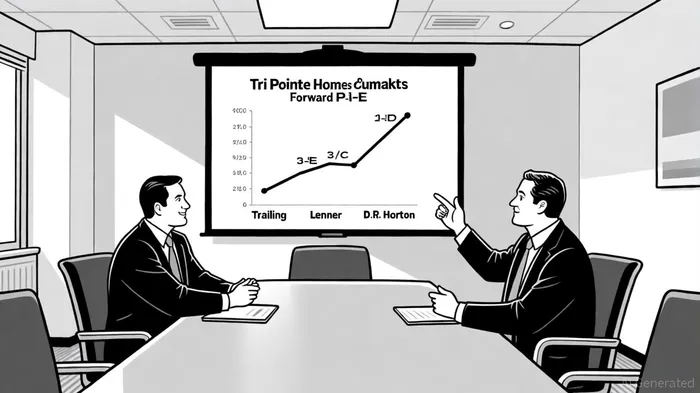
TPH's valuation appears attractive relative to peers. Its trailing P/E ratio of 8.49 and forward P/E of 15.03[9] trail Lennar's 10.4 and D.R. Horton's 13.4, reflecting a discount to earnings growth expectations. Analysts have set an average price target of $42.00 (24.5% upside from current levels)[10], supported by a robust balance sheet ($1.4 billion in liquidity[11]) and a conservative debt-to-capital ratio of 21.7%[12]. The company's price-to-book ratio of 0.91[13] also suggests undervaluation relative to tangible assets.
Forward Guidance and Margin Stability
TPH's 2025 delivery guidance of 4,800–5,200 homes at $665,000–$675,000[14] implies $3.2–$3.5 billion in revenue, with gross margins projected at 20.5–22.0%[15]. While margin compression in recent quarters (from 23.6% in Q2 2024 to 20.8% in Q2 2025[16]) reflects industry-wide pressures, the company's focus on structural pricing and self-developed land (70% of communities[17]) should stabilize margins in 2026. Analysts forecast $3.39 billion in 2026 revenue and $2.80 in EPS[18], underscoring long-term growth potential.
Conclusion: A Strategic Buy for Long-Term Investors
TPH's combination of a premium product mix, strong balance sheet, and expansion into high-growth markets positions it to outperform in a recovery scenario. While near-term challenges persist—elevated mortgage rates and soft absorption rates—the company's valuation discounts these risks. For investors seeking exposure to a homebuilder with structural advantages in a cyclical sector, TPH offers an attractive entry point.





Comentarios
Aún no hay comentarios