
Trezor Safe 7: A Quantum-Ready Strategic Upgrade for Long-Term Crypto Investors
The advent of quantum computing is no longer a speculative threat but a tangible risk to the cryptographic foundations underpinning cryptocurrency. As quantum processors advance toward breaking widely used algorithms like RSA and ECC by 2035 according to F5 Labs, the urgency to adopt post-quantum cryptography (PQC) has intensified. For long-term crypto investors, the transition to quantum-resistant security measures is not merely a technical upgrade-it is a strategic imperative to safeguard assets against the "harvest now, decrypt later" threat model as research shows. In this context, the Trezor Safe 7 emerges as a pioneering solution, offering a quantum-ready architecture that bridges immediate security needs with future-proof resilience.
The Quantum Threat and the PQC Transition
Quantum computing's ability to solve complex mathematical problems exponentially faster than classical systems poses a direct risk to cryptographic protocols. According to a U.S. National Institute of Standards and Technology report, quantum computers could render current encryption standards obsolete within a decade. NIST has already finalized PQC algorithms such as CRYSTALS-Kyber and CRYSTALS-Dilithium, designed to resist both classical and quantum attacks. However, adoption remains uneven: as of 2025, only 8.6% of the top one million websites support hybrid PQC key exchange mechanisms according to F5 Labs. Critical sectors like banking and healthcare lag further, underscoring systemic challenges in the transition.
For cryptocurrency, the stakes are even higher. Blockchains like BitcoinBTC-- and EthereumETH-- rely on elliptic curve cryptography (ECC), which is vulnerable to quantum decryption. The "harvest now, decrypt later" strategy-where adversaries store encrypted data today for decryption in the quantum era- has become a pressing concern. This reality has spurred demand for hardware wallets that integrate PQC, ensuring that private keys and firmware updates remain secure even as quantum capabilities evolve.
Trezor Safe 7: Architecture and Quantum-Ready Innovation
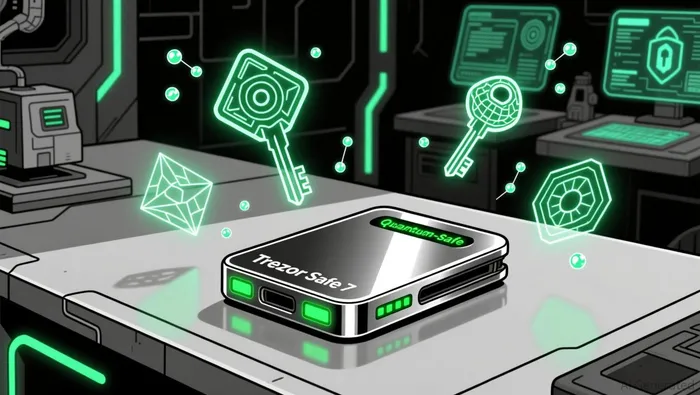
The Trezor Safe 7 distinguishes itself as the first quantum-ready hardware wallet, engineered to support post-quantum cryptographic updates once they are widely adopted. Its hybrid security model combines SLH-DSA-128 (a NIST-standardized hash-based algorithm) with traditional EdDSA (Ed25519) for firmware verification according to Trezor's blog. This dual-layer approach ensures backward compatibility with existing protocols while preparing for future quantum threats. The device also features a post-quantum device certificate, leveraging ML-DSA-44 for fast and secure authentication as described in Trezor's guide.
A key innovation lies in its dual secure element architecture. The Safe 7 integrates the TROPIC01 chip from Tropic Square and the EAL6+ OPTIGA Trust M chip, creating a redundant security framework. This design mitigates risks associated with single points of failure and enhances trust in the device's integrity. Additionally, the Safe 7 supports wireless connectivity (Bluetooth 5.0 and Qi2 charging) while offering a USB-only mode for users prioritizing isolation as reported by CryptoSlate.
Compared to competitors like Ledger Flex and Ledger Nano X, the Safe 7's quantum readiness is a unique selling point. While other wallets emphasize traditional security measures (e.g., EAL6+ certifications), none explicitly address the looming quantum threat. The Safe 7's open-source firmware and transparent secure elements further differentiate it, enabling external audits of critical functions.
Strategic Value for Long-Term Investors
For long-term crypto investors, the Trezor Safe 7 represents a proactive hedge against quantum risk. Its ability to receive post-quantum firmware updates ensures that users remain protected as blockchain networks adopt PQC standards-a process expected to span decades as highlighted in security reports. This adaptability is critical, as blockchains themselves are not yet quantum-safe. By securing firmware and device authenticity against quantum attacks, the Safe 7 prevents potential vulnerabilities during the transition period as explained in Trezor's guide.
Investor sentiment reflects growing recognition of quantum readiness as a strategic asset. High-net-worth individuals and institutional investors are increasingly prioritizing PQC solutions, driven by the "harvest now, decrypt later" threat model. The cost-benefit analysis favors early adoption: while quantum-ready hardware carries upfront costs, the potential losses from quantum decryption justify the investment as analyzed by The Quantum Insider. Moreover, the post-quantum security market is maturing, with firms like QuantumBlock Vault and SafeKey PQ Wallet offering PQC-integrated solutions as reported by The Globe and Mail.
Conclusion: A Quantum-Proof Future Requires Quantum-Ready Tools
The Trezor Safe 7 is not a silver bullet but a critical step toward quantum resilience. Its hybrid cryptographic approach, dual secure elements, and future-proof design position it as a strategic upgrade for investors seeking to mitigate long-term risks. While blockchain networks must eventually adopt PQC, the Safe 7 ensures that hardware wallets do not become a bottleneck in the transition. For those holding significant crypto assets, the question is no longer if quantum threats will materialize but when. The Trezor Safe 7 offers a pragmatic, forward-looking solution to secure digital wealth in an era where cryptographic obsolescence is inevitable.






Comentarios
Aún no hay comentarios