
Treasury Yield Dynamics and Implications for 2026 Fixed Income Strategies
The U.S. Treasury yield curve has emerged as a focal point for fixed income investors in 2026, shaped by a confluence of factors including a steepening curve, delayed economic data, and divergent expectations between the Federal Reserve and market participants. These dynamics are redefining entry points and risk management strategies in the bond market, as investors navigate a landscape of heightened uncertainty and evolving policy signals.
The Steepening Yield Curve: A Barometer of Divergent Expectations
The U.S. Treasury yield curve has steepened significantly in late 2025, with the 5-year/30-year spread reaching 126 basis points on September 5-the widest in over four years before narrowing to 104.8 bps. This steepening reflects a tug-of-war between inflationary pressures and the Fed's anticipated easing cycle. Long-term yields have risen on concerns about persistent inflation, particularly in the services sector, while short-term yields have fallen as investors price in rate cuts.
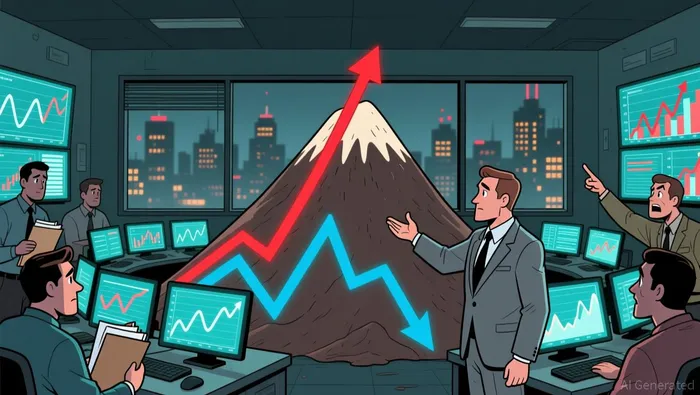 This divergence is not merely technical but signals broader market sentiment. Analysts suggest the steepening curve reflects optimism about a "soft landing," with investors flocking to longer-duration bonds to capture higher yields amid expectations of accommodative monetary policy. In contrast, European yield curves have normalized and steepened as well, indicating improved economic momentum and banking profitability. For U.S. investors, this dynamic suggests a potential "bull steepening" in the front end of the curve, where shorter-term instruments could outperform as the Fed's rate-cutting cycle progresses.
Delayed Economic Data: A Double-Edged Sword for Entry Points
The delayed release of key economic data, particularly the October and November 2025 jobs reports, has introduced significant uncertainty into bond market dynamics. The November report, for instance, showed a modest gain of 64,000 jobs but was clouded by downward revisions to prior months and distortions from a six-week government shutdown. This has led to a fractured market interpretation: some view the data as evidence of a weakening labor market, while others dismiss it as an artifact of the shutdown.
Fed Policy Divergence: Volatility and Strategic Opportunities
The Federal Reserve's policy trajectory for 2026 has diverged sharply from market expectations, amplifying volatility in Treasury yields. While the Fed projects only one 25 bps rate cut in 2026 (with another in 2027), traders are pricing in two cuts for 2026 alone. This disconnect has created a "waggle dance" in bond markets, where shifting expectations about inflation, labor market cooling, and fiscal stimulus drive yield fluctuations.
The Fed's cautious approach is partly driven by its data-dependent stance and the need to balance inflation control with employment support. For instance, the central bank has signaled a willingness to tolerate inflation slightly above 2% if it means avoiding a labor market downturn. This flexibility could allow for rate cuts even if inflation remains stubborn, creating opportunities for investors to capitalize on yield curve steepening and sector-specific dislocations.
Strategic Implications for 2026 Fixed Income Portfolios
Given these dynamics, fixed income strategies for 2026 must prioritize adaptability and risk mitigation. Key considerations include:
- Duration Management: Shorter-duration bonds are likely to outperform as the Fed's rate-cutting cycle progresses, particularly in a steepening curve environment. Intermediate-term instruments, however, offer a balance between yield and interest rate risk.
- Active Laddering: Bond laddering can help investors navigate rate volatility by spreading maturities and reducing exposure to sudden yield shifts.
- Sector Diversification: High-yield bonds and emerging markets may provide attractive returns, but require careful credit analysis given tight spreads and macroeconomic uncertainties.
- Macro-Linked Instruments: Investors should monitor fiscal stimulus and AI-driven business investment, which could bolster corporate and municipal credit markets.
Conclusion
The interplay of a steepening yield curve, delayed economic data, and Fed policy divergence is creating a complex but navigable landscape for 2026 fixed income strategies. While uncertainty persists, the emphasis on active management, shorter-duration exposure, and sector-specific opportunities offers a roadmap for capital preservation and growth. As Treasury Secretary Scott Bessent noted, the U.S. economy is not at risk of a recession, but investors must remain agile in the face of distorted data and evolving policy signals.







Comentarios
Aún no hay comentarios