
The End of the U.S. Treasury Safe-Haven Era and the Rise of Global Diversification
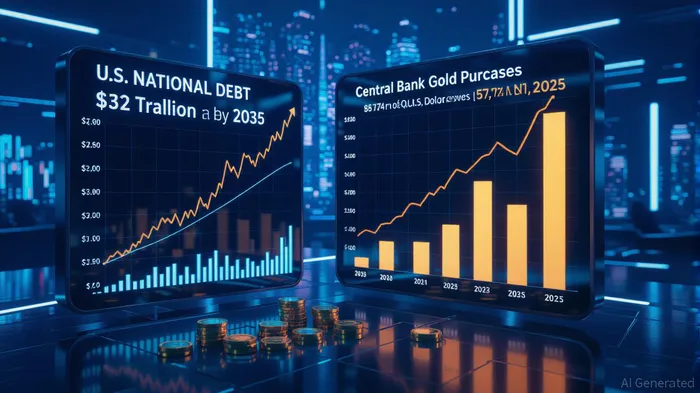
The U.S. Treasury's long-standing status as the global safe-haven asset is under unprecedented strain. For decades, investors turned to U.S. debt as a refuge during crises, buoyed by the dollar's dominance and the perceived inviolability of American fiscal credibility. However, a confluence of rising fiscal risks, structural imbalances, and shifting global capital flows is eroding this foundation. As the U.S. national debt approaches $37 trillion—projected to surpass $52 trillion by 2035—investors are increasingly questioning whether the “convenience yield” of Treasuries justifies their risks [1].
U.S. Fiscal Risks: A Perfect Storm
The Congressional Budget Office (CBO) has painted a stark picture of the U.S. fiscal outlook. For fiscal year 2025, the deficit is expected to reach $1.9 trillion, with debt held by the public climbing from 100% of GDP in 2025 to 118% by 2035 [2]. These figures are exacerbated by the One Big Beautiful Bill Act (OBBBA), which adds $4.1 trillion to deficits over the next decade, pushing debt to 127% of GDP by 2034 [3]. The CBO's long-term projections are even grimmer: by 2055, the deficit could hit 7.3% of GDP, with debt reaching 156% of GDP [4].
The sustainability of this path is increasingly doubted. As the real interest rate (r) converges with the economic growth rate (g), stabilizing the debt-to-GDP ratio would require historically large fiscal consolidations—politically and economically implausible in a polarized environment [5]. Meanwhile, the U.S. net international investment position (NIIP) has deteriorated to nearly 90% of GDP, with gross liabilities exceeding 200% of GDP. The IMF warns that this exposes the U.S. to a portfolio shift away from dollar assets, as global investors demand higher risk premiums [6].
The Diminishing Safe-Haven Premium
The U.S. dollar's dominance in global reserves has also waned. As of Q1 2025, the dollar's share of allocated reserves fell to 57.74%, down from 71% in 1999 [7]. Central banks, particularly in emerging markets, are accelerating diversification into gold, the euro, and other reserve currencies. For example, central banks purchased 183 tonnes of gold in Q2 2024—the 14th consecutive quarter of accumulation—reflecting a strategic pivot to hedge against dollar devaluation risks [8].
The IMF's Spring 2025 meetings underscored broader concerns about U.S. “exceptionalism.” Unilateral tariffs and policy uncertainty have eroded confidence in the dollar's role as a stable reserve asset. While Treasuries retained their safe-haven appeal during the 2025 tariff surge, markets remain wary of long-term implications [9]. The erosion of the dollar's “convenience yield” is evident in the widening yield differential between U.S. Treasuries and German Bunds. By Q3 2025, the 10-year Bund yield reached 2.9%, compared to 4.3% for U.S. Treasuries, reflecting divergent fiscal and monetary policies [10].
The Rise of Global Diversification
Investors are now prioritizing strategic rebalancing to mitigate U.S. fiscal risks. Central banks are not the only actors: institutional investors are increasingly allocating to non-dollar assets, including safe-haven currencies (e.g., Japanese yen, Swiss franc), gold, and short-duration sovereign bonds. Emerging market (EM) debt, in particular, has gained traction. A weaker dollar has boosted EM bond returns, with hard currency debt offering yields of 6.5–7.2%—far outpacing U.S. Treasuries [11].
The shift is driven by both macroeconomic and geopolitical factors. EM economies benefit from the dollar's decline, which eases debt servicing costs and supports growth. Meanwhile, U.S. protectionist policies and geopolitical tensions have made EM debt a compelling diversifier [12]. For example, Indonesia, Malaysia, and South Africa have implemented rate cuts to stimulate growth, attracting capital inflows despite global jitters [13].
Strategic Implications for Investors
The end of the U.S. Treasury safe-haven era demands a reevaluation of traditional asset allocations. Investors must now balance the risks of U.S. fiscal overreach with the opportunities in a more diversified global landscape. Key strategies include:
1. Diversifying Reserves: Increasing exposure to gold, euros, and EM currencies to hedge against dollar volatility.
2. Yield Arbitrage: Leveraging higher yields in EM debt and European government bonds while managing currency risk.
3. Multi-Asset Portfolios: Incorporating market-neutral strategies and alternative assets to reduce reliance on Treasuries.
As the CBO and IMF warn, the U.S. fiscal trajectory is unsustainable without painful adjustments. For now, the dollar's safe-haven status persists, but the window for complacency is closing. Investors who act decisively to rebalance their portfolios will be better positioned to navigate the next phase of global capital reallocation.







Comentarios
Aún no hay comentarios