
U.S. Treasury Bill Market Dynamics: Non-Competitive Bid Trends and Liquidity Strategy Implications
The U.S. Treasury bill (T-bill) market remains a cornerstone of global short-term liquidity, with non-competitive bidding mechanisms playing a pivotal role in ensuring broad investor participation. However, recent trends in non-competitive bid participation-particularly from 2023 to 2025-reveal shifting dynamics that could reshape liquidity strategies for both institutional and retail investors. This analysis examines these trends, their drivers, and their implications for market stability.
The Mechanics of Non-Competitive Bidding
Non-competitive bids allow investors to purchase T-bills at the yield determined by competitive auctions, with a guaranteed allocation up to $5 million per auction, according to Treasury auction data. This mechanism is popular among individual investors and smaller institutions, as it eliminates the complexity of yield speculation while ensuring access to risk-free, short-term assets, as explained in a Non-competitive bidding primer. The U.S. Treasury processes non-competitive bids first, subtracting them from the total offering before allocating remaining securities to competitive bidders, as described in the Sapling guide. This structure ensures price discovery remains market-driven while maintaining accessibility for a broad investor base.
Emerging Trends in Non-Competitive Bid Participation (2023–2025)
Data from 2023 to 2025 highlights a notable evolution in non-competitive bid dynamics. In October 2023, for instance, non-competitive bidders received only 79% of their requested allotments due to a surge in demand for T-bills, which reached $14.7 billion-58% higher than the prior auction, as shown in the October 2023 auction results. This shortfall signaled heightened competition for liquidity, driven by macroeconomic uncertainties, including the collapse of Silicon Valley Bank and Signature Bank in early 2023, which triggered a temporary liquidity crunch, according to a Liberty Street analysis.
By 2025, the landscape had shifted further. The U.S. Treasury increased T-bill supply following the lifting of the debt ceiling, a move expected to drain banking reserves and elevate money market rates, according to a BNY note. Concurrently, primary dealers' share of allocations in long-term Treasury auctions hit record lows, with dealers receiving just 8.7% of a 30-year bond auction in October 2025-the lowest since 2006-reported in a Bloomberg report. This decline reflects a broader trend of institutional investors, particularly investment funds, dominating non-competitive bidding. For example, in TIPS auctions, investment funds' participation surged from 20% in 2008 to 75% by 2019, as documented in an academic study, a pattern likely extending to T-bill markets.
Liquidity Strategy Implications
The evolving non-competitive bid landscape has profound implications for liquidity strategies. First, the increased reliance on non-competitive bids by institutional investors has masked a decline in genuine private demand. A 2025 report by Liquidity Trader noted that mechanical bids from primary dealers artificially inflated bid-to-cover ratios, creating a false impression of robust market demand, as highlighted in a Liquidity Trader report. This "window dressing" risks exposing vulnerabilities if issuance volumes spike, as dealers may struggle to absorb larger supplies at current pricing levels.
Second, the shift toward institutional participation in non-competitive bidding has reduced retail access to T-bills. In October 2023, the 79% allotment rate for non-competitive bidders underscored this tension, as smaller investors faced partial rejections amid heightened demand, as reported by Financial Horse. This trend could exacerbate liquidity fragmentation, particularly if T-bill issuance continues to expand.
Third, the Treasury's liquidity strategy faces challenges from strategic behavior by institutional investors. Research on TIPS auctions revealed that some funds deliberately reduced secondary market demand before auction dates, driving down prices and creating a persistent "auction cycle" of yield volatility; the same academic study documents these tactics. Such tactics, while profitable for specific actors, may distort auction outcomes and increase issuance costs for the Treasury.
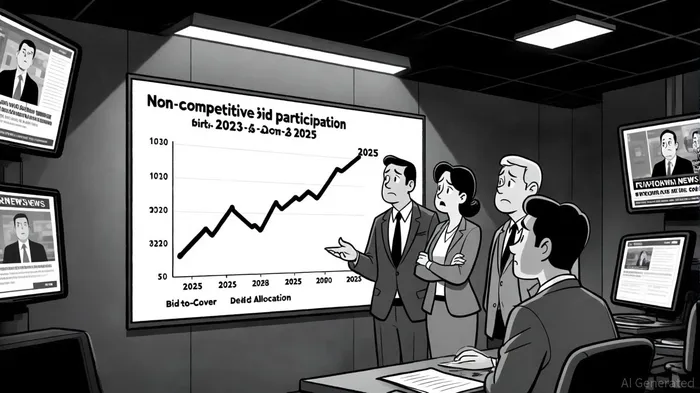
Visualizing the Shift in Non-Competitive Bidding
Strategic Considerations for Investors
For short-term liquidity strategies, the evolving non-competitive bid environment necessitates caution. Investors should:
1. Diversify Access Channels: Given the risk of partial rejections in non-competitive bids, investors may need to allocate portions of their portfolios to competitive bidding or alternative short-term instruments.
2. Monitor Auction Cycles: The persistence of the "auction cycle" in TIPS and potential spillover into T-bill markets suggests that timing trades around auction dates could mitigate yield volatility.
3. Assess Funding Liquidity: As T-bill issuance expands, investors must evaluate how increased supply might strain repo markets and elevate borrowing costs, particularly in stressed environments, as noted in a New York Fed speech.
Conclusion
Non-competitive bidding in the U.S. T-bill market has evolved from a retail-focused tool to a mechanism increasingly dominated by institutional actors. While this shift has maintained auction success, it has also introduced risks to liquidity stability, including artificial demand metrics and reduced retail access. As the Treasury navigates higher issuance volumes post-debt ceiling, investors must adapt their strategies to account for these dynamics, balancing accessibility with resilience in an increasingly complex market.







Comentarios
Aún no hay comentarios