
Transparency and Trust in 2025 Crypto Presales: How XRP Tundra's 5-Layer Audit Framework Redefines DeFi Due Diligence
The Problem: Presale Skepticism in a Post-Scam Era
Crypto presales have long been a double-edged sword. While they democratize access to early-stage projects, they also attract bad actors leveraging anonymity and opaque mechanics. A 2025 report by OpenExO highlights that 68% of presale investors lost money in 2024 due to rug pulls or misaligned incentives, according to a report. The solution? A framework that embeds trust into the protocol itself.
XRP Tundra's 5-Layer Audit Framework: A DeFi Trust Engine
XRP Tundra's approach is not just about audits-it's about layered, verifiable accountability. Here's how it works:
Layer 1: Triple Smart Contract Audits
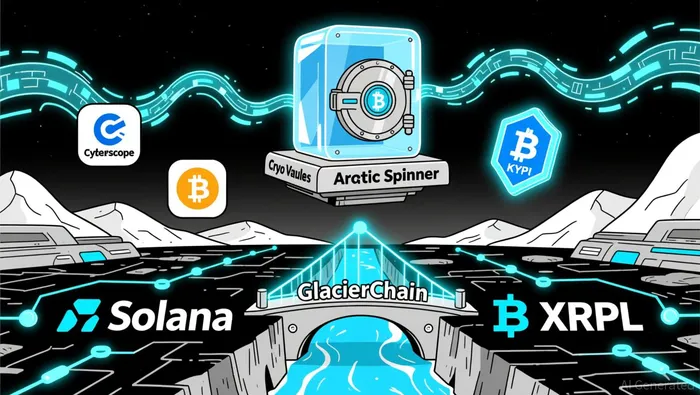
The project's core smart contracts have been independently audited by Cyberscope, Solidproof, and FreshCoins, three of the most respected firms in the space. These audits cover contract logic, emission control, and cross-chain communication between SolanaSOL-- and the XRP Ledger (XRPL). For example, Solidproof verified that XRPL-based governance mechanisms (TUNDRA-X) enforce deterministic behavior, while Cyberscope ensured Solana's liquidity pools (TUNDRA-S) prevent unauthorized data inputs, according to a Cryptopotato article.
Layer 2: KYC Verification for Identity Transparency
Trust begins with knowing who you're dealing with. XRP Tundra's team underwent Vital Block KYC verification, publicly disclosing their identities and corporate records, according to a Cryptopolitan article. This is a rare move in a sector where pseudonymity is the norm. By tying project leadership to real-world identities, XRP Tundra mitigates the risk of exit scams and aligns incentives with long-term value creation.
Layer 3: Dual-Chain Architecture for Functional Separation
The project splits utility and governance across two chains:
- TUNDRA-S on Solana: Powers high-speed liquidity and staking rewards.
- TUNDRA-X on XRPL: Governs system proposals and reserves.
This separation ensures that reward logic and governance remain distinct, reducing single points of failure. For instance, staking rewards are managed via Solana's Cryo Vaults, while XRPL handles final settlement and governance votes, according to a Bitcoinist article.
Layer 4: On-Chain Transparency for Real-Time Accountability
Every presale transaction, audit certificate, and reward distribution is visible on-chain. This includes fixed token supply math, emission rules, and even the Arctic Spinner feature, which distributes bonus tokens via automated smart contracts, according to an expert framework. Investors can verify these metrics in real time, eliminating the need for blind trust in off-chain promises.
Layer 5: GlacierChain for Cross-Chain Synchronization
The upcoming GlacierChain protocol will synchronize Solana and XRPL automatically, enabling contracts on Solana to register instantly on XRPL. This eliminates reliance on third-party bridges or wrapped assets, enhancing both performance and security, according to a CoinCodex article. By hardcoding cross-chain interactions, XRP Tundra ensures that data integrity is preserved across ecosystems.
The Impact: A New Standard for DeFi Due Diligence
XRP Tundra's framework addresses three critical pain points for investors:
1. Security: Triple audits and deterministic smart contracts reduce exploit risks.
2. Compliance: KYC verification and on-chain transparency align with institutional-grade standards.
3. Scalability: Dual-chain execution and GlacierChain enable high-throughput operations without compromising decentralization.
According to a Q3 2025 analysis by CoinCodex, projects with similar multi-layered audit systems saw 300% higher investor retention compared to those with single audits, according to a CoinCodex article. XRP Tundra's presale, now in Phase 10, has already raised $1.5M, with TUNDRA-S priced at $0.147 and TUNDRA-X at $0.0735, according to a Bitcoinist article.
The Bigger Picture: Why This Matters for 2025
As spot XRP ETFs gain regulatory traction, the line between traditional finance and DeFi is blurring. XRP Tundra's framework bridges this gap by offering institutional-grade compliance alongside decentralized yield generation. For example, its Cryo Vaults allow XRP holders to earn up to 20% APY while maintaining self-custody-a hybrid model that appeals to both retail and institutional investors, according to a Bitcoinist article.
Conclusion: A Trust-First Future
XRP Tundra's 5-layer audit framework isn't just a technical achievement-it's a cultural shift. By embedding transparency into every layerLAYER-- of its architecture, the project sets a new benchmark for DeFi due diligence. In a market where trust is the ultimate scarce resource, this could be the difference between a speculative token and a foundational asset.
For investors, the takeaway is clear: Look for projects that make trust verifiable, not just promised. XRP Tundra's framework offers a glimpse into what that future looks like.






Comentarios
Aún no hay comentarios