
Transocean Up 43% in 3 Months: Buy, Hold or Wait for a Better Entry?
Transocean Ltd. RIG is a leading provider of offshore contract drilling services for oil and gas wells, with a fleet primarily focused on high-specification deepwater and ultra-deepwater rigs. Over the past three months, the company’s shares have delivered a strong performance, significantly outperforming its industry peers and the broader energy sector.
During this period, Transocean stock surged 42.8%, surpassing the 32.3% gain recorded by the Oil & Gas Drilling sub-industry (ZSI134M) and more than doubling the 19.2% rise seen in the broader Oil & Energy Sector (ZS12M). This notable outperformance highlights investors’ growing confidence in Transocean’s positioning within the recovering offshore drilling market.
Analysing 3-Month Price Movement
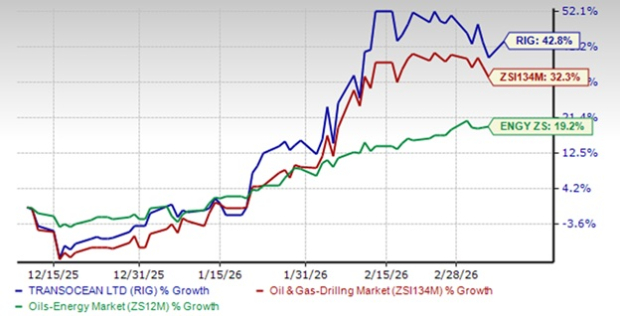
Image Source: Zacks Investment Research
As the energy sector continues to expand, investors are paying close attention to the performance of RIG and assessing whether the stock presents an attractive opportunity. While the company benefits from improving offshore drilling activity, its shares have also experienced periods of volatility, prompting investors to carefully evaluate the risks and potential rewards.
Against this backdrop, it is important to examine the key factors influencing RIG’s recent performance and determine whether the stock currently offers a compelling entry point or calls for a more cautious investment stance.
Factors Strengthening RIG’s Market Position
Exceptional Operational Performance Enhances Customer Trust: RIG demonstrated its industry leadership by achieving a record fleet-wide uptime performance of nearly 98% throughout 2025, all while maintaining a flawless safety record with zero lost time incidents. This level of reliability is paramount for oil and gas companies executing complex, capital-intensive deepwater projects. By consistently delivering predictable and safe operations, RIG solidifies its reputation as a partner of choice, which is a significant competitive advantage when bidding for long-term, high-value contracts against other drilling contractors.
Robust Free Cash Flow Generation Strengthens Financial Flexibility: For full-year 2025, RIG reported a significant increase in free cash flow, reaching $626 million, which is a substantial improvement from the prior year. This strong cash generation, driven by excellent operational performance and effective working capital management, provides the company with the financial resources to proactively reduce its debt burden. Furthermore, this cash flow flexibility allows management to invest in maintaining its high-specification fleet and positions the company to better weather any potential downturns in the cyclical offshore drilling market.
Transformative Valaris Merger Creates Industry Leader: The announced definitive agreement to acquire Valaris VAL is a strategic masterstroke that will create a dominant force in the offshore drilling industry. The pro forma combined entity will command a massive backlog of nearly $11 billion and is expected to generate industry-leading free cash flow. Management has identified more than $200 million in annual cost synergies, which, when realized, will significantly enhance profitability and are projected to reduce the company's leverage to around 1.5 times within just two years of closing the transaction.
Sustainable Cost Reductions Boost Profitability Margins: RIG has successfully implemented a comprehensive cost reduction program, removing about $100 million in costs in 2025 and targeting an additional $150 million in savings for the coming year. These savings, achieved through organizational restructuring and global support rationalization, have made the company leaner and more efficient. By structurally lowering its cost base, RIG is positioned to generate higher EBITDA margins and stronger free cash flow even if market dayrates experience temporary fluctuations, enhancing its overall profitability.
Positive Long-Term Deepwater Market Fundamentals: Management provided an optimistic outlook for the deepwater market, citing increasing tendering activity and multi-year opportunities across major global basins like Namibia, Mozambique and India. This growing demand is driven by customer needs to replace reserves and a strategic pivot back to reliable hydrocarbon sources. With utilization expected to exceed 90% by 2027, the improving supply-demand dynamics are anticipated to create a more constructive and favorable pricing environment for high-specification drilling rigs.
Key Issues Affecting RIG’s Growth Trajectory
Acknowledged Near-Term Activity Softness in Guidance: The company's financial guidance for 2026 explicitly assumes a period of idle time for several key rigs, including the Deepwater Proteus and Deepwater Skyros. This acknowledged near-term softness, particularly in regions like the U.S. Gulf of Mexico, will create a headwind to revenues and earnings in the early part of the year. Even if anticipated, this temporary dip in utilization may test the patience of investors seeking immediate, consistent growth and improved financial results.
Inherent Cyclicality and Volatility of the Industry: The offshore drilling industry remains profoundly cyclical and is highly sensitive to fluctuations in global oil prices. A significant and sustained downturn in oil prices could lead major customers to swiftly cancel or defer deepwater projects, rapidly eroding the currently positive demand outlook. This inherent volatility makes an investment in RIG fundamentally high-risk, as its financial health and contract backlog are largely dependent on a macroeconomic factor completely outside of management's control.
Uncertainty From Delayed Contract Awards: The company’s management revealed that several large, anticipated contract awards have been delayed from late 2025 into 2026, and crucial negotiations with Petrobras PBR regarding contract extensions are taking longer than expected. These delays introduce uncertainty into the company's near-term backlog and revenue visibility. Any further postponement of major awards or failure to finalize the negotiations with Petrobras on favorable terms could negatively impact cash flow projections and undermine investor confidence in the market recovery story.
Complexity of Re-Entering the Jack-Up Market: The merger with Valaris will reintroduce RIG to the highly competitive jack-up rig market, a business segment from which it has been absent. This market often involves a different customer base, including national oil companies, and requires a distinct, leaner cost structure and operational approach. Integrating and successfully managing this new fleet presents a steep learning curve and potential operational complexities for a management team primarily focused on deepwater floaters.
Dependence on Customer Capital Allocation Decisions: The entire investment thesis for RIG hinges on the assumption that its customers will significantly increase their capital spending on offshore projects. Management noted that in 2025, customers were prioritizing balance sheet strength over new commitments. If major oil and gas companies decide to maintain capital discipline and prioritize dividends or share buybacks over sanctioning new deepwater developments, the anticipated surge in tendering activity may fail to materialize, leaving the company with idle capacity.
Verdict for RIG Stock
RIG’s strong operational performance, highlighted by nearly 98% fleet uptime and a flawless safety record, reinforces its reliability and strengthens customer confidence. The company’s robust free cash flow generation, ongoing cost reductions and the transformative merger with Valaris position it to enhance profitability, reduce leverage and capitalize on improving long-term deepwater demand across key global basins. However, near-term activity softness, delays in key contract awards, including negotiations with Petrobras, and the inherent cyclicality of the offshore drilling industry could weigh on short-term performance.
Additionally, the complexity of re-entering the competitive jack-up market and reliance on customers’ capital spending decisions introduce further uncertainty. Given this mix of strengths and potential challenges, investors should wait for a more opportune entry point instead of adding this Zacks Rank #3 (Hold) stock to their portfolios. VAL holds a Zacks Rank #4 (Sell), while PBR carries a Rank #3.
Key Pick
Investors interested in the energy sector might look at a better-ranked stock like TechnipFMC FTI, which sports a Zacks Rank #1 (Strong Buy). You can see the complete list of today’s Zacks #1 Rank stocks here.
TechnipFMC is valued at $25.21 billion. It is a global energy technology company that provides subsea, surface and offshore and onshore project solutions to the oil and gas industry. TechnipFMC specializes in integrated engineering, procurement, construction and installation services for complex energy developments.
Beyond Nvidia: AI's Second Wave Is Here
The AI revolution has already minted millionaires. But the stocks everyone knows about aren't likely to keep delivering the biggest profits. Little-known AI firms tackling the world's biggest problems may be more lucrative in the coming months and years.
SeeWant the latest recommendations from Zacks Investment Research? Today, you can download 7 Best Stocks for the Next 30 Days. Click to get this free report
Transocean Ltd. (RIG): Free Stock Analysis Report
Petroleo Brasileiro S.A.- Petrobras (PBR): Free Stock Analysis Report
Valaris Limited (VAL): Free Stock Analysis Report
TechnipFMC plc (FTI): Free Stock Analysis Report
This article originally published on Zacks Investment Research (zacks.com).







Comentarios
Aún no hay comentarios