
Transatlantic Crypto Cooperation and Market Access: Strategic Implications for Institutional Investors and Fintech Exposure
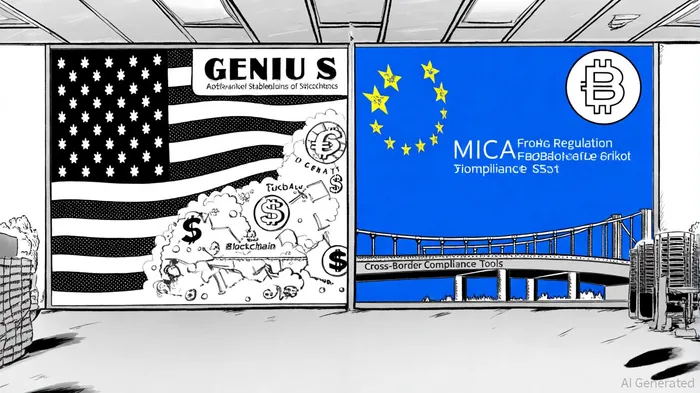
The transatlantic regulatory landscape for cryptocurrencies in 2025 is defined by a delicate balance of alignment and divergence. The U.S. GENIUS Act and the EU's Markets in Crypto-Assets Regulation (MiCA) have created two distinct but overlapping frameworks for stablecoins and digital assets. While both aim to ensure financial stability and consumer protection, their philosophical and structural differences—such as the U.S. prohibition of longer-maturity bonds in stablecoin reserves versus the EU's CBDC ambitions—pose strategic challenges for institutional investors and fintech innovators.
Regulatory Convergence and Divergence
The GENIUS Act, enacted in July 2025, mirrors MiCA's core principles by treating stablecoins as electronic money and requiring 1:1 reserve backing[1]. This alignment has reduced regulatory arbitrage, particularly for USD-backed stablecoins like USDCUSDC--, which now operate under clear compliance benchmarks[4]. However, the U.S. approach diverges in critical ways. For instance, the Act explicitly bans stablecoin reserves from including longer-term bonds, a restriction absent in MiCA[1]. Additionally, the U.S. prioritizes blockchain innovation over CBDCs, while the EU's digital euro initiative reflects a strategic push to counter the dollar's dominance[2].
These differences are compounded by jurisdictional requirements. The GENIUS Act mandates that foreign stablecoin issuers either partner with U.S. entities or establish domestic compliance structures[5], whereas MiCA's passporting system allows EU-licensed firms to operate across member states[6]. This creates a fragmented compliance environment, forcing global crypto firms to adopt jurisdiction-specific strategies.
Institutional Investment Strategies: Navigating Dual Frameworks
Institutional investors are recalibrating their portfolios to align with these regulatory shifts. In the U.S., the GENIUS Act has spurred a surge in stablecoin adoption by traditional banks. JPMorgan and Bank of America, for example, have launched tokenized securities programs and crypto custody services, leveraging the Act's clarity to mitigate reputational risks[4]. Similarly, the approval of BitcoinBTC-- and EthereumETH-- ETFs—amassing over $24 billion in assets under management—has normalized crypto as a mainstream asset class[3].
In the EU, MiCA's structured approach has attracted long-term institutional capital. Exchanges like Binance and Kraken have established EU subsidiaries to comply with MiCA's stringent licensing and transparency requirements[4]. The EU's emphasis on CBDCs also positions it as a hub for institutional-grade stablecoin strategies, particularly in cross-border payments and DeFi protocols[2].
Yet, investors face a strategic dilemma. The U.S. offers agility and innovation-friendly policies, while the EU provides regulatory stability. For example, U.S. banks are exploring tokenized real-world assets (RWAs) like real estate and commodities, with the RWA market projected to exceed $50 billion by year-end[3]. Conversely, EU institutions are prioritizing MiCA-compliant stablecoins for cross-border settlements, leveraging the bloc's harmonized framework[6].
Fintech Innovations: Bridging Compliance and Opportunity
Fintech firms are at the forefront of addressing these regulatory complexities. Compliance-by-design frameworks are now standard, with tools automating reserve tracking, audit preparation, and AML/KYC protocols to meet both GENIUS Act and MiCA requirements[5]. For instance, platforms like Circle's USDC have integrated real-time transparency dashboards to satisfy monthly reserve disclosures mandated by the GENIUS Act[4].
Cross-border compliance tools are also emerging. Fintechs are developing AI-driven solutions to simulate regulatory risks in real time, enabling firms to adapt to U.S. and EU requirements without redundant infrastructure[1]. Additionally, blockchain-based custody solutions are bridging the gap between traditional finance and crypto, with institutions like Franklin Templeton tokenizing government securities to enhance liquidity[3].
Strategic Implications and Future Outlook
The transatlantic regulatory divide will likely shape global fintech strategies for years. U.S. institutions may favor agile, market-driven innovations, while EU-focused investors could prioritize long-term stability. However, the dominance of USD-backed stablecoins in European markets—accounting for 90% of market capitalization—suggests that cooperation, if not full alignment, will remain a necessity[3].
For institutional investors, the key lies in diversifying exposure across both frameworks. Fintechs, meanwhile, must continue innovating to reduce compliance friction. As the U.S. and EU navigate their ideological differences—whether through mutual legal assistance treaties or competing CBDC strategies—the ability to adapt to dual regulatory realities will define success in the evolving crypto landscape[2].





Comentarios
Aún no hay comentarios