
Trade Data Delays and the Fog of Uncertainty: U.S. Government Shutdowns Ripple Through Canada's Economy and Investor Sentiment
Macroeconomic Revisions and the Fragility of Data-Driven Policymaking
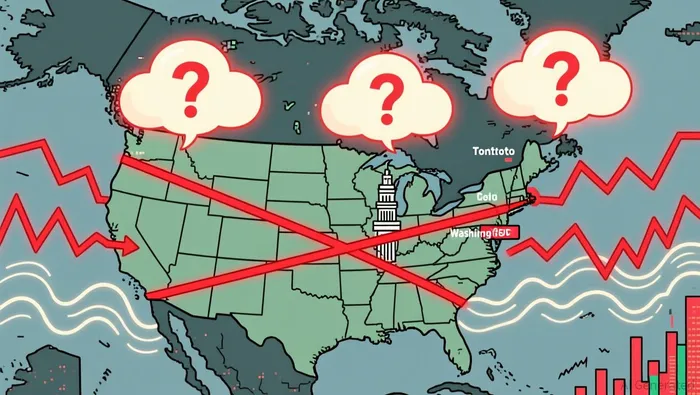 The U.S.-Canada data-sharing agreement is foundational to compiling accurate international trade statistics, particularly for Canada's exports to the U.S., which account for over 75% of its total exports. When the U.S. government shutdowns disrupt this pipeline, Statistics Canada is forced to rely on special estimates for key indicators, including quarterly GDP and the balance of international payments. These provisional figures, while necessary, introduce a risk of larger-than-normal revisions once actual data becomes available. For instance, the Bank of Canada's 2025 staff assessment noted that historical GDP revisions in 2024-driven by robust investment growth-raised potential output by 1.0%, but ongoing trade tensions now threaten to reverse this trend.
The second quarter of 2025 already illustrates the volatility: Canada's GDP contracted 0.4% amid a 7.5% plunge in export volumes, driven by tariffs and policy uncertainty. While domestic demand-particularly household consumption and residential investment-partially offset these declines, the reliance on U.S. trade data means that future GDP revisions could either amplify or mitigate these trends. For example, if actual export figures reveal a sharper contraction than estimated, the Bank of Canada may face renewed pressure to adjust monetary policy, further complicating an already fragile recovery.
Investor Sentiment and the Cost of Uncertainty
The delays in trade data have not only distorted macroeconomic signals but also eroded investor confidence. Over the past five years, U.S. trade policy uncertainties have been shown to exert statistically significant impacts on Canadian stock market returns and volatility, particularly during periods of economic stress. The 2025 trade tensions have exacerbated this dynamic, with Canadian share sales declining sharply as firms grapple with retaliatory measures and unpredictable tariffs.
Financial market participants are particularly vulnerable to this uncertainty. The Bank of Canada's 2025 Financial Stability Report highlights that U.S. trade policy unpredictability has led to sharp volatility in fixed-income markets, testing the resilience of arbitrage strategies and deepening liquidity constraints. For instance, the April 2025 drop in U.S. shipments to Canada-nearly 16%-triggered a wave of pre-tariff stockpiling in Q1 2025, creating artificial surges in trade data that distorted market signals. Such distortions not only complicate corporate planning but also amplify the risk of mispriced assets in Canadian financial markets.
A Path Forward: Mitigating the Fog
The current backlog of trade data and the reliance on special estimates underscore the fragility of Canada's economic data infrastructure. While domestic demand has shown resilience-RBC economists project 0.5% annualized growth in Q3 2025 as the economy steadies-these gains are contingent on the eventual release of accurate U.S. trade data. Policymakers must now navigate a dual challenge: managing the fallout from delayed data while preparing for potential revisions that could reshape economic narratives.
For investors, the lesson is clear: the interdependence of U.S. and Canadian economies means that disruptions in one jurisdiction can have outsized consequences for the other. As the fog of uncertainty lingers, a cautious approach to exposure in trade-sensitive sectors-such as manufacturing and automotive-may be prudent. Meanwhile, the need for more robust contingency planning in data collection and policy communication has never been greater.







Comentarios
Aún no hay comentarios