
Trade Conflict Resilience and Canadian Equities: How Sectoral Diversification Shields Against Geopolitical Risk
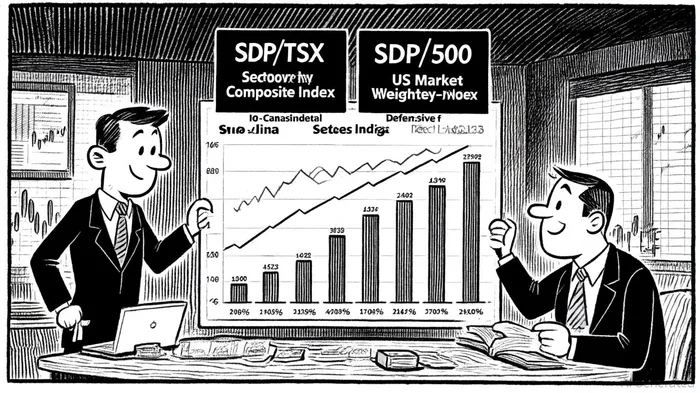
The Canadian equity market has emerged as a standout performer during the protracted trade conflicts between North American neighbors, offering investors a compelling case study in resilience. As U.S.-Canada tensions over tariffs on steel, aluminum, and lumber escalated between 2018 and 2025, the S&P/TSX Composite Index demonstrated a unique ability to weather volatility, driven by its defensive sectoral composition and strategic trade diversification. This analysis explores how Canadian equities have become a hedge against geopolitical risk, with sectoral diversification and monetary policy support playing pivotal roles.
Defensive Sectors as a Buffer
According to a report by Morningstar, over 50% of the S&P/TSX Composite Index's weight is concentrated in defensive sectors such as financials, pipelines, communications, consumer staples, and utilities [1]. These sectors, characterized by stable cash flows and low capital intensity, provided a counterbalance to the turbulence in global markets. For instance, during the third quarter of 2024, Canadian banks outperformed expectations, with earnings bolstered by easing trade tensions and reduced loan loss provisions [2]. This contrasts sharply with the U.S. market, where technology stocks—accounting for a significant portion of the S&P 500—experienced sharper corrections during trade war uncertainty [1].
The energy sector further reinforced this resilience. With nearly 20% of the TSX index tied to energy, companies like EnbridgeENB-- and SuncorSU-- benefited from surging commodity prices and infrastructure investments [3]. Gold mining, a subset of the basic materials sector, also delivered outsized returns as global instability drove demand for safe-haven assets. By 2025, gold prices had reached $3,000 per ounce, propelling miners like Barrick Gold and Goldcorp to record valuations [1].
Valuation Advantages and Monetary Policy Tailwinds
Canadian equities have traded at a persistent discount to their U.S. counterparts, offering an additional layer of protection. As of March 2025, the Morningstar Canada Index was valued at 15 times forward earnings, compared to 22 times for the S&P 500 [1]. This valuation gap, coupled with a weaker Canadian dollar, enhanced export profitability for multinational Canadian firms. The Bank of Canada's aggressive rate-cutting cycle since June 2024 further amplified this effect, redirecting capital from low-yielding bonds to equities [1].
Monetary policy support was critical in stabilizing sectors vulnerable to trade disruptions. For example, rate cuts in late 2024 cushioned the real estate market, which had been under pressure from U.S. tariffs on construction materials. This intervention helped maintain credit performance and investor confidence, even as manufacturing and transportation sectors in Ontario and Quebec faced export declines [3].
Trade Diversification: A Strategic Shield
Beyond sectoral composition, Canada's proactive trade diversification has mitigated the impact of U.S. tariffs. By 2024, Canadian exports to non-U.S. markets had grown by 50% since 2018, driven by energy, minerals, and commercial services [4]. Prime Minister Mark Carney's strategy of deepening ties with the European Union, the United Kingdom, and India has not only reduced dependency on the U.S. but also imposed retaliatory costs on American industries, particularly in tourism and steel [4].
This diversification has translated into corporate resilience. For example, the Trans Mountain pipeline expansion and high global energy prices enabled Canadian energy firms to access alternative markets, insulating them from U.S. tariff shocks [4]. Similarly, gold exports surged as demand from Asia-Pacific countries offset declines in U.S. demand.
Risks and Forward-Looking Considerations
While Canadian equities have shown remarkable resilience, risks remain. Prolonged trade conflicts could erode the benefits of CUSMA exemptions, which currently shield 88% of Canadian exports from U.S. tariffs [3]. Additionally, sectors like lumber and aluminum remain vulnerable to retaliatory measures. Investors must also contend with the Bank of Canada's evolving monetary policy, which could shift from stimulative to restrictive if inflationary pressures resurface.
For investors seeking to hedge against geopolitical risk, Canadian equities offer a compelling case. The combination of defensive sectoral exposure, valuation discounts, and strategic trade diversification has created a robust framework for navigating trade conflicts. However, as the global landscape evolves, maintaining a balanced portfolio with exposure to mid-cap domestic opportunities and nearshoring-aligned sectors will be critical [4].





Comentarios
Aún no hay comentarios