
TQQQ and the Alpha Potential in a Reaccelerating Tech Sector: A 2025 Investment Analysis
The reacceleration of tech-driven growth in 2025 has reignited interest in leveraged ETFs like ProShares UltraPro QQQ (TQQQ), a triple-leveraged vehicle designed to amplify returns from the Nasdaq-100 Index. As artificial intelligence (AI) and semiconductor innovation drive a new wave of demand, investors are scrutinizing whether TQQQ's aggressive structure can generate alpha while navigating the inherent risks of its 3x leverage.
Tech Sector Momentum: A Tailwind for TQQQ
The semiconductor industry is projected to generate $800 billion in revenue in 2025, a 17.6% year-over-year increase, fueled by surging demand for AI infrastructure and datacenter computing, Deloitte projects. Companies like NvidiaNVDA-- (NVDA) and TSMCTSM-- (TSM) are central to this growth, with NVDA's GPU revenue expected to rise 30-fold over six years and TSMC's advanced manufacturing capabilities enabling cutting-edge AI chips, according to a Morningstar analysis. Deloitte notes that global IT spending will grow by 9.3% in 2025, with AI-related investments expanding at a 29% compound annual growth rate (CAGR) through 2028. These trends position the Nasdaq-100-TQQQ's underlying index-well for sustained outperformance, particularly as it is weighted toward tech giants like Microsoft, Apple, and Amazon.
TQQQ's Leverage Mechanism: Amplifying Gains, Compounding Risks
TQQQ's 3x leverage aims to deliver three times the daily performance of the Nasdaq-100, achieved through a mix of equity holdings and derivatives, according to a Seeking Alpha primer. While this structure magnifies gains during bull markets-such as TQQQ's 198.05% total return in 2023, shown on the FinanceCharts performance page-it also exacerbates losses. In 2022, the fund plummeted 79.09% as the Nasdaq-100 declined 32.6% (FinanceCharts). The fund's volatility (68.5% over five years) far exceeds the S&P 500's 17.4%, and its Sharpe ratio of 0.06 lags behind the Nasdaq-100's 1.02, as highlighted in an AlphaAI analysis, underscoring its poor risk-adjusted returns.
Daily compounding further complicates TQQQ's performance. For example, a 1% daily gain in the Nasdaq-100 translates to a 3% gain for TQQQTQQQ--, but a subsequent 1% decline in the index would erase 3% of TQQQ's value, leaving it down 0.03% overall. This "volatility drag" makes TQQQ unsuitable for long-term holding, as noted by OptimizedPortfolio.com, which cautions that "leveraged ETFs are best suited for active traders who understand the risks."
Historical Performance: A Double-Edged Sword
Over the past decade, TQQQ has delivered a 36.52% average annual return, compared to the Nasdaq-100's 18.13% annualized return (FinanceCharts). A $10,000 investment in TQQQ from 2015 to 2025 would have grown to $233,337, versus $50,000 in the Nasdaq-100. However, this outperformance comes at a cost. During the 2022 downturn, TQQQ's 79% loss erased years of gains, illustrating the fund's susceptibility to market corrections.
Recent events, such as the April 2025 tariff crisis, further highlight TQQQ's sensitivity to macroeconomic shocks. A sharp selloff followed President Trump's tariff announcement, but the fund rebounded after the policy was paused, showcasing its potential for rapid recovery in trending markets (Deloitte).
Strategic Implications: Balancing Alpha and Risk
For investors seeking alpha in a reaccelerating tech sector, TQQQ offers compelling upside but demands disciplined risk management. Academic research suggests hedging TQQQ positions with inverse ETFs like SQQQ (which delivers –3x the Nasdaq-100's daily return) can improve risk-adjusted returns by 20–40% through signal-based strategies (AlphaAI). For instance, activating hedges during volatility spikes or momentum divergences could mitigate drawdowns while preserving gains.
However, TQQQ's structure inherently limits its utility for long-term strategies. As WallStreetMindset.com notes, "TQQQ's compounding effect works against investors in choppy markets, making it a tool for tactical trading rather than passive holding." This aligns with Deloitte's 2025 outlook, which emphasizes the need for "disciplined growth and innovation" in tech investing.
Conclusion: A High-Reward, High-Risk Proposition
TQQQ's potential to generate alpha in 2025 hinges on the tech sector's ability to sustain its growth trajectory. With AI and semiconductor demand surging, the Nasdaq-100 is well-positioned to outperform, and TQQQ's 3x leverage could amplify these gains. However, the fund's volatility, low Sharpe ratio, and compounding mechanics necessitate a short-term, active approach. For investors with the expertise to navigate these risks, TQQQ remains a powerful vehicle for capitalizing on the tech reacceleration-but one that demands caution and strategic hedging. 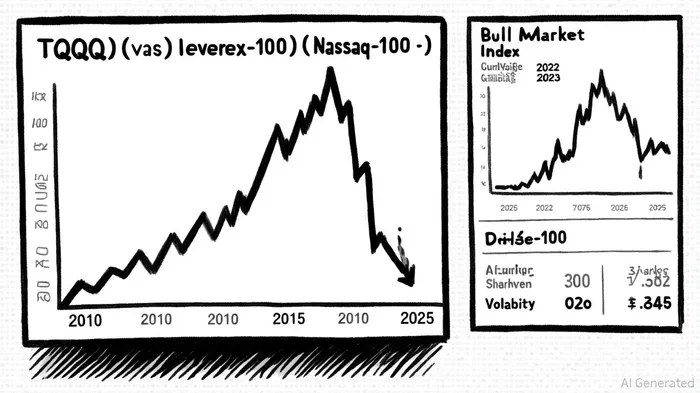





Comentarios
Aún no hay comentarios