
TPL's Path to $361–$440: Assessing the Catalysts and Risks Behind Gotham City Research's Bold Price Target
The stock of Texas Pacific Land CorporationTPL-- (TPL) has long been a study in duality: a high-margin royalty business with a debt-free balance sheet, yet one that dances precariously on the edge of energy sector volatility. With a current share price of $931.28 and a 52-week high of $1,769.14, the stock has seen a 30% pullback in three months. But the question now is whether Gotham City Research's $361–$440 price target—a range 50% below current levels—is a realistic guide for investors or a misread of the company's fundamentals.
Strategic Capital Allocation: A Double-Edged Sword
TPL's strength lies in its ability to allocate capital strategically across its two core segments: oil and gas royalties and water services. Over the past year, the company has spent $500 million acquiring 50,000 acres of surface rights in the Permian Basin, a move that has boosted production to 31,100 barrels of oil equivalent per day—a 25% year-over-year increase. These acquisitions are not just land grabs; they're calculated plays to secure long-term royalty income, with projected cash flow yields of 10% at $70 oil.
However, the same capital discipline that has driven growth could become a liability if commodity prices falter. TPL's royalty income is directly tied to oil and gas prices, which have already shown signs of strain. In Q1 2025, oil prices fell 8% year-over-year, while natural gas prices plummeted 65%. A prolonged downturn could erode the value of these acquisitions, turning once-profitable assets into drag-on-earnings.
Market Sentiment: The Fear Factor
The Fear & Greed Index for TPLTPL-- currently reads 39—a clear signal of investor anxiety. This fear is not unfounded. The company's P/E ratio of 46.5x and P/S ratio of 29.4x suggest it's priced for perfection. If TPL fails to deliver on its 8.5% annual earnings growth forecast, the market could punish it harshly.
Yet, market sentiment can be a fickle beast. TPL's recent removal from the Russell 2500 Growth Index has rattled nerves, but its institutional ownership base—19.4 million shares held by heavyweights like BlackRockBLK-- and Vanguard—provides a floor. These institutions are betting on TPL's ability to navigate the Permian Basin's challenges, including regulatory headwinds and decarbonization pressures.
The Water Angle: A Hidden Catalyst
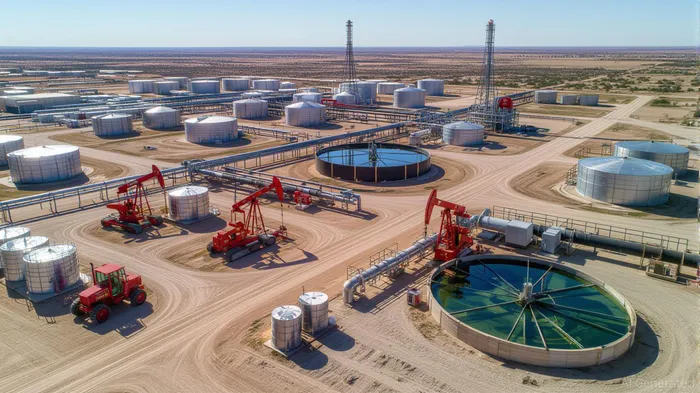
While oil and gas royalties dominate the headlines, TPL's water services segment is quietly becoming a growth engine. The company generated $69 million in water-related revenue in Q1 2025, with produced water royalties up 46% year-over-year. This is no small detail. As operators in the Permian Basin grapple with water management, TPL's desalination projects—like its 10,000-barrel-per-day test facility—position it to capitalize on a $100 million revenue stream by 2025.
Risks That Can't Be Ignored
- Commodity Volatility: A 10% drop in oil prices could slash TPL's royalty income by $150 million annually.
- Regulatory Overhang: Environmental policies targeting fossil fuels could curtail drilling activity in the Permian Basin, directly impacting TPL's earnings.
- Valuation Pressure: At $931, TPL trades at a 40% premium to its five-year average. If growth slows, the stock could face a 30–40% correction.
Is $440 a Realistic Target?
Gotham City Research's $361–$440 price target assumes a perfect storm: a 50% drop in oil prices, a 30% decline in water demand, and a 20% earnings contraction. While this is a plausible worst-case scenario, it ignores TPL's structural advantages. The company's debt-free balance sheet, $460 million in net cash, and 63.24% net profit margin provide a buffer against short-term shocks.
Moreover, TPL's dividend yield of 0.7% and 28% payout ratio suggest management is prioritizing shareholder returns. A $1.60 quarterly dividend, while modest, offers a touchstone of stability in a volatile market.
The Verdict: Positioning for the Long Game
For sophisticated investors, TPL is a high-conviction play that demands a nuanced approach. The stock's 397% five-year gain reflects its ability to outperform in a bull market, but the recent 30% correction signals that the easy money has been made.
Entry Points: Consider buying dips to $800–$850, where the P/E ratio normalizes to 35x.
Long-Term Positioning: Hold for 3–5 years, betting on the Permian Basin's resilience and TPL's water innovation.
Stop-Loss: Set at $700 to limit downside in a commodity crash.
In the end, Gotham City Research's target may be a floor, not a ceiling. TPL's true potential lies in its ability to adapt—whether through desalination, surface lease renewals, or strategic buybacks. The path to $440 is fraught, but for those who believe in the Permian's longevity, the reward could justify the risk.





Comentarios
Aún no hay comentarios