
Toyota's Strategic Shift in U.S. Lexus Production: Operational Efficiency and Long-Term Profitability in the EV Transition Era
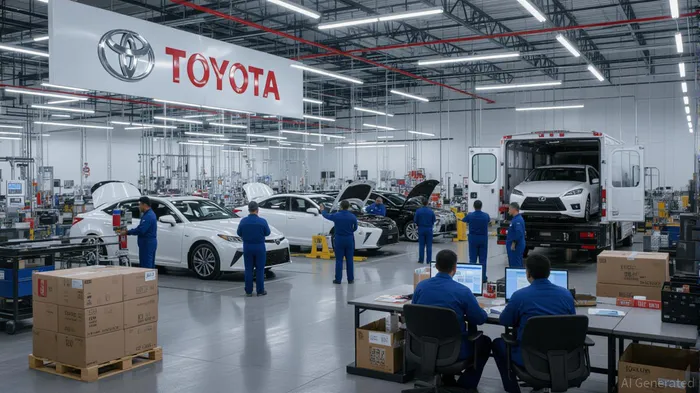
Toyota's recent restructuring of its U.S. Lexus production strategy underscores a pivotal shift in its approach to operational efficiency and long-term profitability amid the global transition to electric vehicles (EVs). By consolidating production from two U.S. plants into one and reorienting its manufacturing footprint to counter U.S. tariffs, the automaker is positioning itself to navigate both immediate cost pressures and the broader electrification race. This move, however, comes with significant financial risks and strategic trade-offs that investors must scrutinize.
Production Consolidation: A Response to Tariffs and Cost Pressures
Toyota has announced plans to centralize U.S. Lexus production in a single plant, shifting away from its previous two-plant model in Kentucky and Indiana. The Kentucky facility, which produced the Lexus ES sedan, will cease Lexus production, while the Indiana plant will focus on the Grand Highlander SUV. This consolidation is a direct response to the Trump administration's 15–25% tariffs on Japanese imports, which ToyotaTM-- estimates will cost the company $9.5 billion in fiscal 2025[1]. By reducing operational complexity and streamlining logistics, Toyota aims to mitigate these costs while maintaining flexibility to meet U.S. demand for hybrid and EV models[2].
The company is also shifting some high-end Lexus production back to Japan, a move that aligns with its broader strategy to leverage lower labor costs and advanced automation in its domestic facilities. This shift, however, risks alienating U.S. consumers who associate local production with quality and job creation. According to a report by Nikkei, the decision reflects Toyota's prioritization of cost efficiency over symbolic “Made in America” branding[3].
EV Transition: Ambitious Targets, but Execution Challenges Loom
Toyota's EV strategy is equally ambitious. The company plans to triple EV production to 600,000 units by 2025 and launch electrified versions of every Toyota and Lexus model globally by that year[4]. A new three-row electric SUV will be produced exclusively at the Georgetown, Kentucky plant, while the Indiana facility will focus on hybrid models. These efforts are supported by a $32 billion investment by 2030, targeting 3.5 million annual EV sales[5].
However, Toyota's EV ambitions face hurdles. The company's historical reliance on hybrid technology has left it playing catch-up to EV-first competitors like TeslaTSLA-- and BYD. While Toyota is developing solid-state batteries for 2027–2028 models, which promise 50% more range than current lithium-ion technology[6], its EV market share in the U.S. remains modest. In Q3 2025, EVs accounted for 44.4% of Toyota's retail sales, up from 35.3% in the same period the previous year[7], but this pales in comparison to Tesla's dominance.
Financial Impacts: Tariffs, Efficiency Gains, and Profit Margins
Toyota's Q3 2025 financial results reveal a mixed picture. Operating profits fell 37% year-on-year to ¥841 billion ($5.7 billion), with tariffs alone reducing operating income by ¥450 billion ($3 billion) in the quarter[8]. The company slashed its full-year operating profit forecast by 16% to ¥3.2 trillion ($21.7 billion), citing currency fluctuations and rising raw material costs[9].
Despite these headwinds, Toyota has made strides in improving operational efficiency. A “Lean 4.0” strategy, integrating AI-driven analytics and predictive maintenance, has reduced unplanned downtime by 47% and maintenance costs by 32%[10]. Additionally, the company's Radius Recycling acquisition and circular economy initiatives are expected to yield long-term cost savings through resource efficiency[11]. These measures have helped Toyota maintain a net profit margin of 11.3% in FY2024, outperforming industry averages[12].
Long-Term Profitability: Balancing Risks and Opportunities
Toyota's strategic shifts highlight a delicate balancing act. While production consolidation and EV investments aim to future-proof the company, they also expose it to short-term volatility. The U.S. market, which accounts for 30% of Toyota's global sales[13], is particularly vulnerable to policy changes and supply chain disruptions. For instance, the Indiana plant's focus on the Grand Highlander—a popular hybrid SUV—could offset some tariff-related losses, but it also limits the plant's ability to pivot toward EVs quickly.
Moreover, Toyota's reliance on Japan for high-end Lexus production may strain its global brand positioning. A recent PESTLE analysis notes that geopolitical tensions and U.S. protectionism could further erode consumer trust in Japanese imports[14]. Conversely, the company's investments in solid-state batteries and modular EV platforms could provide a technological edge in the 2030s, assuming its R&D timelines hold.
Conclusion: A Strategic Pivot with Uncertain Returns
Toyota's U.S. Lexus production consolidation and EV transition represent a bold but risky recalibration. While the company's cost-cutting measures and digital transformation have bolstered short-term efficiency, its long-term profitability hinges on the success of its EV strategy and ability to navigate geopolitical headwinds. For investors, the key question is whether Toyota can replicate its hybrid-era dominance in the EV space—a challenge that will require not only technological innovation but also a cultural shift toward agility in a market dominated by disruptors.





Comentarios
Aún no hay comentarios