
Toyota's Strategic Diversification: Bridging Drones, Off-Road Vehicles, and Next-Gen Mobility
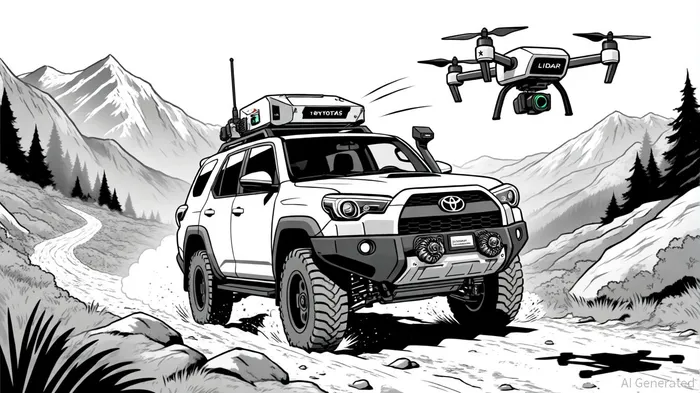
In the rapidly evolving landscape of mobility, Toyota's strategic investments are increasingly focused on redefining the boundaries between terrestrial and aerial technologies. While the automaker has not yet officially launched small drone systems for off-road vehicles, its recent forays into drone technology, autonomous systems, and electrification signal a broader vision for integrated mobility solutions. For investors, this trajectory underscores Toyota's potential to capture emerging markets in electric vehicles (EVs), autonomous driving, and drone-assisted logistics-sectors poised for exponential growth in the coming decade.
Strategic Diversification: From Prodrone to Off-Road Synergies
Toyota's partnership with Japan-based Prodrone, reported by a Flying Cars Market article, exemplifies its commitment to drone technology. These cargo-carrying drones, capable of transporting 50 kg over 50 km, are powered by lithium-ion capacitors from ToyotaTM-- subsidiary JTEKT, as described in a Toyota newsroom article. Initially deployed for emergency supply deliveries in remote areas like Nagano Prefecture, the technology's adaptability hints at potential off-road applications. For instance, such drones could scout terrain ahead of Toyota's rugged vehicles-like the 4Runner, Tundra TRD Pro, or the futuristic Space Mobility prototype-to map obstacles, assess trail conditions, or even deliver spare parts in remote environments. This synergy between ground and aerial platforms aligns with its CASE strategy, which envisions a mobility ecosystem where vehicles and drones operate as interconnected nodes.
Innovation Pipeline: Patents and R&D as Competitive Advantages
Toyota's R&D investments further reinforce its position as a mobility innovator. In 2024, the company secured 2,428 U.S. patents-the most among automakers for 11 consecutive years, according to a Toyota press release. These include advancements in autonomous decision-making systems, vehicle-to-grid (V2G) technologies, and LiDAR-reflective materials, as noted in a PatentPC analysis. Notably, a Reuters report highlights Toyota's exploration of a small drone system specifically for off-road vehicle operations, suggesting that the company is actively bridging its drone expertise with its legacy in off-road engineering. This aligns with its 2025 product roadmap, which includes hybrid powertrains like the i-FORCE MAX and advanced 4x4 systems designed for extreme terrains (see Toyota off-road vehicles at Toyota's site for current model details: https://www.toyota.com/off-road-vehicles/?msockid=0ea50d3769da6210294a1b49689063b2).
Autonomous Ecosystems: Waymo Collaboration and Beyond
Toyota's collaboration with Waymo, announced in a Waymo blog post, to develop autonomous driving technology adds another layer to its mobility strategy. By integrating Waymo's self-driving software into future vehicles, Toyota aims to create a seamless transition from human-driven to autonomous off-road capabilities. This partnership also extends to the development of personally owned autonomous vehicles (POAVs), reflecting a shift toward consumer-centric mobility solutions, as discussed in SimplyMac coverage. For off-road applications, such technology could enable vehicles to autonomously navigate trails while leveraging drone-based reconnaissance to optimize routes-a concept already tested in its Sienna Autono-MaaS program.
Investment Implications: Positioning for Long-Term Growth
Toyota's approach to diversification is not merely defensive but forward-looking. By investing in drone technology, autonomous systems, and electrification, the company is positioning itself to capitalize on three key trends:
1. EV and Hybrid Dominance: With its i-FORCE MAX hybrid and next-gen battery EVs targeting a 1,000 km range by 2026 (see Toyota newsroom article referenced above), Toyota is addressing both on-road and off-road electrification demands.
2. Autonomous Mobility-as-a-Service (MaaS): The Sienna Autono-MaaS platform and Waymo collaboration highlight Toyota's intent to enter the robotaxi and on-demand mobility markets.
3. Drone-Integrated Logistics: Prodrone's success in emergency supply chains demonstrates a scalable model that could expand into adventure tourism, mining, or disaster response sectors-markets where Toyota's off-road vehicles already hold strong brand equity.
Conclusion: A Mobility Company, Not Just an Automaker
Toyota's investments in drone technology and autonomous systems reflect its transformation from a traditional automaker to a comprehensive mobility company. While small drone systems for off-road vehicles remain in the exploratory phase, the company's innovation trajectory-backed by patents, partnerships, and real-world deployments-positions it to lead in integrated mobility solutions. For investors, this strategic diversification offers exposure to high-growth sectors while leveraging Toyota's established strengths in reliability, engineering, and global distribution. As the lines between ground and aerial mobility blur, Toyota's ecosystem-driven approach may well define the next frontier of transportation.







Comentarios
Aún no hay comentarios