
Toyota's Sales Decline: A Warning Signal for Global Automakers Amid Policy and Geopolitical Shifts?
The automotive industry is at a crossroads, with Toyota's recent performance offering a stark case study of the strategic risks confronting global automakers. While the Japanese automaker reported a 16.4% year-over-year increase in vehicle sales for its ToyotaTM-- division in Q3 2025-driven by strong demand for electrified vehicles-its operating profit plummeted by nearly 28% during the same period. This divergence between sales growth and profitability underscores the growing tension between market expansion and the financial toll of navigating a rapidly shifting landscape shaped by policy mandates, geopolitical tensions, and technological disruption. For investors, Toyota's experience raises a critical question: Is this a harbinger of broader challenges for the sector?
The Cost of Electrification and Regulatory Compliance
Toyota's Q3 results highlight the dual-edged nature of electrification. Electrified vehicles accounted for 44.9% of its total sales, a 10.5% year-over-year increase. However, this transition comes at a steep cost. The company's operating profit decline was attributed to surging R&D expenses and labor costs. These challenges mirror industry-wide pressures as automakers race to meet stringent emissions targets. For instance, the EU's mandate for 100% zero-emission vehicle sales by 2035 has forced companies to accelerate platform development and scale battery production, often at the expense of short-term margins.
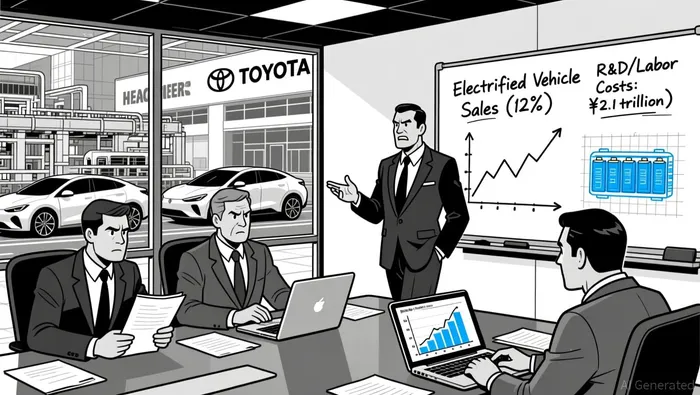
The financial strain is compounded by regional regulatory divergence. While China and Europe offer subsidies and infrastructure incentives for EVs, the U.S. Inflation Reduction Act (IRA) has created a fragmented playing field, favoring domestic production over global efficiency. Toyota's 63% drop in North American operating income during the first nine months of FY2025-largely due to U.S. tariffs-exemplifies how protectionist policies can erode profitability even as sales volumes rise.
Geopolitical Realignment and Supply Chain Fragility
Geopolitical tensions further exacerbate these risks. The U.S.-China trade conflict has fractured global supply chains, pushing automakers to adopt dual sourcing strategies that inflate costs. Toyota's reliance on Japanese production has left it vulnerable to localized disruptions, such as the recent factory halts in its home market. Meanwhile, the Russia-Ukraine conflict has accelerated a shift toward "resilience-driven" supply chains in Europe, prioritizing diversification over cost efficiency.
The Middle East, meanwhile, is emerging as a new battleground. Countries like the UAE and Saudi Arabia are offering EV adoption targets and localization incentives to attract foreign automakers. This regional pivot mirrors broader trends in the industry, where companies must now balance global scale with localized production to comply with trade policies and reduce exposure to geopolitical volatility.
Intensifying Competition and Strategic Reckonings
Toyota's struggles also reflect the intensifying competition from Chinese automakers. Companies like BYD, Chery, and Geely are leveraging cost-effective supply chains and aggressive expansion strategies to capture market share in Europe and beyond. This pressure is forcing traditional OEMs to rethink their strategies, as seen in proposed mergers between Honda and Nissan and Volkswagen's reallocation of production resources. For Toyota, which has historically relied on hybrid technology rather than pure EVs, the rise of Chinese competitors threatens to erode its long-standing reputation for innovation and efficiency.
Strategic Responses and Investor Implications
The path forward for automakers hinges on their ability to adapt to these converging risks. Toyota's revised full-year profit forecast-upwardly adjusted to 3.4 trillion yen-suggests confidence in its product lineup and market recovery. However, this optimism must be tempered by the reality that strategic agility, not just sales volume, will determine long-term success. Key priorities for the industry include:
- Modular Software Architectures: To manage the software-defined nature of modern vehicles and reduce reliance on legacy systems according to industry analysis.
- Localized Production Hubs: To comply with regional trade policies and mitigate supply chain risks according to market reports.
- Supply Chain Diversification: To avoid overexposure to any single geopolitical bloc according to expert commentary.
For investors, Toyota's experience serves as a cautionary tale. While the company's sales growth demonstrates resilience, its profit decline underscores the financial toll of navigating a fragmented regulatory environment and geopolitical uncertainty. Automakers that fail to align their strategies with these realities-whether through inadequate R&D investment, rigid supply chains, or slow adoption of electrification-risk falling behind in a sector where adaptability is now a survival imperative.







Comentarios
Aún no hay comentarios