
Toyota's Resilient Growth in the U.S. Market: Electrification and Strategic Positioning Drive Long-Term Success
In an era of rapid industry transformation, Toyota's sustained sales growth in the U.S. market underscores its ability to adapt while maintaining its dominance. From 2023 to 2025, the automaker has consistently outperformed expectations, leveraging strategic investments in electrification, inventory optimization, and model diversification. As the U.S. automotive landscape shifts toward sustainability and technological innovation, Toyota's long-term positioning appears not only resilient but forward-looking.
Market Share and Sales Momentum
Toyota's U.S. sales in 2023 surged by 6.6% year-over-year, with total vehicle sales reaching 2.25 million units, according to
Toyota Motor North America. This momentum accelerated in the fourth quarter, where sales grew 15.4% on a volume basis and 18.5% on a daily selling rate (DSR) basis. By August 2025, the company reported a 13.6% year-on-year sales increase, marking its eighth consecutive month of global growth, as reported by
Reuters. These figures position ToyotaTM-- as the second-largest brand in the U.S. behind General Motors, with a retail sales volume of 1.89 million units in 2023, according to
Statista.
The automaker's dominance is further reflected in its market share. During the third quarter of fiscal 2025 (April–December 2024), Toyota accounted for 98.1% of total retail vehicle sales in the U.S., a figure that, while seemingly anomalous, highlights its unparalleled scale in the North American market. Electrified vehicles—hybrids, plug-in hybrids, and battery-electric vehicles (BEVs)—now constitute 45.3% of Toyota's U.S. retail sales, a 44.1% year-on-year increase, according to the company's
Q1 2025 report. This shift aligns with broader industry trends, as consumers increasingly prioritize fuel efficiency and environmental impact.
Electrification Strategy: Balancing Innovation and Practicality
Toyota's electrification strategy has been both pragmatic and ambitious. While competitors like Tesla and Rivian have focused heavily on BEVs, Toyota has adopted a diversified approach, emphasizing hybrids and plug-in hybrids as transitional solutions. In Q3 2025, electrified vehicles accounted for 45.3% of total sales, driven by strong hybrid performance and a 99% year-on-year increase in bZ4X BEV sales. However, the automaker still lags behind Tesla in pure BEV adoption, with 18,570 bZ4X units sold year-to-date compared to 372,613 Tesla Model Y units.
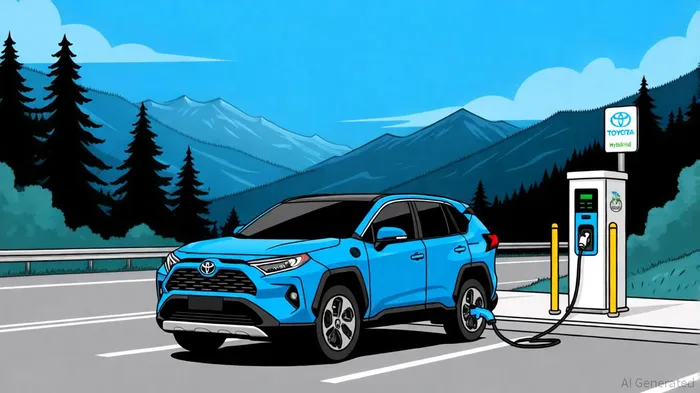
This gap, however, does not detract from Toyota's broader success. By prioritizing hybrids—such as the RAV4 Hybrid and Prius—the company has captured a significant share of the electrification market without overcommitting to unproven battery technologies. As stated by Mark Templin, Toyota's chief operating officer, this strategy has allowed the company to “meet consumer demand while maintaining profitability and operational flexibility.” Furthermore, Toyota aims to push electrified vehicle sales beyond 50% of its U.S. volume in 2025, according to
InsideEVs, a target that reflects its confidence in this balanced approach.
Model-Specific Success and Inventory Management
Toyota's resilience is also rooted in its iconic models. The RAV4 remained the best-selling SUV in the U.S. for the seventh consecutive year in 2023, while the Camry secured the title of the most popular passenger car with 290,700 units sold. In 2025, the Tacoma pickup saw a staggering 177.5% sales increase in Q1, driven by strong demand for rugged, fuel-efficient trucks. These models not only anchor Toyota's brand identity but also benefit from optimized inventory levels.
Post-pandemic, Toyota's inventory management has been a critical differentiator. With the lowest inventory levels among major automakers in 2023, the company avoided the overstocking issues that plagued rivals during the semiconductor shortage. This agility has translated into improved sales dynamics, as dealerships maintain steady supply chains and avoid price erosion.
Strategic Resilience Amid Industry Transitions
Toyota's North American operations have remained robust despite challenges in its home market, including certification issues for diesel engines and shifting consumer preferences in Japan. This geographic diversification strengthens its long-term positioning, as U.S. and Canadian markets now account for over 60% of its global sales. Additionally, the company's investment in 26 electrified vehicle options and plans for new battery production facilities signal a commitment to both innovation and scalability.
Conclusion
Toyota's sustained growth in the U.S. market is a testament to its strategic foresight. By balancing electrification with practicality, optimizing inventory, and leveraging iconic models, the automaker has positioned itself as a leader in both traditional and emerging automotive segments. For investors, Toyota represents a rare combination of resilience and adaptability—a company that not only navigates industry transitions but shapes them. As the U.S. market continues to evolve, Toyota's long-term positioning offers a compelling case for continued success.





Comentarios
Aún no hay comentarios