
Toyota's Q2 Revenue Growth and Revised Fiscal 2026 Outlook: Strategic Resilience in a Shifting Automotive Landscape
Q2 2025: Strong Revenue Amid Structural Challenges
Toyota's Q2 2025 results revealed a mixed but resilient performance. , , , according to the earnings call transcript. , reflecting strong demand for hybrid electric vehicles (HEVs) in North America and China. This growth is a testament to Toyota's long-term bet on hybrid technology, which continues to outperform expectations in markets where battery-electric vehicles (BEVs) face infrastructure or regulatory hurdles.
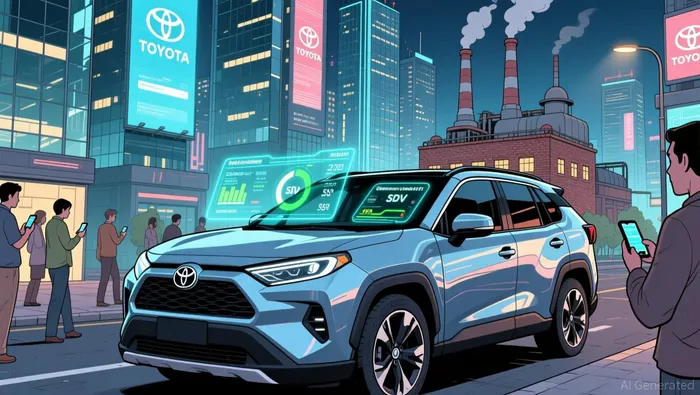
The company also unveiled a Software-Defined Vehicle (SDV) strategy, with the RAV4 as its flagship model. This initiative aims to enhance vehicle functionality through over-the-air updates, aligning with industry trends toward connected and autonomous mobility; the earnings call transcript emphasized that cost-cutting measures and value chain streamlining would further bolster margins, even as U.S. tariffs on Japanese auto parts remain a drag on profitability.
Revised Fiscal 2026 Outlook: A Cautionary Optimism
. , it highlights the company's ability to adapt to external pressures. The upward revision was fueled by improved vehicle sales, particularly in emerging markets, and aggressive cost-reduction initiatives.
However, the path to this forecast is not without risks. U.S. tariffs on Japanese imports, , continue to weigh on margins. Toyota's response has been twofold: expanding production in North America to circumvent tariffs and accelerating automation to reduce labor costs. These measures, while effective in the short term, raise questions about long-term sustainability in a sector increasingly defined by rapid technological shifts.
Strategic Resilience: Electrification and Hydrogen Ambitions
Toyota's dual-track approach to electrification-focusing on hybrids and hydrogen-has been both a strength and a source of controversy. While HEVs dominate its current sales, the company is also investing heavily in hydrogen fuel cell technology. At the 2025 , ToyotaTM-- showcased the Tacoma H2-Overlander Concept, a hydrogen-powered off-road vehicle designed for zero-emission overlanding adventures, highlighting its new . This move signals a strategic pivot toward niche markets where hydrogen's advantages, such as long-range capability and quick refueling, are most pronounced.
Yet, Toyota's hydrogen ambitions face significant headwinds. . District Court for the Central District of California alleges that the company concealed safety defects in its Mirai hydrogen fuel cell sedan and colluded with its hydrogen partner, FirstElement Fuel (True Zero), to mislead consumers, according to a . The lawsuit claims that hydrogen refueling infrastructure is unreliable, leaving Mirai owners stranded and undermining trust in the technology. These legal and infrastructural challenges could delay Toyota's hydrogen roadmap and divert resources from other strategic priorities, despite Toyota's continued commitment to hydrogen.
Conclusion: Balancing Innovation and Pragmatism
Toyota's Q2 2025 results and revised fiscal outlook illustrate a company that is both pragmatic and forward-looking. Its ability to maintain profitability amid tariffs and supply chain disruptions speaks to its operational rigor, while its investments in electrification and hydrogen reflect a willingness to embrace long-term risks. However, the Mirai lawsuit and hydrogen infrastructure gaps highlight the fragility of its dual-track strategy. For investors, the key question is whether Toyota can sustain its innovation momentum while addressing these vulnerabilities.
As the automotive industry pivots toward electrification and digitalization, Toyota's success will depend on its ability to balance short-term pragmatism with bold, long-term bets. The company's recent moves-whether the SDV strategy or the Tacoma H2 concept-suggest it is prepared to adapt. Yet, in a sector defined by rapid disruption, even the most resilient strategies require continuous refinement.





Comentarios
Aún no hay comentarios