
Toyota's Mobility Services: Pioneering Vehicle Lifecycle Management to Sustain Shareholder Value
Toyota's Mobility Services: Pioneering Vehicle Lifecycle Management to Sustain Shareholder Value
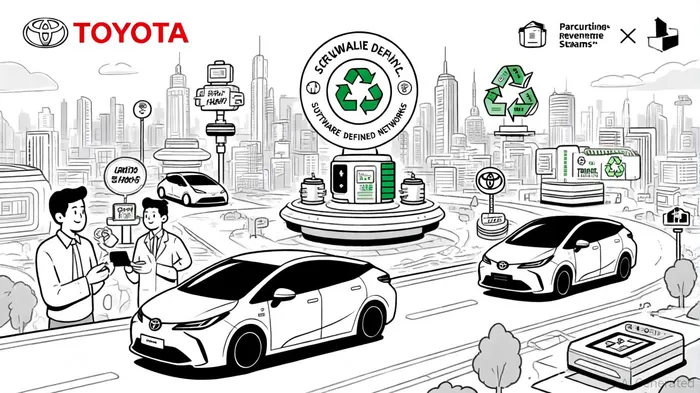
Toyota's transformation from a traditional automaker to a "mobility company" has positioned it at the forefront of the automotive industry's evolution. Central to this shift is its mobility services segment, which integrates vehicle lifecycle management strategies to sustain long-term shareholder value. By leveraging electrification, software-defined vehicles, and a robust battery ecosystem, ToyotaTM-- is not only addressing environmental challenges but also redefining profitability through recurring revenue models. This analysis explores how these strategies align with key financial metrics such as Return on Equity (ROE), dividend stability, and earnings resilience.
Financial Performance and Strategic Shifts in FY2025
Toyota's FY2025 third-quarter results revealed a mixed landscape. While operating income declined by 13.2% year-on-year to 3.68 trillion yen for the nine months ending December 2024, driven by certification issues and one-time expenses, the company maintained a strong income level through production efficiency and demand for electrified vehicles, according to the Q3 financial summary. Electrified vehicle sales in North America surged by 10.5% in Q3 2025, accounting for 44.9% of total sales volume, as reported in Toyota's third-quarter U.S. sales results. This growth underscores the success of Toyota's multi-pathway electrification strategy, which includes hybrids, plug-in hybrids, battery electric vehicles (BEVs), and hydrogen fuel cell vehicles.
Despite challenges, Toyota's commitment to shareholder returns remains unwavering. The company increased annual cash dividends to 90 yen per share in FY2025, with a payout ratio of 25%, as detailed in the FY2025 financial summary. This stability is critical for investors, as it reflects Toyota's ability to balance reinvestment in innovation with rewarding shareholders.
Historical backtesting of Toyota's earnings releases from 2022 to 2025 reveals limited alpha generation for a simple buy-and-hold strategy. Over 110 trading-day observations across five earnings events, average returns in the 0–10 trading-day window ranged from –0.07% to –0.16%, with win rates near 50%-indicating no clear directional bias. While cumulative returns showed a mild positive tilt of ~+0.50% at 16–17 days, this faded by Day 30, underperforming the benchmark by ~20 basis points. These findings suggest that earnings releases alone may not provide a reliable edge for short-term strategies, though longer-term investors may still benefit from Toyota's structural shifts.
Vehicle Lifecycle Management: A Catalyst for Value Creation
Toyota's vehicle lifecycle management strategies are pivotal to its long-term value proposition. By extending the utility of vehicles beyond initial sales, the company is creating recurring revenue streams and reducing environmental impact.
Electrification and Battery Ecosystems
Toyota's focus on electrification is not limited to vehicle production. The company is building a closed-loop battery ecosystem that spans material procurement, collection, and reuse. This approach not only reduces costs but also aligns with global sustainability goals. For instance, Toyota's first overseas battery plant in North Carolina, set to ship in April 2025, underscores its commitment to regionalizing supply chains and lowering production costs as part of its broader BEV and battery plans for the U.S. and China.Software-Defined Vehicles and AI Integration
Toyota is investing $1 billion in Toyota Connected to develop AI-driven and cloud-connected platforms, aiming to roll out its global software platform, Arene, across 50% of new models, according to the Toyota USA product strategy guide. These software-defined vehicles enable over-the-air updates and expanded service offerings, transforming cars into platforms for continuous revenue generation.Hydrogen and Vehicle-to-Grid (V2G) Innovations
Beyond BEVs, Toyota is advancing hydrogen mobility, particularly in commercial vehicles, and exploring V2G technology to integrate vehicles into energy grids, as explained in the Toyotatimes piece titled Why ROE matters. These initiatives position Toyota to capitalize on emerging markets while enhancing the residual value of its vehicles.
Shareholder Value Metrics: ROE and Strategic Resilience
Toyota's ambition to achieve a 20% ROE by 2025 is a clear indicator of its focus on profitability and efficiency, as outlined in Reforming Our Company. This target, significantly higher than industry averages, reflects a strategic pivot from transactional sales to recurring revenue models. For example, mobility services such as car-sharing, subscription models, and data monetization are expected to contribute to earnings stability.
President Koji Sato emphasized that ROE is not merely a financial metric but a "yardstick for the mobility transformation," a point underscored in a multi-pathway mobility analysis. By prioritizing operational excellence through the Toyota Production System (TPS) and expanding into smart city projects, the company is diversifying its value chain profits. Additionally, Toyota's emphasis on human resource development-viewing employees as a source of innovation rather than a cost-further strengthens its competitive edge, as noted in TechCrunch Mobility.
Conclusion: A Blueprint for Sustainable Growth
Toyota's mobility services segment exemplifies how vehicle lifecycle management can drive shareholder value. By integrating electrification, software innovation, and circular economy principles, the company is addressing both market demands and environmental imperatives. While FY2025 financials show short-term headwinds, the strategic investments in mobility ecosystems and recurring revenue models position Toyota to achieve its ROE targets and sustain dividend growth. For investors, this represents a compelling case of long-term value creation in an industry undergoing rapid transformation.





Comentarios
Aún no hay comentarios