
The Toronto Housing Market Correction: A Cautionary Tale for Investors in 2025
The Toronto housing market in 2025 has entered a phase of correction that demands a recalibration of investment strategies. Once a beacon of resilience amid Canada's real estate landscape, the Greater Toronto Area (GTA) now faces a confluence of macroeconomic headwinds, policy interventions, and shifting demographic dynamics. For long-term residential real estate investors, the current environment underscores the need for a nuanced understanding of risk.
A Market in Retreat: Price Trends and Inventory Dynamics
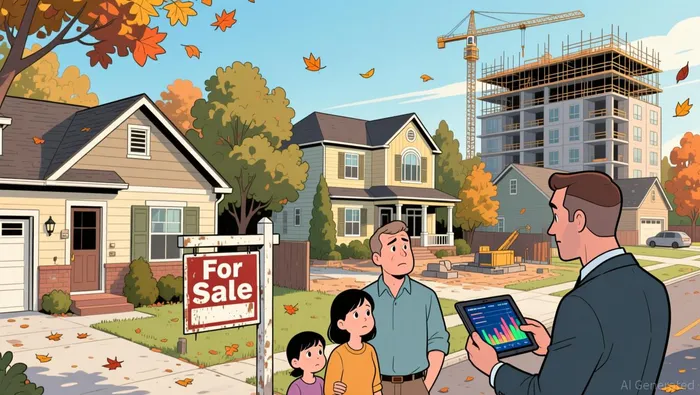 The GTA's housing market has experienced a sharp correction in 2025, marked by declining prices and elevated inventory levels. According to a report by TREB, the benchmark home price in the GTA fell to $942,300 in December 2025, reflecting a 6.3% year-over-year (YoY) decline and a 1.0% month-over-month (MoM) drop. Detached homes, a historically resilient segment, saw a 6.9% YoY price decline to $1.30 million, while semi-detached properties plummeted by 12.1% YoY to $957,000. Condo apartments, already under pressure from oversupply, dropped 7.9% YoY to $628,000.
The Home Price Index (HPI) for the GTA, which peaked at $1.376 million in March 2022, had fallen to $1 million by April 2025-a 26.6% correction over three years. This decline has been accompanied by a 4.6-month supply of housing, signaling a balanced market where neither buyers nor sellers hold significant leverage.
Macroeconomic Headwinds: Interest Rates and Economic Uncertainty
The Bank of Canada's policy rate, which had reached a peak of 5.25% in 2023, was reduced to 2.25% by the end of 2025, offering some relief to borrowers. However, as noted by , this reduction has not reversed the downward trend in home prices, with the average selling price in the GTA falling 5.1% YoY. The lingering effects of high borrowing costs-combined with economic uncertainty from the U.S.-Canada trade war-have dampened buyer confidence. Trade-related disruptions have reduced investment flows into high-cost markets like Toronto, compounding the market's fragility.
Immigration trends, once a key driver of demand, have also shifted. While immigration targets were aggressively raised in previous years, 2025 saw a decline in arrivals, further softening housing demand. This demographic shift, coupled with elevated inventory, has created a self-reinforcing cycle of price declines and buyer hesitation.
Policy Interventions: A Double-Edged Sword
Government policies aimed at addressing affordability and supply shortages have had mixed results. Ontario's "More Homes Built Faster Act" and Toronto's Housing Action Plan sought to streamline approvals and boost construction, but actual housing starts remain far below the province's 1.5-million-unit target for 2021–2031. High development costs-including land transfer taxes and municipal fees- continue to deter developers.
Meanwhile, anti-flipping taxes and vacancy levies have curtailed speculative activity in the condo market. As highlighted by , these measures have contributed to a sharp decline in pre-construction condo sales, exacerbating oversupply in the sector. While such policies aim to stabilize the market, they have also reduced liquidity and investor returns in the short term.
Looking Ahead: A Cautious Path to Recovery
The outlook for 2026 remains uncertain. TD Economics projects a "soft recovery" in the GTA, with prices stabilizing or seeing modest gains in some regions while continuing to decline in others. The condo sector, in particular, is expected to remain under pressure due to affordability challenges and oversupply.
For long-term investors, the key risks lie in the interplay of these factors: prolonged affordability strains, policy-driven market distortions, and macroeconomic volatility. While lower interest rates may eventually stimulate demand, the path to recovery is likely to be uneven and protracted.
Conclusion: Navigating the New Normal
The 2025 correction in Toronto's housing market serves as a stark reminder of the volatility inherent in real estate investment. Investors must now weigh the potential for stabilization against the risks of further price declines, policy shifts, and economic uncertainty. A disciplined, data-driven approach-prioritizing value, liquidity, and diversification-will be critical in navigating this new normal.







Comentarios
Aún no hay comentarios