
Tornado Cash Liquidity Exodus: Implications for DeFi and Privacy-Driven Assets
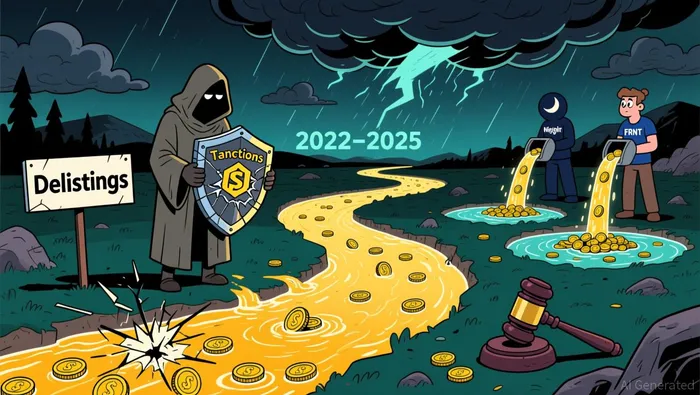
The liquidity exodus from Tornado CashTORN-- in 2025 has underscored the fragile balance between regulatory scrutiny and the decentralized ethos of DeFi. As a privacy-focused protocol, Tornado Cash has long been a lightning rod for debates over financial anonymity, developer liability, and the role of surveillance in digital finance. The U.S. Treasury's 2022 sanctions against the protocol triggered a sharp decline in its activity, with sustained reductions in transaction volume and user diversity across major blockchains like EthereumETH--, BNBBNB-- Smart Chain, and Polygon. While the partial lifting of sanctions in March 2025 led to a limited recovery, the platform's role in laundering stolen funds-such as the 6,300 ETH ($19.4 million) from a compromised multisignature wallet-has cemented its association with illicit activity. This duality-privacy as both a shield for legitimate users and a tool for bad actors-has reshaped liquidity dynamics in DeFi and investor sentiment toward privacy-driven assets.
Liquidity Risk and the Tornado Cash Paradox
The exodus from Tornado Cash highlights the inherent risks of liquidity in DeFi protocols. Regulatory actions have proven to be a double-edged sword: while they can curtail misuse, they also destabilize trust in decentralized systems. For instance, the U.S. Treasury's sanctions in 2022 caused a sustained drop in Tornado Cash's TVL and transaction volume, with activity only partially recovering after the March 2025 delisting. This volatility reflects the fragility of liquidity in protocols that lack centralized oversight. Meanwhile, impermanent loss remains a critical risk for liquidity providers (LPs) in DeFi. Studies show that pools with higher impermanent loss risk tend to offer higher returns, but this comes at the cost of liquidity inefficiencies, with 83-95% of liquidity in major pools like UniswapUNI-- and Curve remaining idle. The Tornado Cash exodus has further exacerbated these inefficiencies, as capital migrates to protocols perceived as more compliant with evolving regulatory frameworks.
Regulatory clarity has also begun to reshape liquidity pool dynamics. The U.S. GENIUS Act and the EU's MiCA framework have created a distinction between "compliant" and "peripheral" liquidity, pushing DeFi protocols to prioritize stablecoins like USDCUSDC-- over alternatives like USDTUSDT-- to meet reserve and audit requirements. This shift has concentrated liquidity around compliant assets, deepening integration with traditional finance but also narrowing yield opportunities for protocols that fail to align with regulatory expectations. For Tornado Cash, the lingering sanctions on its lead developer Roman Semenov illustrate the unresolved tension between decentralization and accountability.
Shifting Investor Sentiment: Privacy as a Strategic Moat
Despite regulatory headwinds, investor sentiment toward privacy-focused protocols has grown more bullish in 2025. Privacy-centric assets like ZcashZEC-- (ZEC) and MoneroXMR-- (XMR) have outperformed the broader market, with ZEC surging 820% and XMR rising 130%-a stark contrast to BitcoinBTC-- and Ethereum's declines. This surge reflects a growing recognition of privacy as foundational infrastructure for on-chain finance, driven by maturing technologies like zero-knowledge proofs and secure enclaves. Institutional adoption has further accelerated this trend, as enterprises seek confidentiality for trade data and competitive strategies. For example, Wyoming's Frontier Stable Token (FRNT) and a private Paxos–Aleo stablecoin demonstrate how privacy and compliance can coexist, offering selective disclosure mechanisms that satisfy regulatory demands while preserving user anonymity.
However, this optimism is tempered by regulatory uncertainty. The U.S. SEC's planned December 2025 roundtable on crypto privacy and financial surveillance signals ongoing tensions between privacy advocates and compliance frameworks. Investors must weigh the utility of privacy protocols against the risk of future sanctions or enforcement actions, particularly for protocols with non-custodial, immutableIMX-- architectures like Tornado Cash. The trial of Tornado Cash co-founder Roman Storm in August 2025, which resulted in a conviction for operating an unlicensed money transmitting business, has further heightened legal risks for developers.
Capital Reallocation and the Rise of Alternative Protocols
The liquidity exodus from Tornado Cash has spurred capital reallocation to alternative privacy protocols. Q3 2025 saw the launch of privacy-by-design blockchains like Midnight, leveraging the Hydra v1 protocol for scalable private transactions. These protocols aim to address Tornado Cash's limitations by integrating privacy at the protocol level rather than relying on decentralized mixers. Additionally, hybrid privacy architectures-such as Wyoming's FRNT stablecoin-have gained traction by combining privacy with compliance-ready infrastructure.
Transaction volume metrics also reveal shifting dynamics. While Tornado Cash recorded a record $400 million in Q3 2025 transactions, this figure masks broader migration trends. Investors and institutions are increasingly favoring protocols that align with regulatory expectations, even if yields are slightly lower. For example, DeFi protocols now prioritize stablecoins like USDC in liquidity pools to meet reserve and governance standards. This reallocation underscores the growing importance of institutional-grade infrastructure in DeFi, where reliable execution and credible risk controls are paramount.
Conclusion: Balancing Privacy and Compliance
The Tornado Cash liquidity exodus has exposed both the vulnerabilities and resilience of privacy-focused DeFi. While regulatory actions have curtailed its misuse, they have also highlighted the need for protocols that balance privacy with compliance. For investors, the key lies in identifying protocols that offer robust privacy features without sacrificing regulatory alignment. The maturation of zero-knowledge proofs and hybrid architectures suggests that privacy will remain a strategic moat in DeFi, but its long-term viability depends on navigating the evolving regulatory landscape. As 2026 approaches, the interplay between privacy, compliance, and liquidity risk will define the next phase of DeFi's institutional adoption.







Comentarios
Aún no hay comentarios