
Top 10 AI Stocks for 2026: Mapping the Infrastructure S-Curve
We are in the early, steep part of an S-curve for compute power. The paradigm shift isn't just about smarter software; it's a fundamental re-engineering of the world's physical infrastructure to handle an explosion in data processing. This isn't a short-term boom. It's a multi-year, trillion-dollar build-out that will define the next decade.
The scale is staggering. Global data center capacity is projected to triple by 2030, driven overwhelmingly by artificial intelligence. AI workloads alone are expected to account for about 70% of this expansion. To meet this demand, the world must invest $6.7 trillion by 2030. That figure represents the largest infrastructure investment cycle in modern history, dwarfing past waves of connectivity or energy development.
This isn't just a future projection; the spending is accelerating now. The build-out is already underway, with US spending on data center construction having tripled in the last three years. Hyperscalers are planning to spend more on data centers in 2026 than ever before, locking in capacity for the next phase of adoption. The growth trajectory is exponential: the industry is on pace for a compound annual growth rate of 14% through 2030, meaning it will build twice the capacity constructed since 2000 in less than a quarter of the time.
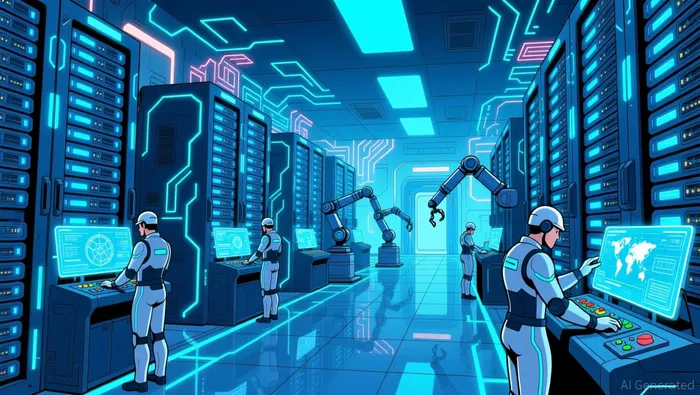
The bottom line is that we are moving from an era of digital services to one of digital manufacturing. Data centers are becoming specialized "AI factories," designed for extreme power density and continuous inference workloads. The companies that master this infrastructure layer-providing the compute, power, and cooling rails for the next paradigm-are positioned to capture the value of an exponential adoption curve. This is the foundational build-out for the next technological singularity.
Stock Picks: Where on the S-Curve Are They?
The AI infrastructure build-out is a multi-year S-curve, and each stock represents a different position along it. The leaders are on the steep, accelerating part, while others are catching up or riding the wave of adoption.
Nvidia sits at the absolute peak of the compute layer. Its Blackwell GPUs are selling off the charts, and cloud capacity is sold out. This isn't just strong demand; it's a sign the industry is in the early, exponential phase of adoption. Nvidia's aggressive annual hardware cadence, with Rubin already in development, shows it's engineering the next leg of the curve. It's not just a supplier; it's defining the infrastructure layer.
Broadcom and AMDAMD-- are the critical infrastructure alternatives, each on a powerful growth trajectory. Broadcom is expected to deliver explosive growth as the AI arms race drives demand for networking and semiconductors. AMD is gaining market share in data center CPUs, a key component for the hyperscaler build-out. Together, they represent the essential, high-margin rails that support the compute giants, benefiting from the same exponential spending surge.
Micron is a pure-play on the memory layer, which is facing a shortage of historic proportions. The company has boosted its outlook for 2025 server unit growth to a high teens percentage, a massive upward revision driven by HBM and DRAM shortages for AI servers. This positions Micron squarely on the steep part of the S-curve for memory, where supply constraints are amplifying pricing power and growth.
Intel is struggling to meet demand for its server CPUs, a sign it's lagging the curve. Yet its scaling of its advanced 18A process in 2026 is a direct attempt to catch up. This is the classic story of a company trying to re-enter the exponential growth phase by mastering the next node of the compute stack. Its position is transitional, not yet on the steep part but aiming for it.
Finally, Nebius and SoundHound AI represent the platform and productivity beneficiary layers. Nebius has sold out all of its available capacity and expects its annual run rate to explode from $551 million to $7-$9 billion by end-2026. This is the parabolic growth of a pure-play infrastructure-as-a-service company riding the wave. SoundHound AI, by integrating generative AI into customer interactions, is a beneficiary of the platform layer's expansion, capturing value from the productivity gains enabled by the underlying compute and memory rails.
Financial Impact and Valuation: From Capex to Cash Flow
The massive infrastructure build-out is now translating into stark financial divergence. Investors are rotating away from AI infrastructure companies where growth in operating earnings is under pressure and capex spending is debt-funded. This selective focus is a natural evolution as the initial, capex-heavy phase matures. The consensus estimate for 2026 capital spending by AI hyperscalers has climbed to $527 billion, up from $465 billion just a few months ago. Yet the stock market is no longer rewarding all big spenders equally. Since June, the average stock price correlation across large public AI hyperscalers has collapsed from 80% to just 20%, signaling a clear rotation.
The next phase of the AI trade is expected to involve AI platform stocks and productivity beneficiaries, moving beyond pure hardware. Goldman Sachs Research notes that investors are increasingly focused on the link between capex and revenue generation. This shift favors companies that can demonstrate a clear path to converting massive capital investments into top-line growth and cash flow. The financial impact is a bifurcation: the infrastructure layer is becoming a high-cost, high-capital barrier to entry, while the platform and application layers capture the value of exponential adoption.
Key catalysts will signal the next phase. For infrastructure, it's the launch of next-generation chips, like Intel's 18A process in 2026, which is critical for catching up in the compute stack. For capacity providers, it's the physical rollout of new cloud computing capacity. Nebius, for example, is aiming to dramatically increase its power capacity, with contracted power expected to rise to 2.5 gigawatts by the end of 2026. If it meets its targets, its annualized run rate revenue could explode from $551 million to $7-$9 billion by year-end, a parabolic growth trajectory that would validate its infrastructure bet.
The bottom line is that financial success is shifting from simply spending capital to efficiently converting it into scalable, profitable operations. Companies that master this transition-by either building the next node of compute or by providing the essential, high-margin rails for the platform layer-will be best positioned to capture value in the next phase of the AI S-curve.
Risks and Counterpoints: Guardrails on the Exponential Path
The exponential build-out is real, but the path isn't frictionless. Several guardrails are emerging that could slow the S-curve or reshape the winners.
First, the sheer scale of spending is a double-edged sword. The consensus estimate for 2026 capital expenditure by AI hyperscalers has climbed to $527 billion, up from $465 billion just a few months ago. Yet this figure is still a projection. The market is becoming more selective, with investors rotating away from all AI big spenders. This divergence is a direct warning: the stock market is no longer rewarding capex for capex's sake. It is focusing on companies that can demonstrate a clear link between massive capital investments and top-line growth. The risk is that some infrastructure bets could lead to overcapacity and execution failure if demand doesn't keep pace with the build-out.
Second, the supply constraints that are fueling current profits are expected to ease, which could compress margins later in 2026. This is a critical inflection point for chipmakers. Micron, for instance, is selling every memory chip it can produce, with capacity constraints expected to ease later in 2026. The same dynamic applies to IntelINTC--, which is struggling to meet demand for server CPUs. While soaring demand has allowed both companies to boost their 2025 server unit growth outlooks to a high teens percentage, the eventual supply ramp will likely bring pricing pressure. For now, the shortage is a tailwind; in the second half of 2026, it could become a headwind.
The bottom line is that the AI infrastructure trade is maturing. The initial phase of capex-driven growth is giving way to a phase of selective valuation. Companies that have built the necessary rails-whether through superior technology, efficient execution, or strategic positioning-will continue to capture value. Those that simply spend heavily without a clear revenue conversion path face a steeper climb. The exponential curve has its guardrails.





Comentarios
Aún no hay comentarios