
Is Tomei Consolidated Berhad (KLSE:TOMEI) a Hidden Value Gem in Malaysia's Retail Sector?
In the shadow of Malaysia's retail sector challenges-ranging from economic headwinds to e-commerce disruption-Tomei Consolidated Berhad (KLSE:TOMEI) emerges as an anomaly. With a Return on Capital Employed (ROCE) of 21.04%, a five-year compound annual growth rate (CAGR) of 31% in earnings per share (EPS), and a P/E ratio of 3.08, the company appears to defy conventional valuation metrics. This analysis argues that TOMEI is a compelling value opportunity, driven by its superior capital efficiency and earnings resilience, even as the broader retail sector grapples with muted growth.
Capital Efficiency: A Stark Contrast to Industry Peers
TOMEI's ROCE of 21.04% is a standout metric in an industry where peers struggle to match even half that figure. For instance, South Malaysia Industries Berhad, a retail sector player, reported a ROCE of just 2.4% in 2025, while Keck Seng (Malaysia) Berhad's ROCE stood at 4.5%. These figures pale in comparison to TOMEI's performance, suggesting a stark divergence in capital allocation discipline.
While the Malaysian retail sector's average ROCE remains unspecified in available data, the broader Industrials sector is projected to grow at a modest 5.0% annually. TOMEI's ROCE not only exceeds this benchmark but also outpaces the Food industry's average of 9.7%, underscoring its operational excellence. This efficiency likely stems from TOMEI's focus on cost optimization and asset utilization, traits that are increasingly rare in a sector marked by thin margins and competitive pressures.
Earnings Growth: Outpacing a Sluggish Sector
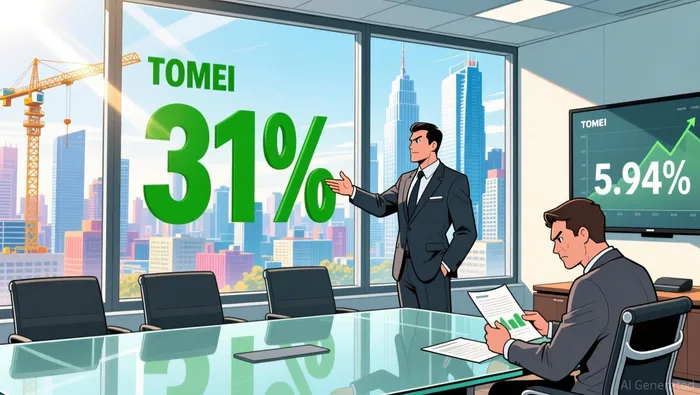 TOMEI's five-year EPS CAGR of 31% is another pillar of its value proposition. The Malaysian retail sector, by contrast, is expected to grow at a CAGR of 5.94% from 2025 to 2030 according to Mordor Intelligence, with subsectors like Retail Distributors posting a more modest 11% annual earnings growth over the past three years. TOMEI's ability to compound earnings at over five times the sector's projected rate highlights its structural advantages, whether through market share gains, pricing power, or operational leverage.
This outperformance is particularly striking given the sector's recent struggles. The 2025 retail growth forecast was revised downward to 3.1% from 4.3% due to weak Q2 performance and economic volatility. Yet, TOMEI has consistently delivered robust earnings, suggesting a business model insulated from macroeconomic headwinds.
Discounted Valuation: A Mispriced Opportunity
At a P/E ratio of 3.08, TOMEI trades at a steep discount to its intrinsic value. For context, the Malaysian retail sector's broader growth trajectory-projected to expand from USD 94.99 billion in 2025 to USD 126.75 billion by 2030-does not justify such a low valuation. Even conservative estimates imply that TOMEI's earnings power warrants a higher multiple, particularly given its capital efficiency and earnings momentum.
The disconnect between TOMEI's fundamentals and its valuation may stem from market pessimism about the retail sector. Analysts have noted challenges such as intense competition and regulatory compliance costs, which could be overshadowing TOMEI's strengths. However, this pessimism creates an entry point for investors who recognize the company's ability to compound capital at exceptional rates.
Total Shareholder Return: A Dividend-Driven Edge
TOMEI's five-year total shareholder return (TSR) of 158%, driven largely by dividends, further cements its appeal. In a sector where growth is often constrained by reinvestment needs, TOMEI's focus on returning capital to shareholders-without sacrificing operational performance-sets it apart. This aligns with a broader trend in value investing, where companies with strong free cash flow and disciplined capital returns outperform peers over the long term.
Conclusion: A Case for Long-Term Compounding
TOMEI's combination of high ROCE, outsized EPS growth, and a discounted valuation positions it as a rare value gem in Malaysia's retail sector. While the industry faces headwinds, the company's capital efficiency and earnings resilience suggest it is not merely surviving but thriving. For investors seeking long-term compounding, TOMEI offers a compelling opportunity to capitalize on a mispriced asset with durable competitive advantages.







Comentarios
Aún no hay comentarios