
Tokenizing Traditional Assets: Amundi's Ethereum Money Market Fund and the Future of Digital Wealth Management
Amundi, Europe's largest asset manager, has taken a bold step into the future of finance by launching the first tokenized share of its AMUNDI FUNDS CASH EUR money market fund, leveraging Ethereum's blockchain for transparent record-keeping and transaction traceability. This hybrid structure allows investors to choose between traditional fund shares and blockchain-based counterparts, marking a pivotal moment in the integration of decentralized technology into institutional investing. The initiative, developed in collaboration with CACEIS, underscores a broader industry shift toward tokenization, driven by the promise of enhanced liquidity, accessibility, and operational efficiency.
Blockchain and Liquidity: Real-Time Settlement and 24/7 Operability
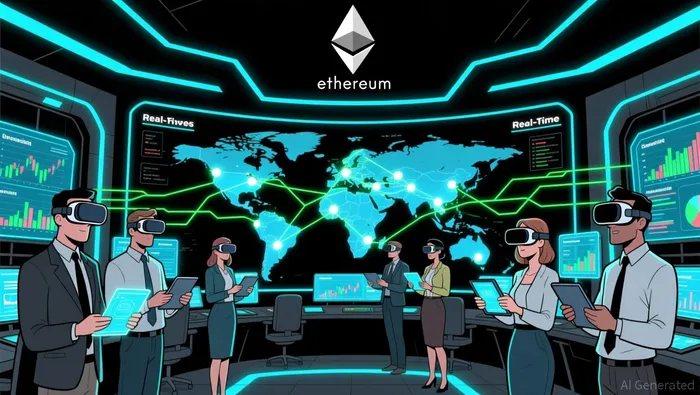
Tokenized funds are redefining liquidity in institutional markets. By enabling real-time settlement and 24/7 trading, blockchain-based structures eliminate the delays inherent in traditional fund operations. For instance, tokenized treasuries have already grown to $6.9 billion in value, offering institutional investors immediate access to yield-bearing opportunities without the friction of legacy systems. Similarly, Amundi's Ethereum-based fund allows instant order execution, a critical advantage in fast-moving markets. This shift aligns with growing demand for liquidity solutions, particularly as institutional players seek to diversify across traditional and alternative assets.
Accessibility: Fractional Ownership and Global Investor Reach
Tokenization is also breaking down barriers to entry. By enabling fractional ownership, blockchain-based funds democratize access to institutional-grade assets, attracting a new generation of investors. For example, tokenized private credit has surpassed $12 billion in value, allowing accredited investors to participate in previously illiquid markets with programmable liquidity mechanisms. Amundi's hybrid model further expands this accessibility, offering investors the flexibility to trade tokenized shares across geographic and operational boundaries. Regulated digital asset platforms now facilitate these transactions, ensuring compliance while broadening participation.
Operational Efficiency: Smart Contracts and Automated Compliance
One of the most transformative aspects of tokenization lies in its ability to streamline operations. Smart contracts automate processes such as interest payments, compliance reporting, and dividend distributions, reducing administrative burdens and minimizing human error. As Jean-Jacques Barbéris of Amundi noted, these efficiencies are accelerating the global adoption of asset tokenization, with firms like Amundi committed to scaling these innovations for clients worldwide. BlackRock's BUIDL fund, which grew from $615 million to $1.87 billion in a single year, exemplifies how tokenization can simplify fund management while enhancing transparency.
The Road Ahead: Market Growth and Institutional Adoption
The institutional shift to tokenized funds is gaining momentum. By 2030, the tokenized fund market is projected to represent 1% of global assets under management (AUM), translating to over $600 billion in value. Secondary market platforms like IXS are further enhancing liquidity by providing trading solutions for tokenized assets, a critical development for institutional portfolios seeking flexibility. Meanwhile, hybrid fund models-combining traditional and tokenized share classes are reshaping investment frameworks, offering customizable structures tailored to evolving investor needs.
Amundi's EthereumETH-- Money Market Fund is not just a product-it's a harbinger of a broader transformation. As blockchain technology continues to mature, its integration into institutional investing will likely redefine liquidity, accessibility, and operational efficiency, creating a more inclusive and agile financial ecosystem. For investors and institutions alike, the future of wealth management is being written on the blockchain.







Comentarios
Aún no hay comentarios