
Tokenized U.S. Treasuries and DeFi Integration: Ripple's Strategic Partnership with Ondo as a Catalyst for Institutional Adoption
The integration of tokenized U.S. Treasuries into decentralized finance (DeFi) is no longer a theoretical exercise but a rapidly maturing market reality. Ripple's strategic partnership with Ondo Finance to launch tokenized short-term U.S. government treasuries (OUSG) on the XRPXRP-- Ledger marks a pivotal moment in this evolution. By enabling institutional investors to mint and redeem OUSG using Ripple's stablecoin RLUSD, the collaboration addresses critical inefficiencies in traditional Treasury markets while unlocking new liquidity and yield opportunities in DeFi. This analysis evaluates how this partnership reshapes risk, liquidity, and yield dynamics, and whether investors should position for this paradigm shift now.
The Ondo-Ripple Partnership: A Strategic Catalyst
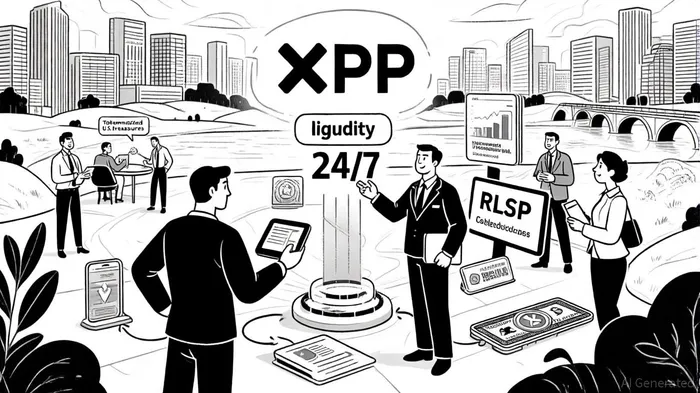
Ondo Finance's OUSG token, now live on the XRP Ledger, represents over $670 million in total value locked (TVL) and is backed by the BlackRockBLK-- USD Institutional Digital Liquidity Fund (BUIDL) [1]. The partnership leverages Ripple's RLUSD stablecoin as a bridge asset, allowing for instant minting and redemption of OUSG 24/7. This eliminates the delays and intermediation costs inherent in traditional Treasury markets, where settlements can take days and require complex custodial infrastructure [2].
Ripple's XRP Ledger, with its fast finality (3–5 second confirmations), sub-cent transaction fees, and native compliance features like Decentralized Identifiers (DIDs), is uniquely positioned to support institutional-grade tokenization [3]. Markus Infanger, RippleX's SVP, emphasized that tokenized finance is “no longer theoretical but maturing in real markets” [1]. The XRP Ledger's Automated Market Maker (AMM) and Central Limit Order Book (CLOB) further enhance liquidity, attracting institutional capital and reducing slippage for traders [4].
Risk, Liquidity, and Yield Dynamics in DeFi
Tokenized U.S. Treasuries introduce a safer collateral alternative to volatile crypto assets and opaque stablecoins. Unlike stablecoins, which often lack yield and face redemption risks (as seen in the TerraLUNA-- UST collapse), tokenized Treasuries offer predictable returns through U.S. government-backed interest [5]. For example, BlackRock's BUIDL fund already yields 4.50% APY, attracting $2.9 billion in assets [6]. This makes them ideal for DeFi protocols seeking low-risk collateral for loans, derivatives, and hedging strategies.
However, new risks emerge when tokenized Treasuries are leveraged in DeFi. Loan-to-value (LTV) thresholds for collateralized positions can trigger automatic liquidations if market conditions shift, creating cascading effects during periods of stress [7]. The U.S. Treasury itself has warned that tokenized assets could amplify volatility in broader financial markets, particularly if interconnected protocols fail to manage counterparty risks [7]. Additionally, rising bond yields driven by inflation and geopolitical tensions pose challenges for investors seeking stable returns [8].
Despite these risks, tokenized Treasuries enhance liquidity in ways traditional systems cannot. Platforms like Deribit and Crypto.com already allow users to post tokenized Treasuries as collateral, demonstrating growing institutional acceptance [9]. The XRP Ledger's 24/7 accessibility and instant settlements further reduce operational friction, enabling real-time capital allocation and arbitrage opportunities [10].
Comparative Advantages Over Traditional Systems
Traditional U.S. Treasury markets, valued at $28 trillion, suffer from delayed settlements, high intermediation costs, and fragmented liquidity. Tokenization addresses these inefficiencies by enabling immediate settlement, reducing intermediary costs by up to 97%, and streamlining liquidity management [11]. For stablecoin holders—who forgo approximately $8 billion annually in yield by holding non-yield-bearing tokens—tokenized Treasuries offer a compelling alternative [12].
The market for tokenized Treasuries is growing rapidly. As of 2025, the sector represents $4 billion in TVL, with projections of $16 trillion by 2030 [13]. This growth is driven by institutional demand for blockchain-based solutions that combine regulatory compliance with DeFi's efficiency. For instance, Franklin Templeton's FOBXX tokenized fund is being used as reserve assets in DeFi-based products, further blurring the lines between traditional and digital finance [14].
Should Investors Position for This Paradigm Shift?
The answer hinges on balancing innovation with caution. For investors seeking yield and liquidity, tokenized Treasuries on the XRP Ledger present a unique opportunity. The XRP Ledger's infrastructure—backed by Ripple's $10 million allocation to tokenized Treasury bills—positions it as a robust platform for institutional DeFi [15]. However, the nascent nature of this market means risks remain untested in systemic stress scenarios.
A dual-track approach is advisable. Conservative investors should prioritize tokenized Treasuries as a yield-generating, low-risk asset class, while more aggressive investors might explore hybrid strategies combining tokenized Treasuries with stablecoins to hedge against volatility. Regulatory clarity will also be critical; investors must monitor developments in compliance frameworks to avoid exposure to unregulated protocols.
Conclusion
Ripple's partnership with Ondo Finance is a catalyst for institutional adoption of tokenized U.S. Treasuries, leveraging the XRP Ledger's efficiency and compliance features to bridge traditional and decentralized finance. While risks such as leveraged liquidations and macroeconomic volatility persist, the advantages in liquidity, yield, and transparency are undeniable. Investors who position now—while prioritizing risk management—stand to benefit from a market poised for exponential growth. As the U.S. Treasury and DeFi protocols continue to evolve, the XRP Ledger's role in this paradigm shift will likely solidify its place as a cornerstone of institutional-grade digital finance.







Comentarios
Aún no hay comentarios