
Tokenized Stocks and DeFi Integration: A New Era of Disruptive Access and Financial Inclusion
Tokenized Stocks: Democratizing Ownership and Liquidity
Tokenized stocks represent a paradigm shift in how equity is issued, traded, and accessed. By converting traditional securities into blockchain-based tokens, companies can reduce settlement times, lower transaction costs, and expand investor pools. A prime example is BlackRock's USD Institutional Digital Liquidity Fund (BUIDL), which entered the tokenization space in 2024 and attracted over $500 million in institutional investment within months. This success underscores the growing demand for tokenized financial products, particularly among institutional players seeking liquidity and efficiency.
Beyond institutional markets, tokenization is also reshaping real-world asset ownership. A luxury hotel in New York was tokenized in 2024, allowing fractional shares to be purchased for as little as $1,000. This model democratizes access to high-value real estate, enabling retail investors to diversify portfolios without the need for substantial capital. Similarly, Hamilton Lane's tokenization of middle-market corporate loans has opened private credit markets to a broader range of investors, offering transparency and liquidity previously absent in these illiquid assets.
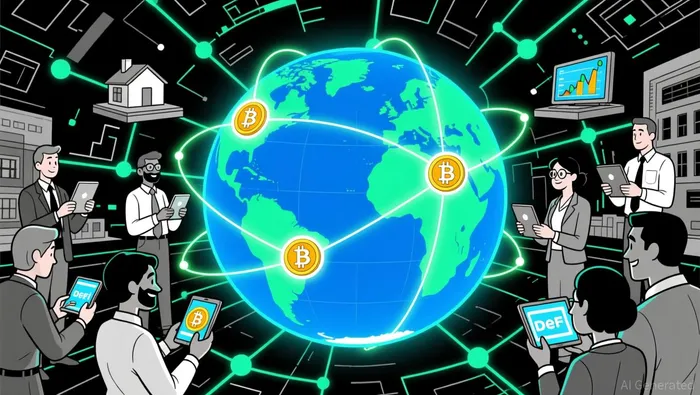 The implications for financial inclusion are profound. Tokenization reduces the minimum investment thresholds for asset classes like real estate and private equity, enabling individuals in emerging markets to access opportunities once out of reach. For instance, in the Democratic Republic of Congo, Embed Financial Group Holdings (EFGH) partnered with Régie de Distribution d'Eau (REGIDESO SA) to modernize digital payments and expand access to financial tools. This collaboration introduced secure, user-friendly bill-payment systems, aligning with national regulations to strengthen financial resilience and promote inclusive growth.
DeFi Integration: Permissionless Access and Global Participation
Decentralized finance (DeFi) is amplifying the disruptive potential of tokenized assets by removing intermediaries and enabling permissionless access to financial services. DeFi platforms, built on blockchain networks like EthereumETH--, allow users to lend, borrow, and trade assets without relying on traditional banks. This is particularly transformative for the 1.4 billion adults globally who remain unbanked.
A key driver of DeFi's inclusivity is its ability to provide financial tools to underserved populations. For example, yield farming-where users earn returns by staking or lending cryptocurrencies-offers higher yields than traditional savings accounts, attracting participants in regions with unstable fiat currencies. Synthetic assets further expand access by enabling users to trade real-world assets (e.g., stocks, commodities) on decentralized exchanges without physical ownership according to DeFi research.
The integration of DeFi with traditional finance (TradFi) is also accelerating. Traditional banks are experimenting with blockchain-based cross-border payments and hybrid digital wallets that combine fiat and cryptocurrencies. Meanwhile, the tokenization of real-world assets is projected to reach $16 trillion by 2030. This convergence is not merely speculative; it reflects a tangible shift in how capital flows are structured and accessed.
Risks and Regulatory Challenges
Despite the promise, tokenized stocks and DeFi face significant hurdles. Regulatory ambiguity remains a major barrier, as frameworks struggle to keep pace with technological innovation. For instance, tokenized investment funds may amplify interconnectedness between digital and traditional financial systems, raising systemic risks during market stress. Smart contract vulnerabilities also pose security threats, as seen in past DeFi exploits.
Moreover, the lack of standardized regulations across jurisdictions creates compliance challenges. While the EU's Markets in Crypto-Assets (MiCA) regulation aims to provide clarity, similar frameworks are still nascent in other regions. Investors and institutions must navigate this fragmented landscape carefully, balancing innovation with risk management.
Conclusion: A Future of Inclusive Capitalism
Tokenized stocks and DeFi are not just technological novelties-they are catalysts for a more inclusive financial ecosystem. By lowering barriers to entry, enhancing liquidity, and empowering unbanked populations, these innovations are redefining what it means to participate in global markets. However, their success hinges on addressing regulatory uncertainties and security risks.
For investors, the opportunities are clear: tokenized assets offer diversification, while DeFi platforms provide exposure to high-growth, permissionless markets. Yet, as with any disruptive technology, caution is warranted. The future of finance will likely be a hybrid of TradFi and DeFi, where innovation and regulation evolve in tandem to ensure stability and inclusion.
As the financial world hurtles toward this new era, one thing is certain: the democratization of capital is no longer a distant vision-it is here, reshaping economies and empowering individuals in real time.





Comentarios
Aún no hay comentarios