
Tokenized Real-World Assets in South Korea: A New Era of Financial Innovation and Investment Opportunities
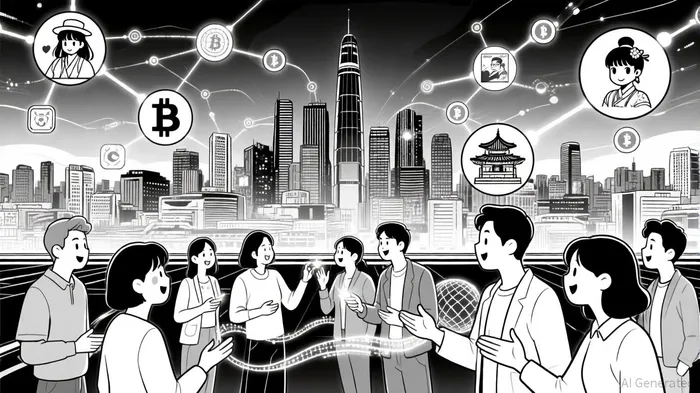
The tokenization of real-world assets (RWAs) in South Korea has emerged as a transformative force in 2025, driven by regulatory clarity, institutional adoption, and innovative infrastructure. As the country's $450 billion crypto market—the world's second-largest by trading volume—evolves, South Korea is positioning itself as a global leader in tokenizing cultural and intellectual property (IP), real estate, and private credit. This shift is not merely speculative; it is underpinned by concrete regulatory frameworks, strategic partnerships, and a growing ecosystem of platforms that are redefining liquidity, ownership, and access to traditionally illiquid assets.
Regulatory Clarity: The Foundation for RWA Growth
South Korea's Financial Services Commission (FSC) has played a pivotal role in legitimizing tokenized assets by treating them as equivalent to traditional securities under the Capital Markets Act. This regulatory equivalence ensures that digital assets corresponding to real-world value—such as K-pop royalties or K-drama rights—must comply with the same disclosure and investor protection standards as paper-based securities[1]. By doing so, the FSC has created a sandbox environment where innovation thrives without compromising stability.
This approach mirrors trends in Singapore and Hong Kong, where tokenization is being integrated into institutional-grade financial systems[1]. For example, South Korea's Security Token Offering (STO) regulatory sandbox has enabled platforms like Seoul Exchange to experiment with blockchain-based settlement while adhering to existing securities laws. The result is a hybrid model that balances innovation with compliance, attracting both domestic and international investors.
Infrastructure Breakthroughs: Seoul Exchange and Story Protocol
At the heart of South Korea's RWA revolution is the partnership between Seoul Exchange—one of only two licensed platforms for unlisted securities—and Story Protocol, a blockchain infrastructure provider. This collaboration has positioned Story's Layer-1 blockchain as the exclusive settlement layer for tokenized RWAs in Korea, including K-pop royalties, webtoons, patents, and gaming IP[2].
The significance of this partnership cannot be overstated. By leveraging Story's blockchain, Seoul Exchange is creating a programmable, transparent, and globally accessible marketplace for cultural IP. For instance, fans of global K-pop acts like BTSBTS-- and BLACKPINK can now invest in tokenized royalties, directly funding new projects while sharing in their long-term value[2]. This model not only democratizes access to entertainment finance but also ensures creators retain ownership and control over their IP.
Moreover, the integration of Story's native token ($IP) into transactions adds a layer of liquidity and utility. Investors can trade these tokens 24/7 on blockchain platforms, bypassing traditional market hours and intermediaries[2]. This shift is particularly appealing to institutional players, as it aligns with the growing demand for real-time settlement and fractional ownership.
Market Expansion: From Cultural IP to Institutional-Grade Assets
While cultural IP has been a standout use case, South Korea's RWA market is diversifying rapidly. By June 2025, the global RWA tokenization market had surged to $24 billion, with private credit and tokenized treasuries accounting for 70% of on-chain value[3]. South Korean platforms like Asset Token Ventures and Hedera are leading the charge in tokenizing real estate, commodities, and even government debt, leveraging blockchain's ability to reduce friction and increase transparency[4].
A key driver of this growth is the rise of RWA oracles—systems that bridge on-chain and off-chain data. For example, RedStone provides sophisticated pricing mechanisms for tokenized assets, ensuring accurate valuations for institutional investors[3]. This infrastructure is critical for scaling RWA adoption, as it addresses concerns around volatility and data integrity.
Adoption Metrics: A Booming Ecosystem
The numbers tell a compelling story. As of August 2025, the global RWA market had surpassed $8 billion in total value locked (TVL), with South Korea contributing significantly to this growth[5]. Platforms like Zoniqx and Ondo Finance are further accelerating adoption by integrating AI-powered compliance tools and bridging traditional finance with DeFi. For instance, Ondo Finance's tokenization of U.S. government debt on the XRP Ledger has enabled 24/7 trading of high-grade assets, a model that South Korean institutions are now emulating[6].
Institutional interest is also surging. BlackRock's BUIDL fund, which focuses on tokenized assets, has amassed $2 billion in assets under management, while tokenized real estate and bond markets in South Korea have reached $5.4 billion and $12.8 billion, respectively[3]. These figures underscore the shift from experimental pilots to production-scale deployments.
The Road Ahead: Challenges and Opportunities
Despite the momentum, challenges remain. Regulatory alignment across jurisdictions, cross-chain interoperability, and the need for standardized pricing models are critical hurdles. However, South Korea's proactive approach—coupled with global trends like Layer-3 rollups and zero-knowledge proofs—positions it to overcome these obstacles[3].
For investors, the opportunities are clear. Tokenized RWAs offer exposure to previously inaccessible markets, from K-culture IP to institutional-grade private credit. Platforms like Seoul Exchange and Story Protocol are not just building infrastructure; they are redefining what it means to own and trade assets in the digital age.
Conclusion
South Korea's RWA ecosystem is a testament to the power of regulatory foresight, technological innovation, and market demand. As the country continues to tokenize its cultural and economic assets, it is setting a blueprint for the future of finance—one where ownership is fluid, liquidity is instant, and value is programmable. For investors, the message is clear: the next wave of financial innovation is already here, and it's being built on blockchain.







Comentarios
Aún no hay comentarios