
Tokenized Markets and the CFTC's Regulatory Shift: A New Era for Derivatives Trading
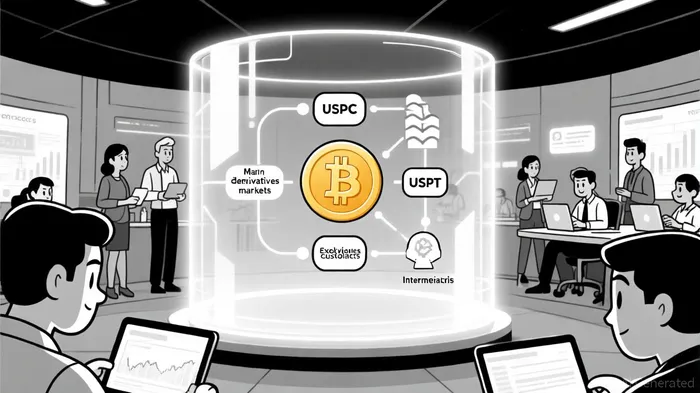
The U.S. Commodity Futures Trading Commission (CFTC) is spearheading a seismic shift in financial markets by integrating tokenized collateral—specifically stablecoins—into derivatives trading. This initiative, announced in September 2025 under Acting Chairman Caroline Pham, marks a pivotal step toward modernizing capital efficiency and operational workflows in the $400 trillion derivatives sector. By leveraging blockchain technology, the CFTC aims to reduce transaction costs by up to 30% and unlock 24/7 liquidity, positioning the U.S. as a global leader in regulated digital asset innovation [1].
Market Structure Transformation: Capital Efficiency and Operational Gains
The CFTC's tokenized collateral initiative is redefining how derivatives markets function. Traditionally, margin requirements have relied on cash or government securities, which are costly to manage and slow to settle. By enabling stablecoins like USDCUSDC-- and USDTUSDT-- as collateral, the CFTC is addressing these inefficiencies. For instance, tokenized assets can be programmatically verified and settled in real time, eliminating the need for intermediaries and reducing counterparty risk [2].
This shift is particularly impactful for institutional investors. A 2023 MIT study estimated that tokenized collateral could cut operational costs by 30% by automating margin calls and enabling dynamic collateral reuse [3]. For example, a hedge fund could use USDC to post margin for a futures contract while simultaneously using the same tokens as collateral for a loan, maximizing asset utilization. The CFTC's initiative also aligns with the GENIUS Act, which provides a regulatory framework for stablecoin issuers, ensuring transparency in reserve management and custody protocols [4].
Derivative Trading Opportunities: New Instruments and Mechanisms
The integration of tokenized collateral is unlocking novel derivative instruments and trading strategies. One immediate opportunity lies in tokenized futures contracts, where stablecoins serve as both margin and settlement assets. For example, a trader could short BitcoinBTC-- futures using USDC as margin, with profits and losses settled in the same stablecoin. This reduces friction compared to traditional cash-settled contracts, which require currency conversion and slower settlement cycles [5].
Another innovation is dynamic margining, where smart contracts automatically adjust collateral requirements based on real-time market conditions. If the value of a trader's position fluctuates, the system could instantly liquidate or add collateral without human intervention. This reduces the risk of default while enabling higher leverage for sophisticated traders [6].
Settlement mechanisms are also evolving. Blockchain-based settlement allows for T+0 (same-day) finality, compared to the T+2 standard in traditional markets. This is critical for high-frequency trading strategies, where even minutes can impact profitability. For instance, a crypto arbitrage fund could exploit price discrepancies between exchanges and settle trades in seconds using tokenized collateral, minimizing exposure to market gaps [7].
Challenges and Risks: Depegging and Regulatory Coordination
Despite the promise, risks remain. Stablecoin depegging—where a stablecoin's value deviates from $1—could destabilize collateralized positions. For example, if USDT temporarily trades at $0.98 due to market stress, margin accounts relying on it could face sudden liquidations. The CFTC is addressing this by requiring robust valuation protocols and stress-testing collateral assets [8].
Regulatory coordination is another hurdle. The SEC's focus on securities law and the CFTC's commodity framework creates ambiguity for tokenized assets. For instance, a stablecoin-backed futures contract might be classified as a commodity derivative by the CFTC but face scrutiny from the SEC if it's deemed an investment contract. The CFTC's public comment period until October 20, 2025, seeks to harmonize these frameworks [9].
Conclusion: A Tokenized Future for Derivatives
The CFTC's initiative is not just a regulatory update—it's a structural overhaul of derivatives markets. By embracing tokenized collateral, the U.S. is fostering a financial ecosystem that is faster, cheaper, and more inclusive. For investors, this means new opportunities in tokenized futures, dynamic margining, and real-time settlement. However, success hinges on addressing depegging risks and regulatory alignment. As industry leaders like CircleCRCL-- and CoinbaseCOIN-- emphasize, this shift could unlock $1 trillion in liquidity for derivatives markets by 2030 [10]. The next few months will be critical as the CFTC refines its rules—and the market adapts to a tokenized future.





Comentarios
Aún no hay comentarios