
Tokenized Interoperability as the Next Frontier in Global Institutional Payments: Strategic Investment in Blockchain Infrastructure Led by Major Banks
The Strategic Push for Interoperability
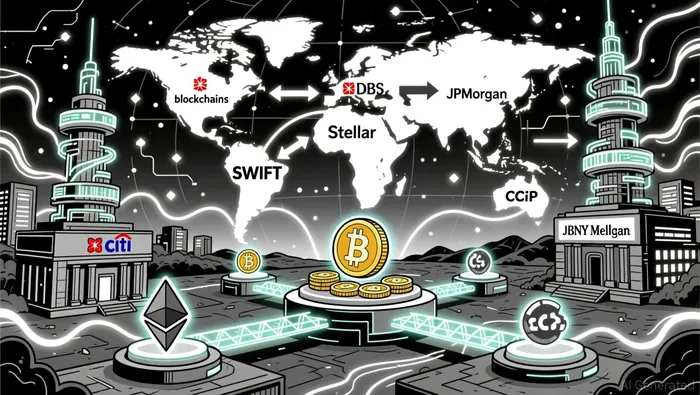
Major banks are no longer experimenting with blockchain in silos. Instead, they are coalescing around frameworks that enable seamless interaction between public and private blockchains. A prime example is the collaboration between DBS Bank and J.P. Morgan's Kinexys, which has developed a cross-network interoperability layer for tokenized deposits. This framework allows digital dollar transfers between Ethereum's Layer 2 network (Base) and DBS's private blockchain, effectively creating a SWIFT-like system for blockchain-based money, according to a Coinfomania report. By eliminating settlement delays and reducing transaction costs, this initiative positions tokenized assets as a viable alternative to traditional cross-border payment systems, the report notes.
SWIFT, the global financial messaging giant, is also leading a coalition of banks-including Citi, Lloyds Banking Group, BNP Paribas, and BNY Mellon-to test interoperability protocols. These efforts focus on three use cases: transferring tokenized assets within a single public blockchain, moving assets between public and permissioned chains, and enabling cross-chain transfers between public blockchains, according to a Insight AI Now analysis. The goal is to create a universal infrastructure that supports trillions in tokenized value, addressing the technical friction that has long hindered blockchain scalability, the analysis notes.
Stablecoins as the Catalyst for Institutional Adoption
Stablecoins are emerging as the linchpin of this transition. A coalition of global banks, including Bank of America, Deutsche Bank, Goldman Sachs, and Santander, is developing stablecoins pegged to major currencies like the U.S. dollar, euro, yen, and pound, according to a CryptoFront News article. These stablecoins are designed to operate on blockchain technology, offering a regulated, transparent alternative to existing stablecoins like TetherUSDT--. This initiative aligns with evolving regulatory frameworks, such as the CFTC's stablecoin collateral rules, and reflects a broader trend of structured integration under the Trump administration's pro-digital-asset policies, the article notes.
Ethereum has become the dominant platform for tokenized assets, hosting $201 billion in tokenized value as of November 2025, according to a TradingView report. This includes stablecoins, tokenized treasuries, and real-world assets (RWAs) like credit instruments. Institutional players such as BlackRock and Fidelity have driven a 2,000% surge in onchain fund assets since 2024, cementing Ethereum's role as a settlement layer, the report says.
Market Growth and Institutional Liquidity
The scale of investment in tokenized infrastructure is staggering. Broadridge Financial Solutions reported that its blockchain-based repo platform processed $385 billion in average daily volumes in October 2025-a 492% increase year-over-year, according to a Bitget report. This dwarfs retail-focused platforms like Bitget and Kraken, which handle tokenized equity trades in the $1–$5 billion range, the report notes. Meanwhile, tokenized treasury and money market products reached $7.4 billion in assets by mid-2025, reflecting an 80% growth from the start of the year, the report says.
Challenges and the Road Ahead
Despite rapid progress, challenges remain. Security is a top priority, with Chainlink's Active Risk Management (ARM) network providing enhanced safeguards for cross-chain transactions, the Insight AI Now analysis notes. Regulatory alignment is also critical, as institutions navigate frameworks like the EU's MiCA and the U.S. CFTC's evolving policies. However, the momentumMMT-- is undeniable: nearly one-third of global jurisdictions are exploring tokenized deposits, according to a 2024 Bank for International Settlements survey, the Coinotag article says.
Conclusion
Tokenized interoperability is no longer a theoretical concept-it is the bedrock of the next era in global payments. By investing in blockchain infrastructure, major banks are not just adapting to change; they are redefining the rules of finance. As these initiatives mature, the ability to transfer value across chains and borders in seconds, with minimal friction, will become the new standard. For investors, the message is clear: the future of institutional finance is tokenized, and it is being built by the world's most powerful banks.





Comentarios
Aún no hay comentarios