
Tokenized Gold vs. Bitcoin: Decentralization, Trust, and the Future of Value Storage
Decentralization: Bitcoin's Trustless Revolution vs. Tokenized Gold's Centralized Illusion
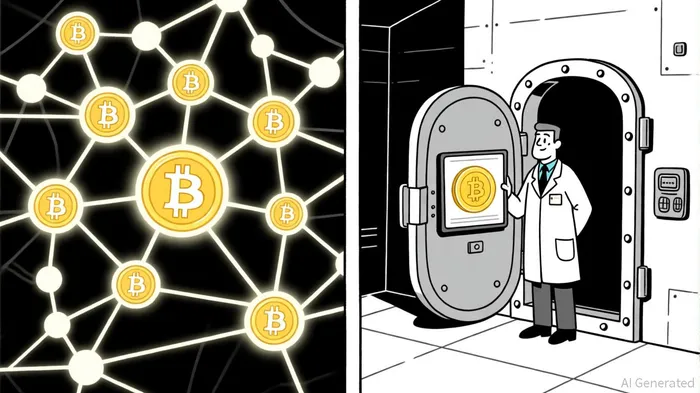
Bitcoin's core innovation-its ability to function as a decentralized, permissionless ledger-remains unmatched. Unlike tokenized gold, which relies on centralized custodians to verify and deliver physical assets, Bitcoin operates through cryptographic consensus, eliminating the need for intermediaries. As Changpeng Zhao argues, tokenized gold is essentially a "trust-me-bro" IOU, where users must place faith in third parties to honor their claims, as reported in a CryptoSlate piece. This contrasts sharply with Bitcoin's design, where trust is derived from mathematical proof and distributed validation rather than institutional promises.
Tokenized gold proponents, like Peter Schiff, highlight its transparency and auditability via blockchain, as covered in a Benzinga article. However, this transparency is superficial. The physical gold backing these tokens is often stored in vaults controlled by centralized entities, creating a paradox: a digital asset that still depends on real-world custodians. In contrast, Bitcoin's supply is algorithmically fixed, and its ownership is verifiable on-chain without relying on off-chain assurances.
Trust Frameworks: Institutional Adoption and the "Hybrid" Middle Ground
Institutional adoption has revealed a nuanced landscape. While Bitcoin is increasingly viewed as a "digital gold" safe-haven asset, tokenized gold is carving out a niche in regulated ecosystems. For example, Custodia and Vantage Bank's tokenized deposit platform allows banks to issue blockchain-based tokens representing insured deposits, blending blockchain efficiency with traditional banking oversight, according to a Cryptopolitan report. This hybrid model appeals to institutions seeking compliance and familiarity, even if it sacrifices Bitcoin's radical decentralization.
Meanwhile, Ethereum's Q3 2025 institutional inflows ($9.6 billion) outpaced Bitcoin's ($8.7 billion), driven by yield-generating staking opportunities and regulatory clarity, as noted in a Coinfomania report. This shift underscores a broader trend: institutions are prioritizing utility and compliance over ideological purity. JPMorgan's recent move to accept Bitcoin and EthereumETH-- as collateral further illustrates this pragmatism, as reported by CryptoFront News. Yet, Bitcoin's role as a store of value remains unshaken, particularly in macroeconomic uncertainty, as noted by Coinotag.
Technical Realities: Why Decentralization Matters for Long-Term Value
Tokenized gold's reliance on custodians introduces inherent risks. If the custodian defaults or manipulates the supply, the token's value becomes decoupled from its physical backing. This vulnerability is absent in Bitcoin, where the code itself enforces scarcity and immutability. As one analyst notes, "Bitcoin's strength lies in its ability to eliminate counterparty risk-a feature tokenized gold can never fully replicate," according to a Coinfomania article.
Conversely, tokenized assets like Ferrari's Token Ferrari 499P demonstrate how blockchain can enhance real-world ownership, albeit within closed, regulated ecosystems . These projects cater to high-net-worth individuals seeking exclusivity and compliance, but they don't challenge Bitcoin's foundational thesis: a global, permissionless store of value.
Investment Implications: Where to Allocate in 2025
For investors, the choice between tokenized gold and Bitcoin hinges on risk tolerance and time horizon. Tokenized gold offers familiarity and regulatory alignment, making it attractive for institutions seeking incremental innovation. However, its centralized nature limits its potential as a true hedge against systemic collapse.
Bitcoin, on the other hand, represents a paradigm shift. Its decentralized trust model appeals to those who prioritize autonomy and resilience. While Ethereum's institutional gains are notable, Bitcoin's role as a store of value remains irreplaceable, especially as macroeconomic volatility persists.
In the long term, the winner may not be a zero-sum battle but a synthesis of both models. Yet, for now, Bitcoin's trustless architecture and institutional acceptance as a safe-haven asset give it a clear edge.






Comentarios
Aún no hay comentarios