
Tokenized Finance's Next Frontier: Onchain Index Data and Institutional Adoption
The Chainlink-FTSE Russell Partnership: A Bridge Between Worlds
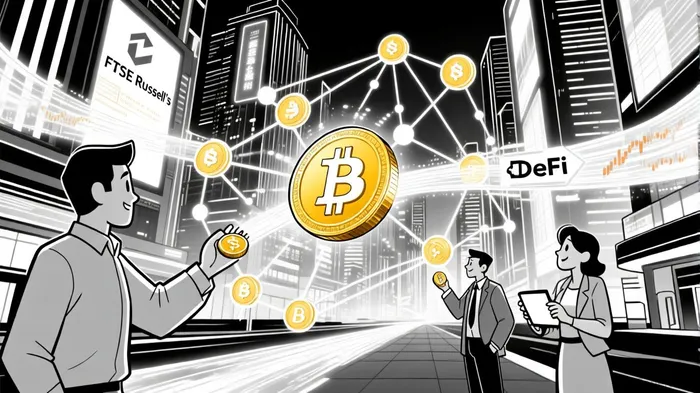
FTSE Russell's indices, including the Russell 1000, Russell 2000, and FTSE 100, now reside on blockchain networks through Chainlink's DataLink service. This marks the first time such high-trust, high-liquidity data is accessible onchain, enabling 2,000+ ChainlinkLINK-- ecosystem applications across 50+ blockchains to leverage it for creating tokenized financial products, according to a PR Newswire release. With over $18 trillion in assets benchmarked against these indices, the partnership unlocks unprecedented opportunities for developers and institutions to build, verify, and trade using onchain data.
Chainlink's oracle technology, which has already facilitated $25 trillion in transaction value and secured $100 billion in DeFi TVL, now serves as the backbone for this integration. For institutions, this means they can access the same level of data integrity and transparency that has long defined traditional finance, but with the programmability and composability of blockchain. Fiona Bassett, CEO of FTSE Russell, emphasized that this initiative accelerates mainstream adoption of tokenized assets by aligning onchain systems with institutional expectations, a point highlighted in the PR Newswire release.
Strategic Implications for DeFi: Trust, Programmability, and Innovation
The onchain availability of institutional-grade index data addresses a critical bottleneck in DeFi: the lack of reliable, verifiable external data. By embedding FTSE Russell's benchmarks into smart contracts, developers can now create synthetic assets, index-linked tokens, and automated derivatives with confidence in their underlying data sources. This programmability opens the door for next-generation financial instruments, such as tokenized ETFs that track traditional indices in real time.
Moreover, the partnership fosters institutional adoption by reducing friction between legacy systems and decentralized platforms. Financial institutions can now verify onchain data against trusted benchmarks, mitigating risks associated with data manipulation or inaccuracies. As Sergey Nazarov, Chainlink co-founder, noted, this collaboration is a "landmark moment" for enabling data-driven financial products, a perspective emphasized in the initial announcement. The result is a virtuous cycle: better data attracts more institutions, which in turn fuels innovation in DeFi.
Impact on ETF Markets: From BitcoinBTC-- to Altcoin Dominance
The recent surge in EthereumETH-- ETF inflows underscores the growing appetite for tokenized financial products. In Q3 2025, spot Ether (ETH) ETFs attracted $9.6 billion in inflows, outpacing Bitcoin ETFs' $8.7 billion, according to a TradingView analysis. This trend is driven by Ethereum's robust infrastructure, including its 87% dominance in DEX trading volume and 29.4% staking participation rate, as noted in a PowerDrill analysis. The availability of onchain index data further amplifies this momentum by enabling ETFs that track a broader array of assets, from traditional equities to digital assets.
The SEC's approval of altcoin ETFs in late 2025 has also accelerated institutional participation. With regulatory clarity improving, institutions are now exploring tokenized ETFs that leverage onchain data for real-time rebalancing and transparency. For example, an ETF tracking the Russell 3000 index could use onchain data to dynamically adjust its holdings, reducing latency and operational costs compared to traditional methods - a use case described in the PR Newswire release.
Future Outlook: Upgrades, Regulations, and the Road Ahead
Looking ahead, Ethereum's Fusaka upgrade in Q3-Q4 2026 promises to enhance scalability, further solidifying its role in onchain financial activity, according to PowerDrill's outlook. Meanwhile, regulatory developments-such as potential approval of ETF staking yields in Q1-Q2 2026-could unlock billions in institutional capital, another projection discussed by PowerDrill. These catalysts, combined with the Chainlink-FTSE Russell partnership, position tokenized finance to become a cornerstone of global markets.
However, challenges remain. Regulatory uncertainty in certain jurisdictions and the need for interoperability standards could slow adoption. Yet, the growing alignment between traditional and decentralized systems suggests these hurdles are surmountable.
Conclusion
The Chainlink-FTSE Russell partnership is more than a technical integration-it's a strategic reimagining of financial infrastructure. By bringing institutional-grade data onchain, it empowers developers to build trustless, transparent, and scalable financial products. For investors, this signals a shift toward a future where tokenized assets and ETFs are not just complementary to traditional markets but foundational to them. As the lines between old and new finance blur, the winners will be those who embrace the programmable, data-driven paradigm now.






Comentarios
Aún no hay comentarios