
Tokenized Deposits and the Future of Institutional Cash Management
In the ever-evolving landscape of institutional finance, the line between traditional banking and digital infrastructure is blurring. At the forefront of this transformation is BNY Mellon, the world's largest custodial bankBANK--, which has launched a groundbreaking initiative to tokenize deposits and build real-time, on-chain liquidity infrastructure. This move is not just a technological upgrade-it's a strategic pivot to redefine how institutional cash is managed in an era where speed, programmability, and 24/7 operability are no longer luxuries but necessities.
BNY's Tokenized Deposits: Bridging Legacy and Digital
BNY Mellon's tokenized deposit service, launched in early 2026, enables institutional clients to mirror their deposit balances on a private, permissioned blockchain. This innovation allows for near-instant settlement of transactions, eliminating the delays inherent in traditional payment systems. By creating digital representations of demand deposits, BNY is effectively turning cash into a programmable asset, enabling clients to execute collateral and margin transactions in real time.
The significance of this shift lies in its ability to address a critical pain point: liquidity friction. Traditional cash management systems, constrained by legacy infrastructure, often require days for settlements and lack the flexibility to adapt to the always-on demands of modern markets. BNY's tokenized deposits, however, operate on a blockchain that supports 24/7 availability, ensuring that institutional clients can access liquidity whenever needed. This is particularly valuable for firms like Citadel Securities and DRW, which rely on rapid capital movement to optimize trading strategies.
Strategic Partnerships and Market Integration
BNY's vision extends beyond its own platforms. In a landmark collaboration with Goldman Sachs, the bank has tokenized ownership records for money market fund (MMF) shares, creating a bridge between traditional assets and digital rails. This partnership, the first of its kind in the U.S., allows clients to subscribe to MMF shares via BNY's platforms, with ownership represented as mirrored tokens on Goldman Sachs' GS DAP platform. The initiative underscores BNY's role as a facilitator of interoperability, connecting institutional cash with digital-native ecosystems while maintaining regulatory compliance.
Such partnerships are not accidental but part of a broader strategy to position BNY as the connective tissue between traditional finance and emerging digital infrastructure. By integrating tokenized deposits with stablecoins and tokenized MMFs, BNY is creating a unified liquidity network that reduces counterparty risk and enhances transparency. For example, the bank's collaboration with Circle-a stablecoin issuer- highlights its commitment to leveraging digital assets for institutional-grade solutions.
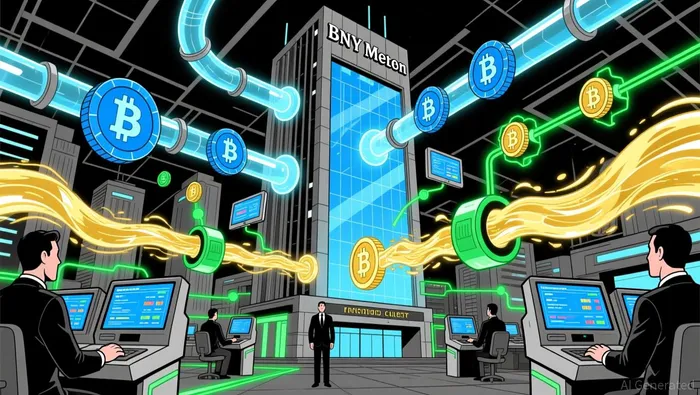
Quantifying the Impact: Efficiency Gains and Cost Savings
The empirical benefits of BNY's tokenized deposits are already materializing. According to a report by Bloomberg, the initiative has reduced settlement times for collateral and margin workflows from days to minutes, enabling clients to free up capital that would otherwise be locked in intermediaries. For a firm processing $2.5 trillion in daily payments BNY's current volume, even marginal improvements in efficiency translate to significant cost savings.
Moreover, the programmability of tokenized deposits allows for automated liquidity management. Institutions can now execute rules-based cash sweeps, repo transactions, and cross-border settlements with minimal human intervention. This not only cuts operational costs but also reduces the risk of errors inherent in manual processes. Early adopters, including ICE and StoneX Digital, have reported enhanced operational flexibility, with one participant noting a 30% reduction in settlement-related overhead.
The Broader Implications: A New Financial Infrastructure
BNY's efforts are part of a larger industry shift toward always-on financial systems. As markets increasingly demand real-time transactions, the traditional T+2 settlement model is becoming obsolete. Tokenized deposits provide the infrastructure to support this transition, enabling institutions to operate in a 24/7 environment without sacrificing regulatory oversight.
This shift is also being accelerated by regulatory clarity. The U.S. Genius Act, which provides a framework for tokenized assets, has created a conducive environment for innovation. BNY's private blockchain approach-where tokenized deposits remain within the bank's regulated infrastructure- ensures compliance while embracing digital efficiency. This balance between innovation and governance is critical for institutional adoption, as it mitigates the risks associated with unregulated digital assets.
Looking Ahead: The Road to Programmable Cash
BNY's tokenized deposits are just the beginning. The bank has signaled plans to expand the use cases for its on-chain liquidity infrastructure, including supporting rules-based, near real-time cash movements. This could revolutionize sectors like repo markets, where speed and transparency are paramount. Additionally, the integration of tokenized deposits with stablecoins and tokenized securities could create a seamless ecosystem for asset management, further blurring the lines between traditional and digital finance.
For investors, BNY's strategic move represents more than a technological upgrade-it's a harbinger of a new financial paradigm. As institutional demand for real-time liquidity grows, firms that fail to adapt risk being left behind. BNY's leadership in this space positions it as a key player in shaping the future of institutional cash management, offering a compelling case for long-term investment in digital infrastructure.







Comentarios
Aún no hay comentarios