
Tokenized Deposits and the Future of Banking Infrastructure
The $2 Trillion Opportunity
JPMorgan Chase & Co. has underscored the potential for stablecoins to reinforce the U.S. dollar's dominance in global finance, a point echoed in a Bernstein forecast. While estimates vary-ranging from $500 billion to $2 trillion-the consensus is clear: stablecoins are no longer a niche phenomenon. Bernstein Research forecasts that USDCUSDC--, with its institutional-grade transparency and regulatory compliance, could triple in supply to $150 billion by 2027. This growth is fueled by demand for faster, cheaper cross-border transactions and the need for regulated digital assets in institutional portfolios.
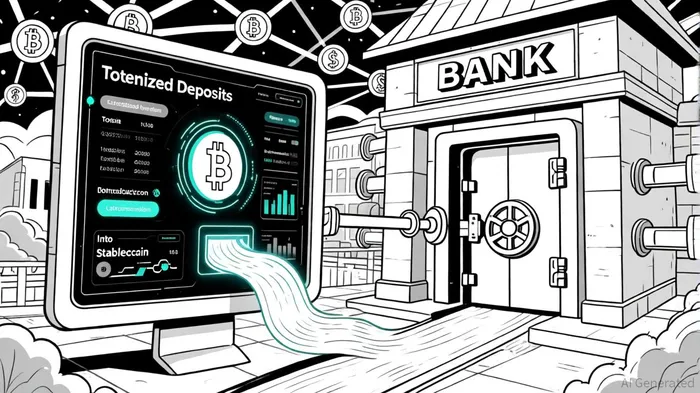
However, this expansion poses a dual challenge for banks. On one hand, stablecoins threaten to disintermediate traditional deposit systems by offering real-time, blockchain-based alternatives. On the other, they present an opportunity for banks to innovate. Custodia Bank and Vantage Bank have already launched a blockchain-based platform for tokenized deposits, enabling institutions to tokenize customer funds while retaining full control, as Custodia announced. This solution notNOT-- only mitigates the risk of deposit outflows but also integrates seamlessly with stablecoins, creating a hybrid model that leverages the best of both worlds.
Regulatory Clarity as a Catalyst
The success of tokenized deposits hinges on regulatory frameworks that balance innovation with oversight. The U.S. Genius Act, enacted in July 2025, has been a game-changer, providing a clear legal pathway for stablecoin adoption, as shown in coverage of the Genius Act. This legislation has spurred collaboration between traditional institutions and crypto-native firms. For instance, Circle's partnership with Deutsche Börse Group has positioned USDC and EURC as viable tools for capital markets, enabling faster trading and settlement under the EU's Markets in Crypto-Assets Regulation (MiCAR), a relationship highlighted in the Deutsche Börse partnership report.
Circle's cooperation with Deutsche Börse has also been covered elsewhere; for example, Benzinga reported on market reactions to that collaboration. Meanwhile, Visa's pilot program using stablecoins for international payments has demonstrated the technology's institutional legitimacy. Those industry moves are mirrored by bank–crypto partnerships: Custodia and Vantage launch platforms that integrate tokenized deposits with stablecoin rails. These developments signal a shift from speculative adoption to mainstream integration, with banks now competing to offer stablecoin-enabled services that align with regulatory expectations.
Strategic Advantages for Early Adopters
Banks that embrace tokenized deposits gain three critical advantages:
1. Interoperability: By tokenizing deposits, banks can offer customers seamless access to stablecoin ecosystems without sacrificing control over funds. This is particularly valuable for cross-border payments, where stablecoins reduce friction and costs; Custodia's recent U.S. push illustrates that dynamic, as noted in coverage of Custodia's U.S. push.
2. FDIC-Like Protections: Custodia's platform ensures that tokenized deposits retain FDIC-like safeguards, addressing concerns about security in decentralized systems (the Custodia announcement referenced above highlights these protections).
3. Scalability: The Infinant Interlace network, a patent-protected blockchain infrastructure, allows banks to scale tokenized deposit solutions rapidly, according to reporting on the Infinant Interlace network. Early adopters are already testing applications in supply chain finance and payroll systems, demonstrating the versatility of the model.
The Road Ahead
The stablecoin market's projected growth to $2 trillion by 2028 (estimates and industry commentary referenced above) means that banks must act swiftly. Those that delay risk losing market share to fintechs and crypto-native platforms. Conversely, institutions that invest in tokenized deposit infrastructure today will position themselves as leaders in a hybrid financial ecosystem. The key is to balance innovation with compliance, leveraging partnerships like those between Custodia and Vantage to stay ahead of the curve.
For investors, the implications are clear: banks with robust tokenized deposit strategies-backed by regulatory alignment and institutional partnerships-are poised to outperform in the next decade. The question is no longer whether stablecoins will reshape finance, but who will lead the transition.







Comentarios
Aún no hay comentarios