
Tokenized Deposits: The Next Frontier in Institutional Finance
The financial landscape is undergoing a seismic shift as institutions increasingly adopt blockchain-native solutions to address long-standing inefficiencies in treasury management and cross-border payments. At the heart of this transformation lies tokenized deposits, a concept that reimagines traditional banking infrastructure by leveraging blockchain's programmability, transparency, and speed. For institutional investors and financial infrastructure builders, this innovation represents not just a technological upgrade but a strategic pivot toward a more interconnected, liquid, and resilient financial system.
The Rise of Tokenized Deposits: A New Asset Class
Tokenized deposits are digital representations of fiat-backed value issued by licensed depository institutions, enabling 24/7 availability, instant settlement, and programmable features according to a report. Unlike traditional deposits, which are siloed within banking systems and subject to intermediated processes, tokenized deposits operate on distributed ledgers, allowing seamless integration with decentralized finance (DeFi) protocols, stablecoin networks, and cross-border payment systems according to research. This shift unlocks use cases such as real-time collateral management, automated margin calls, and dynamic liquidity allocation-capabilities that are particularly valuable in institutional settings where speed and precision are critical according to data.
A key driver of adoption is the potential to reduce systemic risks. By tokenizing deposits, institutions can create a more transparent and liquid ecosystem where assets are programmatically allocated to meet margin requirements or redemption pressures without relying on opaque intermediaries according to analysis. However, this interconnectedness also introduces new challenges. For instance, a shock in one tokenized fund could rapidly propagate across linked systems, amplifying contagion risks during periods of market stress according to research.
Strategic Infrastructure Investments: Building the Blockchain-Enabled Future
The transition to tokenized deposits requires robust infrastructure investments, particularly in blockchain protocols, custody solutions, and cross-border settlement networks. Two recent developments highlight this trend:
UBS Digital Cash: The Swiss banking giant has launched a permissioned blockchain system enabling near-instant cross-border transactions in USD, EUR, CHF, and CNY according to a case study. By eliminating intermediaries, UBS reduces settlement delays from days to seconds while providing real-time visibility into fund movements. This system is particularly appealing to multinational corporations seeking to optimize working capital and manage foreign exchange exposure according to analysis.
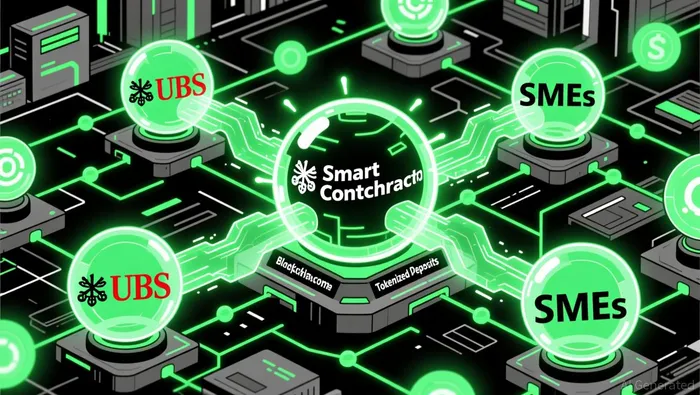 Blockchain.com's Digital Asset Treasury Solutions (DATS): A $200 million initiative aimed at bridging traditional and crypto markets, DATS offers institutional access to BitcoinBTC--, EthereumETH--, and other digital assets through regulated, onshore vehicles according to a report. By integrating blockchain-based custody and settlement tools, DATS addresses compliance and security concerns, making digital assets viable for institutional treasuries according to analysis.
These projects underscore a broader shift: institutional players are no longer viewing blockchain as a speculative experiment but as a foundational infrastructure layer. According to a report by Oliver Wyman, tokenized deposits could reduce cross-border payment costs by up to 80% while enabling programmable financial contracts that automate complex workflows according to research.
Cross-Border Payments: A $5.7 Trillion Opportunity
The global cross-border payment market, valued at $32 trillion in 2024, is a prime use case for tokenized deposits according to market analysis. Traditional systems are plagued by high fees (2–7% of transaction value) and multi-day settlement cycles, creating friction for businesses and individuals alike according to analysis. Blockchain-based solutions, however, leverage stablecoins-cryptocurrencies pegged to fiat-to enable near-zero-cost, real-time transactions.
For example, small and medium enterprises (SMEs), which often bear the brunt of high remittance fees, can save up to 60% by adopting blockchain-native payment systems according to data. Smart contracts further enhance this value proposition by automating payments based on predefined conditions, such as delivery confirmations or regulatory compliance checks according to research. This not only reduces operational overhead but also minimizes counterparty risk.
Risks and the Path Forward
Despite the promise, tokenized deposits are not without risks. The interconnectedness of blockchain-based systems could amplify systemic vulnerabilities, particularly if tokenized funds are used as collateral in leveraged positions according to analysis. Regulators are also grappling with how to apply existing frameworks to this nascent asset class, creating uncertainty for early adopters.
To mitigate these challenges, infrastructure providers must prioritize interoperability and regulatory alignment. For instance, UBS's permissioned blockchain model balances innovation with compliance by restricting access to authorized participants according to case study. Similarly, DATS emphasizes onshore, regulated exposure to crypto, addressing concerns around anti-money laundering (AML) and know-your-customer (KYC) requirements according to analysis.
Conclusion: A Strategic Imperative for Institutional Investors
Tokenized deposits are poised to redefine institutional finance by democratizing access to liquidity, reducing friction in cross-border transactions, and enabling programmable financial systems. For investors, the key opportunities lie in infrastructure projects that address scalability, security, and regulatory compliance. As the market matures, early adopters-like UBS and Blockchain.com-will set the benchmarks for a new era of financial infrastructure.
The next decade will likely see tokenized deposits evolve from niche experiments to mainstream tools, much like the internet's transition from academic networks to global commerce. For institutions, the question is no longer if to invest in this space, but how to position themselves at the forefront of the blockchain revolution.






Comentarios
Aún no hay comentarios