
Tokenized Deposits: BNY Mellon's Strategic Move to Revolutionize Cross-Border Payments in 2025
The Rise of Tokenized Deposits: BNY Mellon's Blueprint for a New Financial Era
In 2025, BNY Mellon has emerged as a pivotal player in the global shift toward blockchain-driven financial infrastructure. The bank's $2.5 trillion daily payment processing volume, according to a Coindesk report, has become a testing ground for tokenized deposits, a technology poised to disrupt traditional payment rails. By leveraging blockchain, BNY Mellon aims to address the inefficiencies of legacy systems, including slow settlement times, high intermediary costs, and operational constraints tied to banking hours, as Cointelegraph reports.
Tokenized deposits, which represent digital claims on commercial bank balances, offer a compelling alternative to stablecoins in cross-border payments. Unlike stablecoins-often issued by non-bank entities and backed by opaque reserves-tokenized deposits are fully integrated into a bank's balance sheet, ensuring FDIC insurance and regulatory compliance, according to a Forbes piece. This distinction positions them as a safer, more institutional-grade solution for real-time settlements. BNY Mellon's initiative aligns with broader industry trends, as competitors like JPMorganJPM-- and HSBCHSBC-- also pilot tokenized deposit systems to modernize their infrastructure, per a Coinotag report.
Tokenized Deposits vs. Stablecoins: A Strategic Divergence
The debate between tokenized deposits and stablecoins hinges on risk, compliance, and use cases. Stablecoins, such as USDCUSDC-- and USDTUSDT--, dominate DeFi and cross-border remittances due to their liquidity and interoperability across public blockchains like EthereumETH--, notes the ABA Banking Journal. However, they lack the regulatory safeguards of tokenized deposits, which are redeemable one-to-one for commercial bank balances and operate on permissioned blockchains to ensure compliance, per a Tearsheet interview.
BNY Mellon's Executive Platform Owner for Treasury Services, Carl Slabicki, emphasizes that these two instruments are complementary rather than competitive. "Stablecoins will continue to serve retail and DeFi use cases, while tokenized deposits will become the backbone of institutional cross-border payments," he stated, in a Finovate article. This bifurcation reflects BNY's strategy to integrate blockchain into its treasury services while maintaining the trust and regulatory certainty of traditional banking.
For instance, BNY's collaboration with BlackRock on the BlackRock USD Institutional Digital Liquidity Fund (BUIDL) demonstrates the practical application of tokenized deposits. By broadcasting fund valuations on-chain via BNY's Digital Asset Data Insights tool, the bank reduces reliance on third-party accounting services and enhances transparency for investors, as shown in a BNY press release. This innovation not only streamlines fund management but also sets a precedent for tokenized assets in institutional markets.
Efficiency Gains and Real-World Impact
BNY Mellon's tokenized deposit pilots have already yielded measurable improvements in cross-border payment efficiency. By moving transactions onto blockchain rails, the bank has reduced settlement times from hours to seconds, enabling 24/7 operations and cutting intermediary costs by up to 30%, according to an analysis by John Milne. These gains are critical for a firm processing $2.5 trillion daily, where even marginal efficiency improvements translate into significant cost savings.
A case in point is BNY's partnership with Swift to develop a blockchain-based shared ledger for real-time cross-border payments. This initiative, part of a broader digital transformation strategy, is detailed in a BNY press release. The bank's open banking platform, which connects to over 5,000 fintech partners, has already driven a 40% increase in transaction volume, underscoring the scalability of blockchain-integrated systems, according to a NextSprints guide.
Investment Implications and Future Outlook
For investors, BNY Mellon's foray into tokenized deposits signals a strategic pivot toward a decentralized financial future. The bank's ability to harmonize blockchain's speed with traditional banking's compliance infrastructure creates a unique value proposition. As global standards for tokenized assets evolve, BNY's early adoption could solidify its dominance in cross-border payments, a market projected to grow at 12% annually, notes a CryptoNews report.
However, challenges remain. Regulatory uncertainty, interoperability hurdles, and the need for industry-wide adoption could slow progress. Yet, with BNY's $2.5 trillion payment ecosystem as a proving ground and its partnerships with major players like Goldman Sachs and BlackRock, according to The Block, the bank is well-positioned to navigate these obstacles.
Conclusion
BNY Mellon's tokenized deposit initiative represents more than a technological upgrade-it is a paradigm shift in cross-border payments. By offering a safer, faster, and more transparent alternative to stablecoins, the bank is redefining the boundaries of institutional finance. For investors, this strategic move underscores the transformative potential of blockchain in a sector long dominated by legacy systems. As BNY continues to bridge traditional and digital finance, its success could serve as a blueprint for the next generation of financial infrastructure. 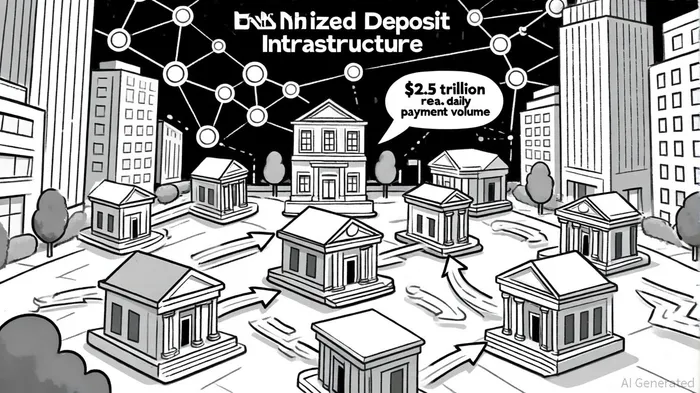







Comentarios
Aún no hay comentarios