
Tokenization of Real-World Assets: A New Paradigm for Liquidity and Democratization
The tokenization of real-world assets (RWA) is reshaping the global financial landscape, unlocking liquidity in traditionally illiquid markets and democratizing access to institutional-grade investments. By 2025, the total value of tokenized RWAs has surged to $33 billion, with projections suggesting a potential $10 trillion market by 2030. This exponential growth is driven by institutional adoption, regulatory clarity, and technological innovation in blockchain infrastructure. For investors, the key lies in identifying the foundational infrastructure projects enabling this paradigm shift-those that facilitate cross-chain interoperability, compliance, and scalability.
The Rise of Institutional-Grade RWA Tokenization
Institutional players are leading the charge. BlackRock's USD Institutional Digital Liquidity Fund (BUIDL), which tokenized $7.4 billion in money market assets, attracted over $500 million in months. Similarly, Siemens' €300 million corporate bond issuance on a blockchain reduced settlement times to two hours. These cases underscore the efficiency gains of tokenization: real-time settlement, reduced counterparty risk, and global accessibility.
The UAE has emerged as a strategic hub for RWA innovation, with platforms like Mavryk Network securing investments to tokenize over $10 billion in premium real estate. Meanwhile, the U.S. Treasury's tokenization efforts, coupled with private credit and debt instruments valued at $14 billion, highlight the sector's diversification.
Infrastructure as the Backbone of RWA Adoption
Blockchain infrastructure is the linchpin of this transformation. Ethereum and its Layer-2 networks dominate the RWA market, but Bitcoin-based solutions like the Liquid Network and RGB protocol are gaining traction. Platforms such as Hadron by Tether and Chainlink provide institutional-grade services, including price oracles and cross-chain interoperability.
Cross-Chain Protocols: Breaking Liquidity Silos
Cross-chain interoperability is critical for scaling RWA adoption. Protocols like Wormhole and Chainlink CCIP enable seamless asset transfers between EthereumETH--, SolanaSOL--, and Base, eliminating liquidity fragmentation. 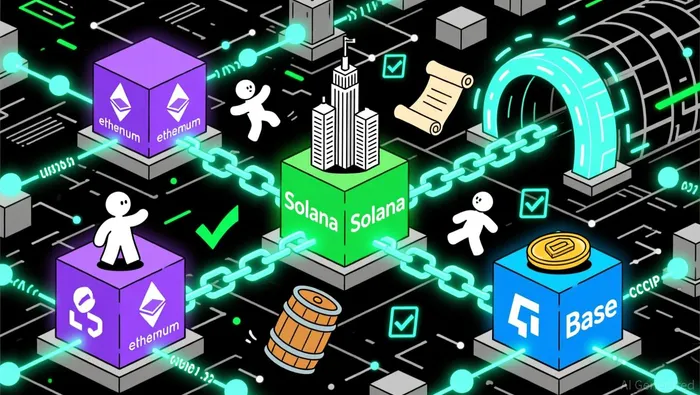 For instance, Wormhole's architecture allows tokenized real estate in Dubai to be traded globally without rehypothecation risks.
Compliance Tools: Meeting Regulatory Demands
Regulatory compliance is non-negotiable for institutional adoption. The ERC-1400 standard, with sub-standards like ERC-1594 (transfer validation) and ERC-1643 (forced transfers), ensures tokenized assets adhere to jurisdictional rules. In the EU, ERC-3643 aligns with MiCA regulations, enabling tokenized equity and fund management according to reports. Platforms like Securitize and Antier Solutions embed biometric KYC and AI-driven AML checks, offering real-time audit trails.
Scalability Solutions: Enabling Mass Adoption
Scalability remains a hurdle. Hybrid token designs-combining fungible and non-fungible properties (e.g., an NFT deed with ERC-20 shares)-balance legal precision with liquidity. Aave's Horizon Market further enhances scalability by allowing tokenized RWAs as collateral in lending markets.
Strategic Investment Opportunities
Investors should prioritize infrastructure projects with proven institutional partnerships and technical robustness:
1. Chainlink: Its integration with the DTCC and startups like Backed for tokenized stocks positions it as a compliance and data verification leader.
2. Mavryk Network: Purpose-built for RWA tokenization, it leverages UAE regulatory sandboxes to tokenize real estate at scale.
3. Wormhole: By enabling cross-chain asset movement, it addresses liquidity bottlenecks critical for global RWA markets.
The Road Ahead: From $33B to $10T
The RWA market's trajectory hinges on three factors:
- Regulatory Clarity: Frameworks like MiCA in Europe and VARA in Dubai are fostering institutional confidence.
- Technological Maturity: Innovations in hybrid tokens and Layer-2 solutions will reduce costs and improve user experience.
- Institutional Demand: With tokenized U.S. Treasuries and private credit dominating early adoption, the market is primed for exponential growth.
Conclusion
The tokenization of real-world assets is not a speculative fad but a structural shift in finance. For investors, the opportunity lies in backing the infrastructure that underpins this shift-cross-chain protocols, compliance tools, and scalable platforms. As the market evolves from $33 billion to $10 trillion, early adopters of these foundational projects will reap outsized rewards.





Comentarios
Aún no hay comentarios