
Tokenization of Financial Assets on XRP Ledger: Institutional Adoption as a Catalyst for XRP's Utility and Value
The financial landscape is undergoing a seismic shift as institutions increasingly adopt blockchain technology to tokenize real-world assets (RWAs). At the forefront of this transformation is the XRPXRP-- Ledger (XRPL), a high-performance blockchain platform that has emerged as a critical infrastructure for institutional-grade tokenization. By enabling the seamless digitization of financial instruments—from U.S. treasuries to private equity—the XRPL is not only redefining liquidity and efficiency but also solidifying XRP's role as a utility-driven asset.
Institutional Partnerships: A New Era of Tokenization
Ripple's strategic collaborations with regulated financial institutionsFISI-- have positioned the XRP Ledger as a preferred platform for tokenizing traditional assets. In 2025, Ripple partnered with Archax, a UK-regulated digital asset exchange, to onboard hundreds of millions of dollars in RWAs, including equities, debt instruments, and money market funds[1]. This partnership leverages the XRPL's compliance-ready infrastructure, allowing institutions to tokenize assets with features like automated market makers (AMMs) and decentralized identifiers (DIDs), which streamline regulatory adherence[1].
Another landmark development was the launch of OUSG, a tokenized U.S. government treasury product by Ondo Finance on the XRPL. Backed by BlackRock's USD Institutional Digital Liquidity Fund (BUIDL), OUSG allows institutional investors to mint and redeem tokens using Ripple's RLUSD stablecoin, offering 24/7 liquidity and institutional-grade security[3]. Similarly, Ripple, DBS Bank, and Franklin Templeton collaborated to tokenize money market funds, with Franklin Templeton's sgBENJI token now listed on DBS Digital Exchange alongside RLUSD. This initiative enables institutional clients to use tokenized assets as collateral for repurchase agreements, expanding the utility of digital securities[4].
The World Economic Forum (WEF) highlighted another milestone in May 2025: Aurum Equity Partners launched the first $1 billion private equity and debt tokenized fund on the XRPL. By digitizing ownership in traditionally illiquid assets, this project enhances transparency and liquidity while leveraging the XRPL's efficiency[1]. Meanwhile, Mercado Bitcoin tokenized over $200 million in real-world assets, including fixed-income and equity-income instruments, as part of its international expansion strategy[3].
XRP's Direct Utility: From Reserve Asset to Transactional Backbone
Beyond tokenization, XRP itself is gaining traction as a reserve asset and operational tool for institutions. Companies like Webus International, VivoPower, and Wellgistics Health have allocated hundreds of millions to XRP, using it for global payments, energy transactions, and real-time financial operations[1]. This trend aligns with Messari's analysis, which identifies XRP as a strategic reserve asset for enterprises seeking to reduce reliance on traditional banking systems[1].
The XRP Ledger's low transaction fees (often under $0.0005) and high throughput (1,500 transactions per second) further enhance its appeal for institutional use[2]. These features are critical for cross-border settlements, tokenized securities trading, and stablecoin operations. For instance, Ripple's RLUSD and Circle's USDCUSDC--, both supported on the XRPL, facilitate institutional treasury management with near-instant finality and minimal cost[2].
Infrastructure for Institutional DeFi
The XRPL's roadmap includes features tailored to institutional needs, such as EVM-compatible sidechains, lending protocols, and permissioned decentralized exchanges (DEXs)[5]. These advancements enable interoperability with Ethereum-based DeFi ecosystems while maintaining compliance with regulatory frameworks. For example, the ledger's AMM and central limit order book (CLOB) systems provide liquidity optimization for tokenized assets, addressing a key pain point for institutional traders[1].
Regulatory engagement in Asia, where governments are fostering tokenized government bonds and digital asset ecosystems, further strengthens the XRPL's institutional appeal[2]. This alignment with regulatory priorities reduces friction for adoption, particularly in markets like Singapore and Japan, where tokenization is gaining momentum.
Market Trends and Projections
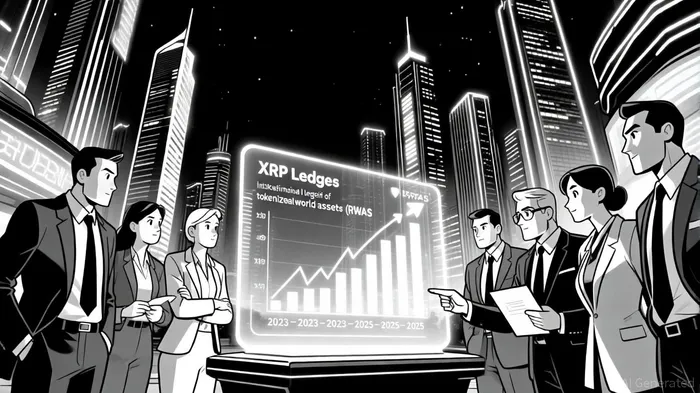
Data from Token Relations and Ripple reveals that tokenized RWAs on the XRP Ledger grew by 2,260% in 2025, rising from $5 million in January to over $118 million by mid-year[4]. This surge reflects broader institutional interest in blockchain-based finance, with 87% of institutional investors expected to allocate to digital assets in 2025[3].
Conclusion: XRP as a Value Driver in Institutional Finance
The XRP Ledger's institutional adoption is not merely a technical achievement—it is a catalyst for XRP's utility and value. By enabling tokenization of trillions in real-world assets, the XRPL is transforming XRP from a speculative asset into a foundational component of global finance. As more institutions tokenize assets, collateralize digital securities, and adopt XRP as a reserve asset, the demand for XRP is poised to grow in tandem with the expanding ecosystem. For investors, this represents a compelling case: the XRP Ledger is not just a blockchain; it is a bridge between traditional finance and the digital economy.





Comentarios
Aún no hay comentarios