
Tokenization of Aviation Revenue Streams and Its Disruptive Potential for Alternative Yield Investing
The Rise of Tokenized Aviation Assets
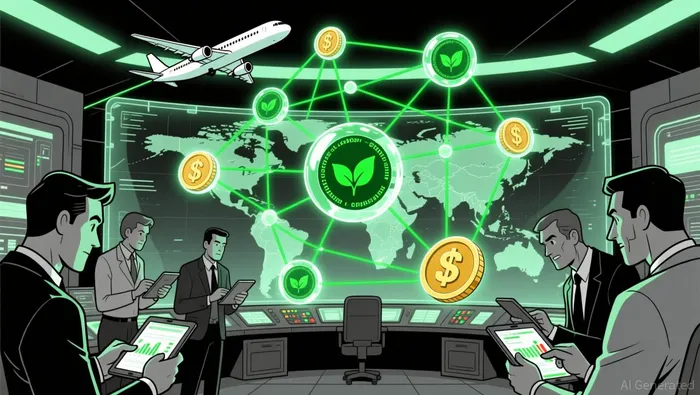
Tokenization is democratizing aviation finance by converting traditionally opaque assets into programmable, tradeable digital securities. For instance, Dreamstone Partners in South Korea is pioneering blockchain-based tokenization of aircraft leasing assets, transforming stable cash flows into fractionalized investments accessible to a global audience, as noted in Dreamstone Partners to Launch Blockchain-Based Tokenization of Aircraft Leasing Assets. Similarly, AriyaX, a Dubai-based private aviation firm, launched the AXPT token, which represents yield from private jet leasing and charter operations. Backed by a Special Purpose Vehicle (SPV) and governed by smart contracts, AXPT ensures compliance with AML/KYC protocols while enabling real-time yield distribution, according to Private Aviation Company AriyaX Launches Tokenized Aviation Framework AXPT.
This shift is not theoretical. The aviation blockchain market, projected to grow from $1.16 billion in 2025 to $5.53 billion by 2034, is already seeing tangible applications, as reported in Does blockchain have a place in Aviation?. Airlines are tokenizing loyalty programs to let passengers trade rewards, while airports tokenize parking spaces and lounge access. The result? Enhanced liquidity, reduced transaction costs, and a new class of investors who can allocate capital to aviation without owning a single aircraft.
Compliant Digital Securities: The New Gold Standard
Regulatory frameworks are catching up with innovation. In Hong Kong, Franklin Templeton launched the city's first tokenized money-market fund, with shares represented as blockchain tokens backed by U.S. Treasury securities, as noted in Franklin Templeton Launches Hong Kong's First Tokenized Fund. This aligns with the HKMA's Fintech 2030 plan, which emphasizes tokenization as a cornerstone of modern finance, as described in the same report. Similarly, AriyaX's AXPT tokens are structured as security tokens, ensuring compliance with global standards while attracting institutional and accredited investors, according to the Private Aviation Company AriyaX Launches Tokenized Aviation Framework AXPT report.
The benefits are clear:
1. Fractional Ownership: Investors can now own a slice of a $100 million aircraft for as little as $1,000.
2. Transparency: Smart contracts automate yield distribution and enforce governance rules, reducing fraud risk.
3. Liquidity: Tokens listed on platforms like Green-X (which previously tokenized Chinese ceramicsGreen-X Approves Listing of Tai Shan Digital STO, Revolutionizes Asset Management Through Digitization and Tokenization of Refined Chinese Ceramics) enable 24/7 trading, bypassing traditional market hours.
Aviation Carbon Credits: A Tokenized Climate Solution
As the industry races to meet net-zero goals, tokenized carbon credits are emerging as a game-changer. While no aviation-specific projects are yet public, the broader carbon credit tokenization market is booming. Blockchain platforms now track emissions data in real time, using IoT sensors and smart contracts to verify offsets, as described in Blockchain-based Carbon Credit Platform Development Market. For airlines, this means cheaper, verifiable compliance with ETS (European Union Emissions Trading System) and other regulations.
AriyaX's AXPT framework, for example, integrates sustainability by tokenizing carbon credits alongside aircraft yields, according to the Private Aviation Company AriyaX Launches Tokenized Aviation Framework AXPT report. This dual-income model appeals to ESG-focused investors, who can now align their portfolios with climate goals while earning competitive returns.
The Road Ahead: Challenges and Opportunities
Despite its promise, tokenization faces hurdles. Regulatory uncertainty in jurisdictions like the U.S. and EU could slow adoption, while interoperability between blockchain platforms remains a technical challenge. However, the market's projected 17.8% CAGR from 2025 to 2032, as noted in Blockchain-based Carbon Credit Platform Development Market, suggests these obstacles are surmountable.
For investors, the key is to focus on projects with regulatory alignment and real-world utility. AriyaX's SPV structure and Dreamstone's partnerships with Asian financial institutions, as noted in Dreamstone Partners to Launch Blockchain-Based Tokenization of Aircraft Leasing Assets, are early indicators of a maturing ecosystem.
Conclusion
Tokenization is not just a buzzword-it's a paradigm shift. By fractionalizing aviation assets and embedding compliance into smart contracts, this technology is creating a new frontier for alternative yield investing. As the market evolves, early adopters will reap the rewards of a sector that is finally breaking free from its legacy constraints.







Comentarios
Aún no hay comentarios