
Tokenization of Assets and Its Global Investment Implications: Strategic Opportunities in Markets Leading the Tokenization Revolution
The tokenization of real-world assets (RWAs) is reshaping the global investment landscape, unlocking liquidity, reducing friction, and democratizing access to traditionally illiquid markets. As of 2025, the U.S., Singapore, the UAE, and other jurisdictions are leading this revolution, driven by regulatory clarity, institutional innovation, and technological infrastructure. For investors, these markets represent not just speculative opportunities but strategic entry points into a new era of asset ownership and capital efficiency.
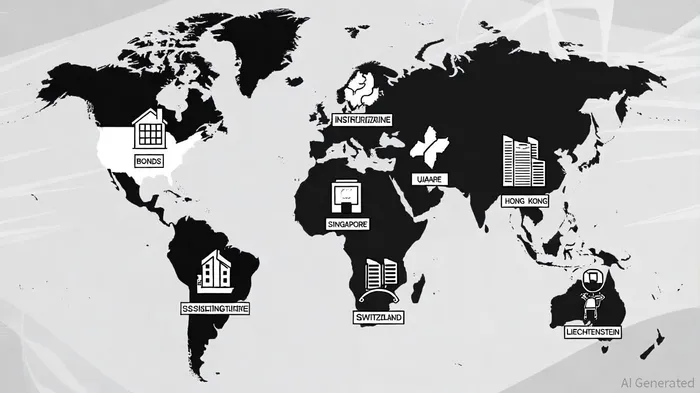
The U.S.: A Powerhouse of Institutional Adoption
The United States remains the largest market for asset tokenization, accounting for 34.8% of global initiatives in 2025, according to an Antier report. This dominance is fueled by major institutional players like BlackRock and Franklin Templeton, which have launched platforms such as BUIDL and Benji to tokenize treasuries and other assets, as noted in the Antier report. Regulatory progress, including the approval of BitcoinBTC-- ETFs and the Lummis-Gillibrand Stablecoin Bill, has further legitimized tokenization as a mainstream financial tool, according to a BinaryX guide.
For investors, the U.S. offers access to high-liquidity, institutional-grade tokenized assets. However, the market is still fragmented, with regulatory uncertainty lingering in certain sectors. Early adopters who partner with established players or invest in infrastructure (e.g., blockchain-based custodians) stand to benefit as the ecosystem matures.
Singapore: The Regulated Innovation Hub
Singapore has emerged as a global leader in regulated tokenization, thanks to the Monetary Authority of Singapore's (MAS) proactive approach. The Project e-VCC initiative, spearheaded by institutions like UBS, State Street, and InvestaX, has demonstrated the feasibility of tokenizing Variable Capital Companies (VCCs) using blockchain, as highlighted in the Antier report. This project tested both blockchain-native and tokenized security structures, proving that Singapore's legal framework under the Securities and Futures Act supports tokenized assets without explicit prohibitions, according to the Antier report.
Singapore's appeal lies in its regulatory clarity and institutional-grade infrastructure. For example, SBI Digital Markets and UBS Asset Management recently concluded a technical pilot for tokenized VCC funds in an SBI DM press release, signaling growing consensus on efficiency gains. Investors should focus on Singapore's tokenized bond and fund markets, which are poised to attract global capital as the country solidifies its position as a fund management innovation hub, per the BinaryX guide.
UAE: Real Estate Tokenization as a Game Changer
The UAE, particularly Dubai, has pioneered real estate tokenization, transforming property investment into a liquid, fractionalized asset class. In 2025, Dubai's Prypco Mint platform successfully tokenized two properties: a Dh2.4 million apartment in Business Bay (fully funded in one day by 224 investors) and a Dh1.2 million apartment in Mohammed Bin Rashid City (sold out in under two minutes by 149 investors), details originally noted in the SBI DM press release. These projects, supported by the Dubai Land Department (DLD) and VARA, highlight the UAE's ambition to capture 7% of total property transactions through tokenization by 2033, as described in the SBI DM release.
For investors, the UAE's model offers low barriers to entry (minimum investments as low as Dh2,000) and access to high-growth real estate markets. However, risks include regulatory evolution and market saturation as more projects launch. Strategic opportunities lie in platforms that integrate with Dubai's blockchain-based property title registry, ensuring enforceability and transparency, as discussed in the Antier report.
Switzerland and Liechtenstein: Legal Certainty for Institutional-Grade Assets
Switzerland's DLT Act and the SIX Digital Exchange provide a robust legal framework for tokenized bonds and real estate, making it a hub for institutional-grade offerings, according to the Antier report. Liechtenstein, meanwhile, has pioneered the concept of "physical validators"-a legal innovation that treats tokens as containers representing tangible assets, ensuring enforceability under its tokenization laws, as noted in the SBI DM release.
These jurisdictions are ideal for investors seeking legal certainty and high-quality tokenized assets. Switzerland's focus on bonds and Liechtenstein's emphasis on securities tokenization present niche but high-potential opportunities, particularly for cross-border institutional investors.
Visualizing the Tokenization Landscape
Strategic Opportunities for Investors
- Institutional Partnerships: Collaborate with firms like BlackRockBLK-- or UBS to access tokenized treasuries and VCC funds.
- Jurisdictional Arbitrage: Allocate capital to markets with complementary regulations (e.g., Singapore for funds, UAE for real estate).
- Infrastructure Investment: Target blockchain-based custodians, registry platforms, and DLT infrastructure providers.
- Retail Democratization: Invest in platforms enabling fractional ownership of high-value assets (e.g., Prypco Mint).
Conclusion
The tokenization revolution is no longer a speculative trend-it's a structural shift in how assets are owned, traded, and managed. For investors, the key is to align with jurisdictions that combine regulatory clarity, institutional adoption, and market demand. The U.S., Singapore, UAE, and Switzerland are leading the charge, but the opportunities extend globally. As the ecosystem evolves, early movers who understand the interplay between regulation, technology, and capital flows will reap the greatest rewards.





Comentarios
Aún no hay comentarios