
Token Unlocks: Catalysts for Chaos or Catalysts for Growth?
Token unlocks are the double-edged swords of crypto markets-events that can either catalyze explosive growth or trigger cascading sell-offs. In October 2025, two high-profile unlocks-Aster's $325 million ASTERASTER-- token release and Meteora's $610 million MET token generation event (TGE)-are testing the resilience of the SolanaSOL-- ecosystem. These events, while distinct in structure and intent, offer a masterclass in how tokenomics design and market psychology collide to shape price dynamics.
Aster's $325M Unlock: A Stress Test for Buyer Sentiment
Aster's 183.13 million ASTER token unlock on October 17, 2025, represents 11% of the token's market capitalization, creating immediate downward pressure as fresh supply floods the market, according to an October Showdown piece. Despite a 20% price drop in the lead-up to the event, institutional whales and high-profile figures like Mr. Beast have continued accumulating ASTER, with off-exchange withdrawals signaling long-term conviction, according to a Live Bitcoin News report. This dichotomy-short-term pain versus long-term optimism-highlights a critical question: Will retail investors panic-sell, or will institutional demand absorb the influx?
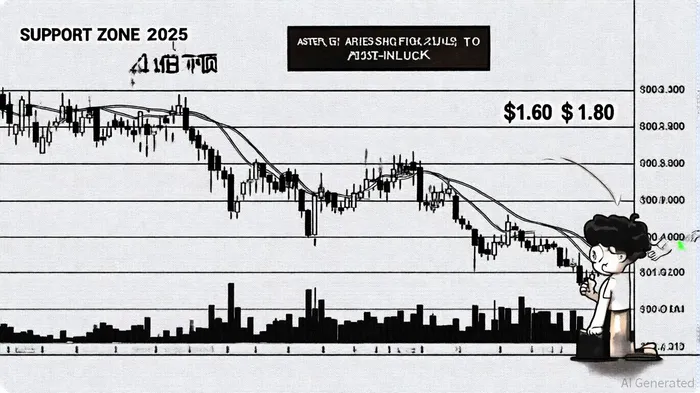
Price action suggests a pivotal test at the $1.60–$1.80 support zone. A successful defense here could validate ASTER's bullish case, with a break above $2.00 resistance potentially propelling the token toward $2.22–$2.45, as that October analysis suggested. Conversely, a breakdown below $1.25 would signal capitulation, extending volatility into the Meteora TGE on October 23.
Historical data reveals that a strategy of buying ASTER at support levels and holding for 30 trading days yielded an average return of 5.0% per trade, with a total return of 68.4% over the backtest period, per that October analysis. While the hit rate (54% win rate) suggests moderate consistency, the maximum drawdown of 30.3% underscores the risks of volatility during holding periods. These findings reinforce the importance of patience and risk management when targeting support-based entries.
Meteora's PhoenixPHB-- Rising Plan: Community-Driven Tokenomics
Meteora's TGE on October 23 unlocks 500 million MET tokens (50% of the 1 billion total supply), with the remaining 500 million vesting over six years for the core team and reserves, according to a Phemex article. This "Phoenix Rising Plan" deliberately avoids continuous inflation, prioritizing community alignment over team capitalization. Token allocations-ranging from 20% for Mercurial stakeholders to 3% for JupiterJUP-- stakers-reflect a deliberate effort to decentralize ownership, according to Live BitcoinBTC-- News.
Unlike Aster's abrupt unlock, Meteora's phased approach mitigates immediate selling pressure. However, the sheer size of the TGE-combined with Solana's crowded memeMEME-- coin ecosystem-poses risks. If liquidity dries up post-unlock, MET could face a "race to the bottom." Yet, the project's focus on LP stimulus and ecosystem growth (e.g., 15% allocated to liquidity provision) hints at a long-term value proposition, as noted in the Phemex article.
Market Dynamics: Volatility as a Feature, NotNOT-- a Bug
October's unlocks-including SuiSUI-- (SUI) and EthenaENA-- (ENA)-create a volatile environment where liquidity is king, according to a BingX roundup. For ASTER, the key variable is whale behavior: Will large holders dump their positions, or will they use the unlock to average down? Recent data shows whales have already offloaded ASTER via over-the-counter (OTC) channels, suggesting strategic accumulation rather than panic selling, as that roundup observed.
Meteora's success hinges on its ability to absorb the 500 million MET influx without triggering a price war. The project's emphasis on stake-to-earn mechanics and memecoinMEME-- synergies (e.g., 2% allocated to M3M3 holders) could attract retail FOMO, but only if the token's utility justifies the hype.
Strategic Entry Points: Buy the Dip or Sell the Rumor?
For ASTER, the $1.60–$1.80 support zone represents a high-probability entry if buyers reassert control post-unlock. A rebound above $2.00 would validate institutional demand, while a breakdown to $1.25 would force a reevaluation of the token's fundamentals. Meteora's TGE offers a more speculative play: Early entry at the $0.20–$0.25 range (based on pre-TGE liquidity pool data) could yield outsized returns if the community-driven model gains traction.
However, both projects require caution. Token unlocks are not inherently bullish or bearish-they reflect the interplay of supply, demand, and narrative. In a market where "buy the rumor, sell the news" is the norm, the true test lies in post-unlock execution.
Conclusion: The Long Game
Aster's unlock and Meteora's TGE are more than short-term volatility events-they are stress tests for the Solana ecosystem's capacity to absorb large token supplies while maintaining price stability. While immediate selling pressure is inevitable, the accumulation by whales and the structural design of Meteora's tokenomics suggest that long-term value realization is possible. For investors, the key is to separate noise from signal: Use price action and on-chain data to identify strategic entry points, and avoid getting swept up in the hype cycle.






Comentarios
Aún no hay comentarios