
Token Issuer Accountability in DeFi Acquisitions: Unveiling Structural Risks for Token Holders in Fragmented Ecosystems
The rapid evolution of decentralized finance (DeFi) has introduced transformative opportunities for financial innovation, but it has also exposed token holders to unprecedented structural risks. Between 2023 and 2025, DeFi acquisitions and ecosystem expansions have highlighted critical accountability gaps in token issuer practices, particularly in fragmented, permissionless environments. These risks-ranging from rug pulls to governance failures-have left investors vulnerable to cascading losses, often without recourse. This analysis examines the systemic challenges posed by token issuer accountability in DeFi acquisitions, drawing on recent case studies and regulatory developments to underscore the urgent need for structural reforms.
The Accountability Vacuum in DeFi Acquisitions
DeFi's decentralized nature inherently complicates accountability. Unlike traditional finance, where centralized entities bear legal and fiduciary responsibilities, DeFi platforms often lack enforceable governance mechanisms or identifiable actors to hold accountable. For instance, the collapse of Stream Finance in November 2025-a $285 million loss-exposed the dangers of the "Risk Curator" model, where unregulated third parties manage user deposits without capital requirements or identity disclosure. This model, prevalent on platforms like MorphoMORPHO-- and EulerEUL--, incentivizes high-risk strategies while shifting losses entirely onto token holders.
The absence of accountability is further exacerbated by the fragmented regulatory landscape. While the EU's MiCA framework seeks to harmonize blockchain regulations, the U.S. remains a patchwork of state and federal enforcement models. This divergence creates jurisdictional loopholes that token issuers exploit, as seen in the COAI token crash of late 2025. Here, 87.9% of the token supply was controlled by just ten wallets, enabling a coordinated depegging that erased 88% of its value and caused $116.8 million in losses. 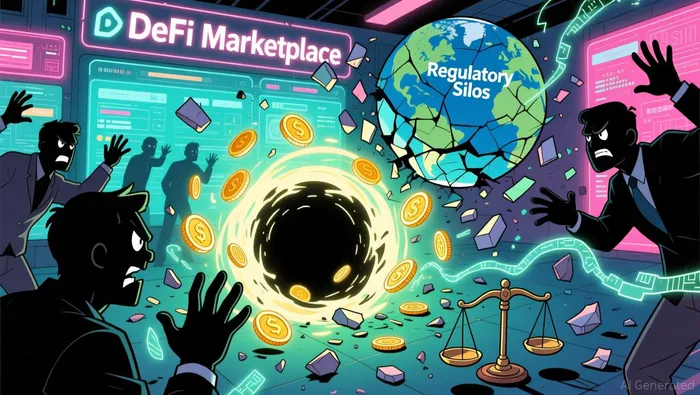 Such cases underscore how fragmented ecosystems enable opaque governance and concentrated power, leaving token holders with minimal oversight.
Case Studies: Structural Failures in Action
Recent DeFi acquisitions and platform collapses illustrate the tangible consequences of accountability failures. The HyperVault yield-farming protocol incident in September 2025, where developers drained $3.6 million in user deposits without code exploits, exemplifies the classic rug pull. Similarly, the MetaYield Farm debacle in 2025 saw $290 million siphoned from investors, with 75% of rug pulls involving unaudited smart contracts. These cases highlight a troubling trend: as DeFi scales, so does the sophistication of scams, often leveraging fragmented ecosystems to obscure liabilities.
Governance failures further compound these risks. The GMX V1 exploit in July 2025, which exploited a re-entrancy vulnerability to drain $40–42 million, revealed how even technically robust protocols can falter without rigorous audits. Meanwhile, the depegging of DeFi-native stablecoins like XUSD and deUSD in 2025 demonstrated how interconnected liquidity pools and oracle dependencies amplify systemic risks. In these scenarios, token holders bear the brunt of losses, often without legal avenues for redress.
Regulatory Responses and Legal Precedents
Regulators have begun to grapple with the challenges posed by DeFi's fragmented structure. A landmark 2023 U.S. District Court ruling dismissed claims against Uniswap Labs, affirming that decentralized platforms are not liable for third-party token scams. This decision, while providing legal clarity for DeFi developers, also underscores the limitations of existing frameworks in protecting token holders. Conversely, the SEC's DoubleZero DePIN no-action letter in September 2025 offered a more nuanced approach, exempting the 2Z2Z-- token from securities classification. Such targeted interventions reflect a growing recognition of DeFi's unique characteristics but fall short of addressing systemic accountability gaps.
Mitigating Risks: A Path Forward
To safeguard token holders, DeFi ecosystems must adopt structural reforms that align incentives and enforce accountability. Key measures include:
1. Mandatory Smart Contract Audits: Platforms like Halborn's 2025 report emphasize that 34.6% of exploits stem from faulty input validation. Rigorous audits and transparency in code repositories can mitigate these risks.
2. Multi-Signature and Institutional-Grade Wallets: Tools like multi-party computation (MPC) solutions reduce single points of failure, as outlined in the EEA's DeFi risk guidelines.
3. Regulatory Sandboxes and International Coordination: Harmonizing enforcement models, as proposed in the EU's MiCA framework, could address jurisdictional arbitrage.
4. Enhanced Governance Mechanisms: Protocols must enforce identity disclosure, capital requirements, and risk constraints for curators, as advocated by Chaincatcher.
Conclusion
DeFi's promise of financial democratization is undermined by structural risks rooted in token issuer accountability failures. As acquisitions and ecosystem expansions accelerate, token holders face a volatile landscape where fragmented governance and regulatory gaps enable exploitation. While legal precedents and technological safeguards offer partial solutions, systemic change requires a reimagining of DeFi's foundational principles-prioritizing accountability, transparency, and user protection. For investors, the lesson is clear: in the absence of enforceable accountability mechanisms, due diligence and risk mitigation must be non-negotiable.






Comentarios
Aún no hay comentarios