
Token Buybacks Spend $880M+ Last Year, But Prices Stalled Anyway – One Number Now Decides If They Work
Token buybacks dominated crypto narratives in 2025 as protocols responded to criticism over tokenomics. CoinGecko data shows buyback spending accelerated sharply in the second half of the year. Hyperliquid, Pump.fun, and JupiterJUP-- led with significant buyback programs.
The initial price surges from these programs created a new valuation framework for tokens. However, by year-end, the pattern had reversed as buyback announcements carried less punch. Prices stalled despite continued repurchases, prompting critics to question the strategy.
The core issue is whether the conditions that made early programs effective still hold. Market participants are refocusing on unlock schedules and revenue durability. Optimism's proposal arrives at an inflection point for the debate on buyback effectiveness.
Why Buybacks Lost Their Punch
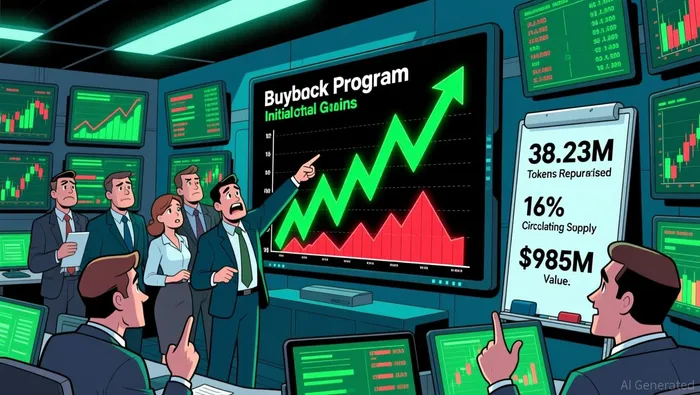
Hyperliquid's Assistance Fund became the defining case study for programmatic buybacks. Data from ASXN shows the fund bought back 38.23 million HYPE tokens. This represented 16% of the circulating supply and nearly $1 billion in token value.
Jupiter (JUP) and Pump.fun followed similar paths with systematic buybacks. ENAENA-- combined buybacks with stablecoin expansion to amplify its narrative. These programs initially succeeded due to transparent execution and depressed valuations.
The effectiveness faded as market caps rose and buyback yield compressed. Unlock schedules overwhelmed repurchase flows, diluting the impact of buybacks. Revenue cyclicality created a pro-cyclical trap, with protocols buying high during bull runs.
How Markets Are Reassessing Buybacks
Criticism sharpened through late 2025, not because the mechanism failed. Protocols faced increasing opportunity costs as buybacks competed with growth spending. This mirrors traditional finance debates about share repurchases versus reinvestment.
Optimism's 50-50 revenue split attempts to balance buybacks with growth. By reserving half of Superchain revenue for active treasury management, the protocol maintains growth flexibility. This approach acknowledges that buybacks cannot substitute for fundamental growth.
The mechanical question is whether buyback flows exceed dilution on a net basis. Tokenomist's unlock calendars reveal significant future supply pressure. Hyperliquid faces an unlock on Feb. 6, with 76% of its total supply still locked.
The buyback coverage ratio determines the direction of net supply. When coverage exceeds 1, supply contracts and price support becomes mechanical. HYPE's next unlock is valued at $470 million, five times its average monthly buyback.
What Analysts Are Watching Next
Optimism positions its buyback program as a token redesign rather than price defense. The program represents roughly 0.7% of OP's $1.33 billion fully diluted valuation. That's a modest yield by DeFi standards, suggesting long-term value creation goals.
The 50-50 revenue split is the key design choice. By preserving half of incoming fees for active treasury management, OptimismOP-- maintains funding for ecosystem incentives. This approach recognizes that buybacks cannot substitute for growth but can compound existing value.
The strategic question is whether Superchain's revenue grows fast enough to make buybacks material. If layer-2 transaction volume and application adoption accelerate, fee collection scales. Growth stalls or intensifying competition could leave the program as a rounding error.
The Jan. 10 unlock arriving before buybacks begin will test market reactions. Markets must weigh immediate supply pressure against forward structural demand. What buybacks can and cannot do depends on four testable conditions.
First, buyback dollars must be large relative to free float and daily trading volume. Retiring 0.5% of supply annually is noise, while retiring 5% creates mechanical scarcity. Second, buybacks must exceed dilution on a net basis over rolling quarterly windows.
Third, revenue sources must prove durable through market cycles. Buyback capacity must not evaporate when support is most needed. Fourth, supply reduction must be permanent through burns or locked treasury governance.
Token buybacks work when they alter supply-demand dynamics enough to force repricing. When conditions fail, buybacks devolve into one-time repricing events. Criticism holds when programs are discretionary, opaque, or dwarfed by unlocks.
The distinction is mechanical, not philosophical. It is measurable and falsifiable through market data and supply math. Optimism's program tests whether a modest buyback can reframe token economics.
If Superchain revenue scales and buybacks persist, the model becomes a blueprint. If revenue stalls or unlocks dominate, the experiment confirms buybacks alone cannot manufacture moats. The answer determines whether token economics still matter in crypto markets.
The debate shifts from theoretical to testable as Optimism's program begins. Markets will watch how the protocol balances growth, price support, and tokenomics. Investor confidence will depend on whether the buyback strategy aligns with sustainable growth.
The answer to these questions determines whether liquidity and narrative have already priced in every structural lever protocols can pull. What matters most is whether buybacks create structural tailwinds or temporary support. Investors will assess whether the conditions for effective buybacks still hold in 2026.






Comentarios
Aún no hay comentarios