
Toast, Inc.'s Strategic Position in the Restaurant Tech Sector: Operational Transformation and SaaS Scalability Drive Institutional Confidence
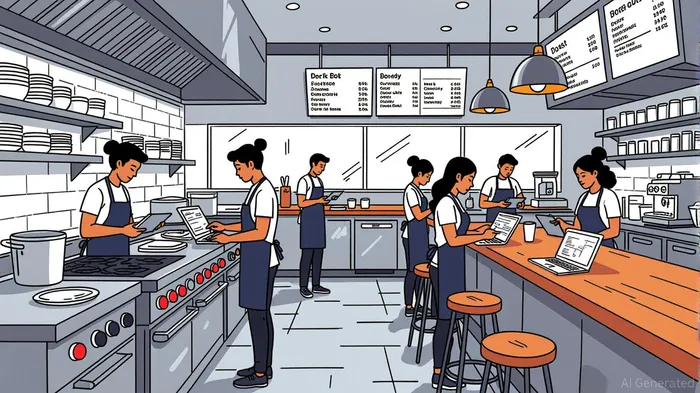
In the rapidly evolving restaurant technology sector, ToastTOST--, Inc. (TOST) has emerged as a leader through its vertically integrated SaaS platform, which combines cloud-based software, payment solutions861277--, and fintech services to transform operational efficiency. The company's recent participation in the 2025 Goldman SachsGS-- Communacopia + Technology Conference underscores growing institutional confidence in its strategic positioning and scalability. As the restaurant industry grapples with labor shortages, rising costs, and shifting consumer preferences, Toast's ability to deliver recurring revenue growth and margin expansion has positioned it as a compelling case study in SaaS-driven operational transformation.
Institutional Confidence and Strategic Visibility
Toast's appearance at the 2025 Goldman Sachs conference, moderated by analyst William Nance, marked another high-profile engagement with investors and industry experts[1]. The event, which followed the company's Q2 2025 earnings report, highlighted Toast's progress in scaling its platform while maintaining profitability. According to a report by Marketscreener, the fireside chat emphasized Toast's “commitment to engaging with investors and analysts,” reflecting a broader trend of institutional interest in restaurant tech's potential to digitize and optimize operations[2]. This visibility aligns with Toast's broader strategy to solidify its role as a digital operating system for restaurants, a vision articulated by CEO Aman Narang during the Q2 earnings call[3].
Operational Transformation: Metrics and Margin Expansion
Toast's operational efficiency is evident in its financial performance. In Q2 2025, the company added a record 8,500 net new locations, bringing its global total to 148,000[1]. Annualized recurring revenue (ARR) grew 31% year-over-year to $1.9 billion, driven by robust adoption of its subscription and fintech services[3]. Recurring gross profit from subscriptions and fintech expanded by 35% and 32%, respectively, while Adjusted EBITDA reached $161 million—a 35% margin, up 13 percentage points year-over-year[1]. These metrics reflect disciplined cost management and a scalable unit economics model, where an average contract value (ACV) of $10,000 justifies investments in a distributed sales force targeting high-density urban markets[4].
The company's vertical integration further enhances efficiency. For example, Supper Club, a restaurant chain, leveraged Toast's integrated SaaS tools to boost catering sales by 40%[1]. Similarly, AI-powered features like ToastIQ and Sous Chef have demonstrated tangible results, such as a 6% increase in average order volume at Mission Boat House[4]. These innovations not only improve customer outcomes but also reinforce Toast's ability to differentiate itself in a competitive market.
SaaS Scalability and Competitive Advantages
Toast's SaaS model is designed for cross-segment scalability, serving small and medium businesses (SMBs), enterprises, and international markets. In Q1 2025, the company expanded its SMB footprint by adding 6,000 locations, leveraging a geographic sales strategy that focuses on localized relationship-building[4]. For enterprises, Toast has secured landmark deals, such as its partnership with Applebee's, which represents one of the largest enterprise contracts in its history[1]. Internationally, the company has expanded into the UK, Ireland, and Canada, with improved attach rates and unit economics[4].
A key differentiator is Toast's embedded fintech solutions, which generate recurring revenue streams while enhancing customer retention. The recent partnership with American ExpressAXP-- to offer personalized hospitality experiences further illustrates its ability to integrate third-party services into its platform[3]. Additionally, the launch of the Toast Go® 3 handheld device and AI-driven tools like ToastIQ positions the company to address evolving operational needs, from order management to predictive analytics[3].
Long-Term Growth and Institutional Validation
Toast's strategic initiatives have not gone unnoticed. Institutional confidence is reflected in its revised full-year guidance, which includes 29% growth in FinTech and subscription gross profit[1]. The company also raised its Q3 adjusted EBITDA forecast to $140–150 million, signaling optimism about its ability to balance growth with profitability[3]. Analysts at DataInsightsMarket note that Toast's disciplined margin expansion and proactive cost adjustments—such as optimizing its sales and marketing spend—underscore its long-term financial stability[5].
Moreover, Toast's entry into the Australian market in 2025 marks a strategic step toward global diversification[3]. This move, combined with its AI-driven product roadmap, positions the company to capitalize on the $120 billion global restaurant tech market[5]. As noted in a Marketscreener analysis, Toast's consistent presence at industry conferences like Goldman Sachs' event highlights its role as a thought leader in operational innovation[2].
Conclusion
Toast, Inc. has redefined restaurant efficiency through its vertically integrated SaaS platform, combining operational rigor with technological innovation. Its recent financial performance—marked by 31% ARR growth, 35% EBITDA margins, and a 35% expansion in recurring gross profit—demonstrates the scalability of its model. The 2025 Goldman Sachs fireside chat, while lacking direct executive quotes, served as a testament to the company's institutional credibility and strategic clarity. As the restaurant sector continues to digitize, Toast's focus on AI, fintech integration, and global expansion positions it as a leader in a market ripe for disruption. For investors, the alignment of operational transformation, SaaS scalability, and institutional confidence makes Toast a compelling long-term opportunity.







Comentarios
Aún no hay comentarios