
TNL Mediagene's 1H 2025 Performance and Growth Trajectory: Strategic Positioning in the Evolving Biotech Landscape
In the dynamic interplay of innovation and capital allocation, companies must navigate both immediate financial pressures and long-term strategic imperatives. TNL MediageneTNMG-- (NASDAQ: TNMG), a media and technology firm with a public listing since December 2024, exemplifies this balancing act in its first half of 2025 performance. While its operations are not rooted in traditional biotechnology, the company's strategic use of AI, expansion into global markets, and content-commerce partnerships position it at the intersection of digital transformation and emerging tech-a space increasingly vital to the broader biotech ecosystem.
Financial Resilience Amid Operational Challenges
According to a PR Newswire release, TNL Mediagene reported revenue of $21.8 million in H1 2025, a 5.7% increase from $20.6 million in the same period in 2024. This growth, however, was accompanied by a net loss of $4.3 million, a 27.2% reduction from $5.9 million in H1 2024, according to the release. The narrowing loss reflects operational improvements, including a reduced operating margin of (25.9%) and a Management Adjusted EBITDA margin of (6.5%), both showing slight improvements from 2024 per the release.
The company's financial resilience is further underscored by a $5.0 million reduction in outstanding debt and a maintained cash balance of $1.8 million as of September 30, 2025, as noted in the release. These metrics suggest disciplined capital management, a critical factor for firms navigating the high costs of public company compliance and R&D investments. While specific R&D expenditures for H1 2025 were not disclosed in the shareholder letter, the company's FY2024 financials revealed $8.2 million in property and equipment and $2.9 million in capitalized development per the TNMG Financial Report, indicating a historical commitment to technological infrastructure.
Strategic Expansion and AI-Driven Innovation
TNL Mediagene's growth trajectory is anchored in its strategic positioning as a digital media and commerce platform. The company's expansion into new language markets-such as launching Roomie International and laying the groundwork for Business Insider Taiwan-targets the global Mandarin-speaking audience of over 1 billion people, a point highlighted in the PR Newswire release. This move aligns with broader trends in content localization, where regional relevance drives engagement and monetization.
In parallel, the firm has leveraged AI to enhance performance. The Ad2 AI Agent, which integrates AI Audience and AI Creative to optimize ad placements and creative strategies, represents a forward-looking approach to digital advertising mentioned in the release. Such innovations are critical in an era where AI-driven personalization is redefining user experiences and ad efficacy.
Content Commerce and Ecosystem Partnerships
The company's partnerships with e-commerce platforms like PChome and TikTok Shop Japan further illustrate its strategic alignment with the evolving digital economy. By forming a content-commerce alliance with PChome, TNL Mediagene aims to harness first-party retail data and next-generation ad products, creating a feedback loop between content creation and consumer behavior, as described in the release. Similarly, its TikTok Shop Japan initiative with 7NaNatural-a brand recognized for clean beauty-highlights the potential of social commerce in niche markets, also noted in the release.
These partnerships are not merely transactional; they reflect a broader ecosystem-building strategy. In the biotech and health-tech sectors, for instance, such data-driven commerce models could facilitate personalized product recommendations, a trend gaining traction as consumers demand tailored solutions.
Leadership and Organizational Streamlining
A shareholder letter from July 29, 2025, emphasized key leadership appointments and organizational streamlining as part of the company's "active and transformative" H1 2025. Strengthening talent pipelines and operational efficiency are essential for firms aiming to scale in competitive markets. For TNL Mediagene, these efforts appear to complement its technological and market expansions, ensuring agility in execution.
Strategic Positioning in the Evolving Landscape
While TNL Mediagene is not a biotech company in the traditional sense, its strategic initiatives resonate with the broader ecosystem of innovation driving the sector. The integration of AI, data analytics, and global content strategies mirrors the cross-industry trends shaping biotech's future-where digital tools enhance R&D, patient engagement, and commercialization. For investors, the company's ability to adapt to these trends positions it as a potential beneficiary of the convergence between media, technology, and life sciences.
However, risks remain. The company's reliance on public company costs and its yet-to-be-disclosed R&D figures for H1 2025 could impact long-term profitability. Additionally, the competitive nature of digital advertising and e-commerce requires sustained innovation to maintain market share.
Conclusion
TNL Mediagene's H1 2025 performance demonstrates a blend of financial prudence and strategic ambition. By expanding into new markets, deploying AI-driven tools, and forging content-commerce partnerships, the company is positioning itself as a versatile player in the digital economy. For investors, the key will be monitoring how these initiatives translate into scalable revenue and profitability, particularly as the firm releases its full H1 2025 financial results in August 2025. In an era where adaptability defines success, TNL Mediagene's trajectory offers a compelling case study in strategic reinvention.
Historical data from 2022 to the present reveals that TNL Mediagene's stock has experienced negative cumulative returns of approximately -14.6% in the 30 days following earnings releases, compared to -6.6% for the benchmark. While the sample size of five events is limited, this pattern suggests that post-earnings volatility may pose challenges for a simple buy-and-hold strategy. Investors should weigh these historical trends against the company's operational improvements and long-term strategic bets when evaluating risk-reward dynamics.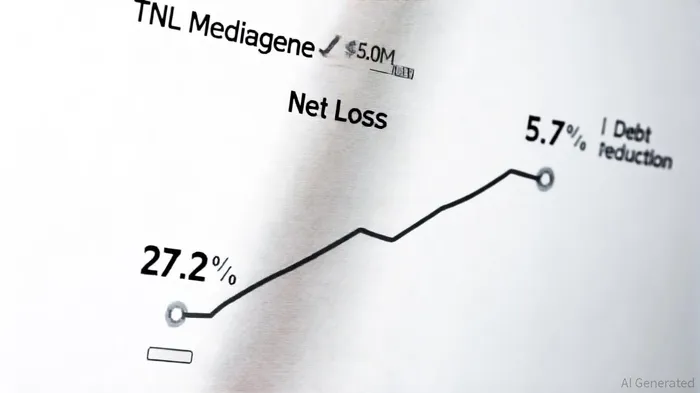





Comentarios
Aún no hay comentarios