
TMC's High-Stakes Gamble: Can Deep-Sea Mining Deliver a Green Gold Rush?
The Metals Company (TMC), once known as DeepGreen Metals, has positioned itself at the intersection of technological ambition and environmental controversy. As a deep-sea mining pioneer targeting polymetallic nodules in the Clarion Clipperton Zone (CCZ), TMCTMC-- claims to hold the key to unlocking critical metals for the energy transition. But with regulatory headwinds, ecological backlash, and a precarious financial position, the question remains: Is TMC a speculative goldmine or a cautionary tale?
The Minerals of the Future, Buried in the Deep
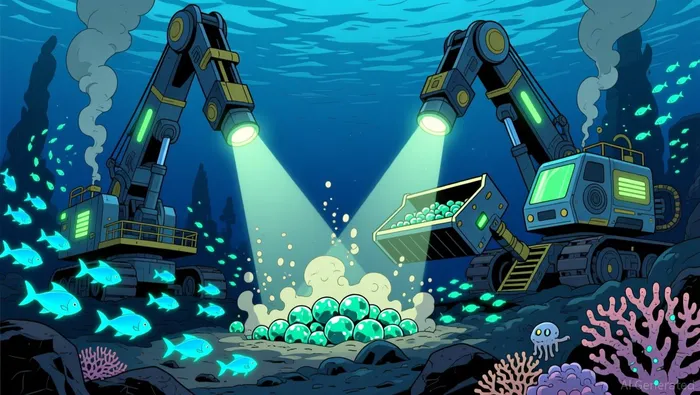
TMC's business model hinges on the extraction of polymetallic nodules-rock-like formations rich in nickel, copper, cobalt, and manganese-found in international waters. These metals are indispensable for electric vehicles (EVs), batteries, and renewable energy infrastructure. According to the IEA, global demand for nickel could double by 2040, driven by EV adoption, while cobalt demand is projected to grow by 50-60% over the same period. Manganese, though abundant, faces a critical bottleneck in producing battery-grade manganese sulfate, a component for next-gen EV cathodes.
TMC's technological progress is notable. The company has demonstrated its ability to process nodules into battery-grade materials and secured $37 million in strategic investments to scale operations. However, its path to commercialization is fraught with delays. Regulatory approvals remain pending, and the company's Q3 2025 net loss-largely due to non-cash expenses-highlights its pre-revenue status.
A Legal Quagmire in International Waters
TMC's most significant hurdle is regulatory. The International Seabed Authority (ISA), the U.N.-backed body governing deep-sea mining in international waters, has repeatedly criticized TMC's strategy of seeking U.S. jurisdiction to bypass ISA oversight. The ISA asserts that such actions violate the United Nations Convention on the Law of the Sea (UNCLOS), which designates the seabed as the "common heritage of humankind." Meanwhile, TMC's application to NOAA under a Trump-era executive order has drawn skepticism, with critics warning of diplomatic fallout and potential litigation.
Environmental groups have also mobilized against TMC. Studies suggest that industrial-scale nodule collection could disrupt deep-sea ecosystems irreversibly, with unknown long-term consequences. Major insurers and banks have distanced themselves from the project, citing unacceptable risks. Even TMC's early supporters, like Maersk, have retreated, underscoring the sector's reputational fragility.
The Calculus of Risk and Reward
For TMC to succeed, it must navigate a perfect storm of technical, regulatory, and environmental challenges. Its long-term vision-commercial production by late 2027-depends on securing permits, proving its technology at scale, and mitigating ecological harm. If successful, TMC could capitalize on a projected tripling of critical mineral demand by 2030, as outlined by the World Economic Forum.
Yet the financial risks are stark. With $115.6 million in cash as of September 2025, TMC must raise additional capital to fund operations-a prospect complicated by its volatile stock price and lack of revenue. The company's reliance on a single, unproven technology in a politically charged arena makes it a high-beta play, appealing to speculative investors but ill-suited for risk-averse portfolios.
Conclusion: A Gamble on the Edge of the Abyss
TMC embodies the paradox of the energy transition: a company seeking to supply the metals needed for a greener future while operating in an industry synonymous with environmental degradation. Its potential to disrupt mineral supply chains is real, but so are the existential risks. For investors, the key is to weigh TMC's strategic alignment with decarbonization trends against its exposure to regulatory and ecological blowback.
In the end, TMC is not a stock for the faint of heart. It is a bet on whether deep-sea mining can evolve from a controversial experiment into a sustainable, scalable solution. Until then, it remains a high-risk, high-reward speculative play-one that could either redefine resource extraction or become a cautionary tale of hubris in the abyss.





Comentarios
Aún no hay comentarios